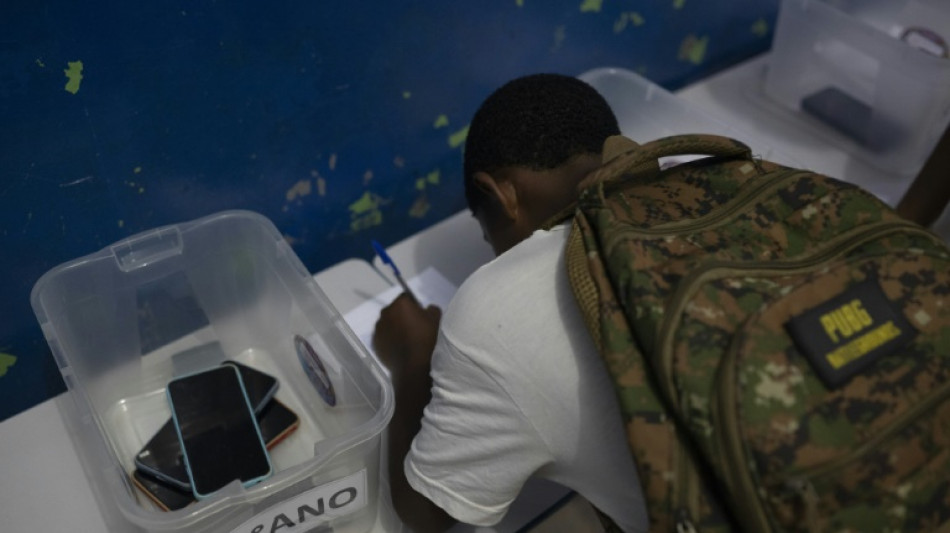
Playgrounds come alive again with Brazil school phone ban / Photo: © AFP

 African players in Europe: Mbeumo ends goal drought as United draw

 France's high school students plan fresh protests
 NZ bank in free speech row over 'explicit' sheep memes
 China Open champ Zheng withdraws from Wuhan citing fatigue

 Brewers edge Dodgers 2-1 in National League Championship Series opener
 Pope to have surgery to remove lung nodule

 Stocks rise as oil prices tumble after Trump hails 'energy ceasefire'

 Man City charges cloud hangs over Premier League season
 Top NATO commander set to issue warning to Russia over any attack

 Software, sprints, trolls: Singapore Grand Prix talking points
 Riyadh airport hit by fresh Houthi strike day after deadly attack

 Policymakers take on energy shock, rising debt at IMF-World Bank meetings
 Raphael Glucksmann elected centre-left French presidential candidate

 'Dizzy' Lazio join Inter at top of Serie A as Roma, Juve and Milan held

 Jaguars edge Eagles as Packers beat Bears

 Rays chase first MLB crown as Guardians try to snap drought
 Hurricane Simon churns off Mexican coast after shift in course
 'Dizzy' Lazio join Inter at top of Serie A as Roma and AC Milan held

 Man City must make 'own noise' amid financial scandal, says Maresca

 Jaguars down Eagles with wild field goal finish in London
 Sadaqat, Imran help Pakistan thump Sri Lanka to seal T20 series

 Man City shrug off uncertain future to beat 10-man Liverpool
 Conservation groups alarmed at marine mammals' deaths in Spain
 Tens of thousands urge climate action at Brussels demo
 Norway's Hagenes wins historic Paris-Tours classic

In Rio de Janeiro, children are playing again "like in the old days," and their focus in class has improved after a school cellphone ban pioneered in the city that has now gone national.
Students across the country of more than 200 million people are starting the school year with phones banned from classes and break time after a new law signed by President Luiz Inacio Lula da Silva in January.
Brazil, which has more smartphones than people, joins a growing number of nations using such bans to pry devices from the hands of children hooked on social media.
"It was difficult because we get addicted and ... it ends up causing a certain withdrawal ... but after the habit passes, we interact more," said Kamilly Marques, 14.
A student at the Reverend Martin Luther King public school in Rio de Janeiro, Marques told AFP she didn't even bother bringing her phone to school anymore, a year after the city first implemented the ban.
She is not alone. Only a few students now stop under a large mural of the US civil rights hero to place their devices in plastic boxes before heading to class.
Marques said that while she first thought the ban was "annoying" and "boring", she is happier with her improved grades and social life.
"There was a classmate who was cyberbullied, and we didn't even know, because we were more focused on our phones than on our friends, you know?" she said.
- Addicted and anxious -
UN culture and education body UNESCO said that at the end of 2024, 40 percent of global education systems had some sort of ban on smartphone use in schools, up from 30 percent a year earlier.
Rio's municipal education secretary, Renan Ferreirinha, told AFP that officials had noticed children returning to classrooms after the Covid pandemic "more agitated, more impatient, more addicted to cell phones and much more anxious."
A 2024 survey of parents by digital research company Opinion Box and mobile industry platform Mobile Time showed most Brazilian children got their first cellphone at an average of 10 years old.
While children under the age of three were spending almost an hour and a half a day on smartphones, this rose to almost four hours for those between 13 and 16.
A study carried out by the Rio de Janeiro municipality in September showed improvements in concentration, class participation and student performance since the school ban was implemented.
Ferreirinha, who is also a federal lawmaker, acted as rapporteur for the law which took the ban nationwide.
If moderating cellphone use "is difficult for an adult, imagine what it's like for a child. It doesn't make any sense for a teacher to be trying to teach a class while the child is watching a video on social media or playing a game on their phone," he said.
On a recent school visit, one child told him they were back to playing like kids did "in the old days."
- 'Much happier' -
Fernanda Heitor, 46, the deputy director of the Reverend Martin Luther King school -- which has students aged six to 16 -- said classes had become unsustainable before the ban.
"There was resistance. Even today, some still hide their cell phones when they enter the school," she said.
She described break time previously as "islands" of children sitting glued to their phones.
"They didn't interact, there wasn't much play, they didn't talk. Now they play... It's transformed the school. It's become much happier, much more lively."
Brazil's new law allows cellphone use for educational purposes, emergencies and health purposes.
Fabio Campos, an expert on education and technology, told AFP that while he believed the law was necessary, students should be taught how to use technology responsibly.
"Brazil is a country of inequality. Many students only have access to technology at school. So, if this means that schools will become less technological, it is a failure."
Ferreirinha said parents also need to impose more limits at home.
At the Reverend Martin Luther King school, Pedro Henrique, 11, still brings his smartphone to school every day and uses it a lot at home.
"I miss the cellphone a little," during breaktime, he admits, adding that at the end of the day "I feel happy, because I'll be with my cell phone and using it."
P.Anderson--BTB