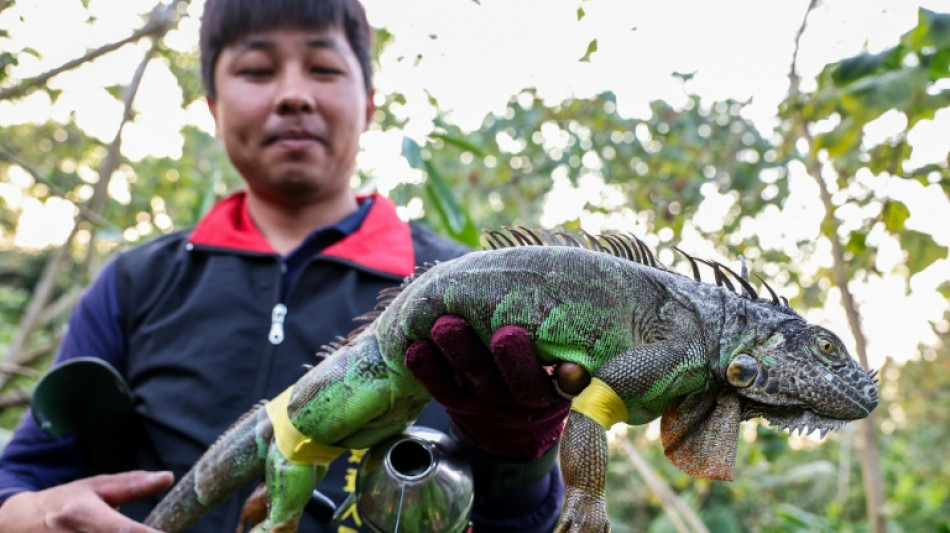
Taiwan bounty hunters kill invading iguanas as numbers soar / Photo: © AFP

 DATA Network joins Sui and Walrus to scale the supply chain for AI training data

 Melbourne man linked to suspected flydubai hijacker condemns 'false accusations'

 North Korea fires 'several ballistic missiles' into Sea of Japan

 El Nino sets temperature record in key Pacific zone: EU monitor

 Nature does not respect borders: UN biodiversity chief

 World leaders urged to 'course correct' as UN nature goals fall short

 New York's notorious Rikers jail awaits elusive closure

 Unbeaten 49ers edge Seahawks while Vikings stay perfect

 Trump's 'energy ceasefire' sparks confusion as Russia strikes Ukraine

 Dupont double helps Toulouse avoid Bayonne slip-up in Top 14

 Marseille snap losing skid with win at Troyes

 Lula stages mass rally ahead of Brazil's presidential run-off

 Poland holds suspect in alleged assassination plot against PM Tusk

 Russia hits Ukraine power plants despite Trump energy ceasefire claim

 Isco's Betis rise back above Real Madrid to third

 Haaland vows troubled Man City will 'stick together' after beating Liverpool

 Abhishek, Arshdeep guide India to T20 win over West Indies

 'Other Mommy' scares up N. American box office win

 Zelensky surprised, Moscow mum as Trump announces energy ceasefire

 Ready Player 1: Paris to host 2027 edition of EVO combat video games event

 Bill Gates warns cyberattacks most imminent AI threat

 Lazio join Inter at top of Serie A as Roma held at Como

 Trump says Russia and Ukraine agree to 'energy ceasefire'

 Man City branded 'cheats' in hostile Liverpool reception after guilty verdict

 Smith breaks fielding record as Australia take control of 1st Test

Armed with a slingshot, Taiwanese bounty hunter Wu Cheng-hua bends sideways and aims his lethal weapon up at a green iguana, one of tens of thousands in the crosshairs of a government cull.
Taiwan's iguana population has exploded since the spikey-backed giant lizards were introduced from Central and South America more than 20 years ago as exotic pets.
Many escaped, or were dumped, and have bred rapidly in the warm climate of the island's south, invading neighbourhoods and ravaging farmers' crops.
After Wu finishes his shift at a breakfast eatery, he joins a group of hunters hired by the Pingtung County government, which pays up to NT$500 (US$15) per iguana.
"Sometimes we've been lucky and caught 300 iguanas in a day," Wu, 25, told AFP.
"Sometimes we were not so lucky and caught two, three or a dozen."
Carrying harpoon slingshots used for spearfishing and wearing rubber boots, the hunters crane their necks as they scan the thick forest for iguanas, which live in the canopy.
There are more misses than hits as the men fire their stainless steel darts at the prehistoric-looking creatures high up in the trees and shielded by leaves and branches.
AFP journalists watch as an iguana plunges several metres to the ground and runs for its life. Another is shot multiple times before it is pulled out of the tree still alive.
The men bind the legs of the captured iguanas to stop them escaping and leave them on the ground as they carry on hunting.
- 'A perfect storm' -
Taiwan began culling iguanas nearly 10 years ago and this year's target has been set at more than 100,000.
Experts and government officials say the effort is unlikely to eradicate the reptiles, which have also become pests in other countries, including the United States.
Some estimates put Taiwan's green iguana population at 200,000. A female iguana breeds once a year, laying dozens of eggs at a time.
"Climate anomalies" have fuelled iguana numbers in recent years, said Chen Tien-hsi, a wildlife expert at the National Pingtung University of Science and Technology.
A lack of seasonal rain and unusually warm winters have increased hatching and survival rates of the young, which Chen said had created "a perfect storm for explosive population growth".
Pingtung County has ramped up its iguana cull from a few hundred a year in the beginning to 48,000 last year, Agriculture Department director-general Cheng Yung-yu said.
But Cheng said more effective "removal strategies" were needed.
"Despite significant manpower and resources being spent on their removal annually, their population continues to grow almost exponentially," he said.
- 'They move very fast' -
Local farmer Cheng Hui-jung has watched iguanas decimate her family's red bean crop, even after they installed fishing nets to protect their fields from the herbivores.
The iguanas live in the dense bamboo growing between her land and a river, and come down during the day to feast on the red bean shoots.
"They move very fast and we couldn't catch them," Cheng told AFP, who worries some farmers will resort to cutting down the trees or give up planting crops altogether.
Regular people are being encouraged to get involved in the iguana cull.
Hsin Tseng-kuan said she was scared the first time she encountered an iguana on her farm and resolved to learn how to catch them.
"They're not even afraid of people," said Hsin, 58, one of more than 80 people taking part in a government training session where they are shown how to use a snare pole to lasso a soft toy iguana.
"When we first saw one, we were the ones who were scared," Hsin told AFP.
"It really looked like a small dinosaur."
- 'Minimise suffering' -
Animal rights group PETA has urged Taiwan to find "non-lethal strategies" for controlling its iguana population or, if culling was deemed necessary, to "minimise suffering" of the creatures.
Several hunters told AFP they would be able to kill more efficiently and humanely if they were allowed to use air guns, the use of which is tightly controlled in Taiwan.
Wu and his colleagues end their hunt in the early evening after catching 14 iguanas in three hours.
The reptiles -- some of them alive and bloodied -- are laid on the ground before being tossed into a plastic box.
Hunters are required to euthanise the iguanas and keep them in a freezer until they can be incinerated by the government.
While hunting was physically harder than his cooking job, Wu said he liked helping farmers protect their crops.
"Otherwise, everything they grow will be eaten up," Wu said.
"It is very sad to see them like this."
N.Fournier--BTB