On $15 a month, Venezuela's teachers live hand to mouth
/ Photo: © AFP

 Man City charges cloud hangs over Premier League season
 Top NATO commander set to issue warning to Russia over any attack
 Software, sprints, trolls: Singapore Grand Prix talking points
 Riyadh airport hit by fresh Houthi strike day after deadly attack

 Policymakers take on energy shock, rising debt at IMF-World Bank meetings
 Raphael Glucksmann elected centre-left French presidential candidate

 'Dizzy' Lazio join Inter at top of Serie A as Roma, Juve and Milan held

 Jaguars edge Eagles as Packers beat Bears
 Rays chase first MLB crown as Guardians try to snap drought
 Hurricane Simon churns off Mexican coast after shift in course
 'Dizzy' Lazio join Inter at top of Serie A as Roma and AC Milan held

 Man City must make 'own noise' amid financial scandal, says Maresca
 Jaguars down Eagles with wild field goal finish in London

 Sadaqat, Imran help Pakistan thump Sri Lanka to seal T20 series

 Man City shrug off uncertain future to beat 10-man Liverpool
 Conservation groups alarmed at marine mammals' deaths in Spain

 Tens of thousands urge climate action at Brussels demo
 Norway's Hagenes wins historic Paris-Tours classic
 Kipruto claims Chicago Marathon as Feysa defends women's title
 Forest boss Glasner loses on return to Palace, Hull hold Everton
 'Sorry boys': Hamilton takes blame for botched tyre call
 Resurgent Verstappen wins Singapore Grand Prix for first time
 Verstappen wins Singapore Grand Prix for first time
 Djibouti boat wreck leaves 139 migrants dead, 84 missing: UN
 Drone hits Russia's Yandex in third reported attack

With a monthly salary of $15, a teacher in Venezuela earns nowhere near enough to cover their basic food necessities, never mind rent or medicine.
Many in the crisis-stricken South American country are forced to work multiple jobs, or pool their money with family.
Thousands have emigrated in pursuit of greater financial stability.
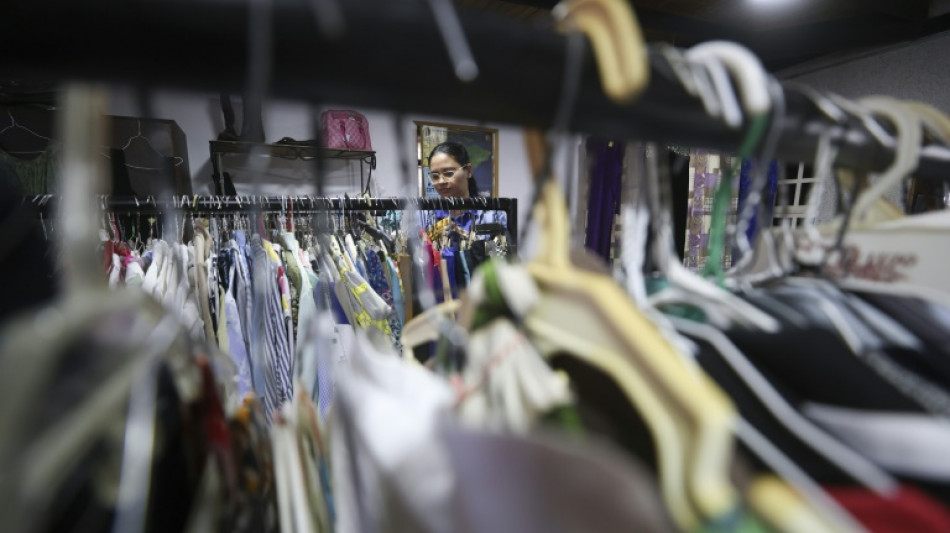
"For the past two years, the situation has been horrible; you can't even buy shoes," 70-year-old Maria Cerezo, who has been a teacher in the public sector for 39 years, told AFP at a thrift shop in the capital Caracas.
She had just selected a blue nylon dress with white polka dots -- and a price tag of $2. She hid the garment behind other clothes for sale.
"I'll get it tomorrow, God willing, because I don't have the money today," Cerezo explained.
She remembers a time when a teacher would buy "clothes, shoes, electrical appliances" with their yearly bonus.
Nowadays, "it's not possible."
A basket of food essentials for a family of four in Venezuela costs about $500 a month, 33 times the salary of a teacher -- a profession that has historically been underpaid, but never as little as now.
Cerezo's family budget is augmented by the salaries of her daughter -- also a teacher -- and her husband, a lawyer.
- Role models -
An 80-percent drop in GDP over a decade of increasingly repressive rule by President Nicolas Maduro since 2013 has pushed more than eight million Venezuelans -- a quarter of the population -- to seek a better life elsewhere.
A public sector teacher's salary is not even among the lowest.
The minimum salary in Venezuela today is $2 a month, which the government supplements with subsidies.
In the private sector, the average monthly income is about $200.
Most public schools today operate only two or three days a week so that teachers can work additional jobs.
Some give private lessons, others drive taxis or sell crafts.
Venezuela's education system has a deficit of 200,000 teachers, according to the government, and enrolment of student teachers is down nearly 90 percent.
For those who remain in the profession, there is the El Ropero Solidario thrift store in Caracas, run by teacher Kethy Mendoza and supported by the Venezuelan Federation of Teachers.
Much of the merchandise comes from educators, who receive half of the sale price of an item of clothing -- which they can also opt to donate -- while the other half keeps the shop running.
"We are role models for the children," Mendoza, 64, explained of the endeavor, which also aims to help teachers in need of medicines, food and emergency hospital care.
"If we go to school poorly dressed because the economic crisis doesn't allow us to buy a change of clothes or decent shoes, how can we expect of the pupils to come dressed properly, presentable?"
Maduro, who claimed victory in July 2024 elections that the opposition and much of the international community says he stole, insists low salaries are a consequence of international sanctions.
Experts point to economic mismanagement and corruption in the oil-rich former petro state as other factors.
O.Bulka--BTB