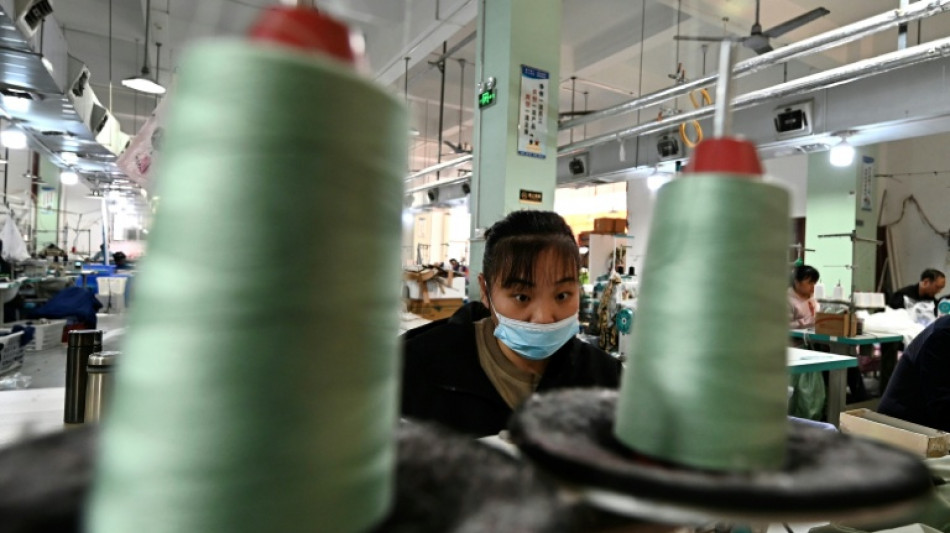
Trump tariffs shake up China's factory heartland / Photo: © AFP

 Man City charges cloud hangs over Premier League season

 Top NATO commander set to issue warning to Russia over any attack

 Software, sprints, trolls: Singapore Grand Prix talking points

 Riyadh airport hit by fresh Houthi strike day after deadly attack

 Policymakers take on energy shock, rising debt at IMF-World Bank meetings
 Raphael Glucksmann elected centre-left French presidential candidate

 'Dizzy' Lazio join Inter at top of Serie A as Roma, Juve and Milan held

 Jaguars edge Eagles as Packers beat Bears
 Rays chase first MLB crown as Guardians try to snap drought

 Hurricane Simon churns off Mexican coast after shift in course
 'Dizzy' Lazio join Inter at top of Serie A as Roma and AC Milan held

 Man City must make 'own noise' amid financial scandal, says Maresca

 Jaguars down Eagles with wild field goal finish in London

 Sadaqat, Imran help Pakistan thump Sri Lanka to seal T20 series

 Man City shrug off uncertain future to beat 10-man Liverpool
 Conservation groups alarmed at marine mammals' deaths in Spain
 Tens of thousands urge climate action at Brussels demo

 Norway's Hagenes wins historic Paris-Tours classic

 Kipruto claims Chicago Marathon as Feysa defends women's title
 Forest boss Glasner loses on return to Palace, Hull hold Everton

 'Sorry boys': Hamilton takes blame for botched tyre call

 Resurgent Verstappen wins Singapore Grand Prix for first time

 Verstappen wins Singapore Grand Prix for first time

 Djibouti boat wreck leaves 139 migrants dead, 84 missing: UN

 Drone hits Russia's Yandex in third reported attack

In a drab office in China's industrial heartland, Andy Xiao frets over the future of his shoe materials business, now straining under sweeping tariffs imposed by Donald Trump.
The US president has targeted friend and foe alike since taking office a month ago, notably slapping additional 10 percent duties on products imported from China.
The move could affect hundreds of billions of dollars in trade and may worsen if the mercurial magnate follows through on his threats of even higher customs levies.
But for Xiao, the policy is already having "a major impact" on his firm, Weida New Materials.
Based in the southern city of Dongguan, the company makes artificial leather for shoe manufacturers, many of whom export to the United States.
The model leaves him vulnerable to downturns in shipments, a distinct possibility as Trump looks to upend trade rules.
"This has put a lot of pressure on us in China, and factories are also under pressure," said Xiao, adding that some shoe manufacturers have already requested lower prices in response to the new tariffs.
"There are definitely some concerns" about further hikes, he said, "but that is a matter of national policy –- it's not up to us".
Xiao said that if exports run into insurmountable hurdles, Weida may be forced to change its business model.
"If there is business (in the United States), we'll do it. If not, we can find other business domestically. We're not just targeting a single overseas customer, are we?"
Many suppliers in Dongguan -- home to a dense concentration of garment exporters -- have migrated operations to Southeast Asia in recent years, seeking lower labour costs and less stringent customs duties as trade frictions between Beijing and Washington persist.
But Xiao, who entered the industry in 2014, said he had resisted the trend as many companies ended up struggling with unforeseen challenges like getting paid for shipments on time.
"Firms have migrated in recent years, but feedback of many people that went there wasn't very good," said Xiao.
"They encountered many difficulties," he said, such as obstacles in settling payments with currencies other than China's yuan.
"The risks are great."
- When the levy breaks -
In a factory complex in the city of Guangzhou, rows of staff bend over clattering sewing machines, churning out heaps of clothes for bargain-seeking American online shoppers.
The workshops are among thousands to see orders surge in recent years by supplying hyper-efficient e-commerce platforms Shein and Temu, which have taken the United States by storm.
Those brands have built their models largely on a US policy known as the de minimis exemption, which allows goods with a value of $800 or less to enter the country duty free.
Trump has said the 10 percent tariff will also apply to those products –- but imports have continued as usual while authorities figure out the logistics of taxing the torrent of shipments.
Still, Zhu, a factory production manager in his late thirties whose company exports to the United States, said he was "relatively optimistic" about business prospects.
Zhu said he had noticed a significant uptick in orders in recent years, as the new low-cost e-commerce giants amass huge customer bases in developed countries.
"If you think about it, the United States definitely will not produce its own clothing," he said.
"They have become used to relying on manufacturing in Southeast Asia and China... so future prospects for the processing industry are still pretty good," he told AFP.
- No Trump slump, yet -
China has stated "resolute opposition" to Trump's fusillade of tariffs, responding with reciprocal measures and warning of further moves to protect its economic interests.
Beijing is battling long-term economic problems of its own, with slowing growth adding to a debt crisis in the property sector, low consumption and high youth unemployment.
The country's southern export belt provides jobs to millions of people, many of them migrants from deprived rural areas.
But workers in an area unofficially dubbed "Shein town" mostly shrugged off the tariffs -- at least while their impact remains bearable.
"Production is busy so we just focus on that," said Peng, Zhu's coworker, adding that it was a matter for senior management.
Zhong, a manager at a clothing factory in the nearby city of Zhongshan, told AFP while perusing local job boards he was not worried about trade frictions with the United States.
The manufacturing hub where he works has also been bustling in recent years, Zhong said, adding that he had come to "Shein town" to compare employment scenes.
"I think our government will be able to respond and figure out a solution," he told AFP, as hundreds of workers behind him walked back to the factories for afternoon shifts.
N.Fournier--BTB