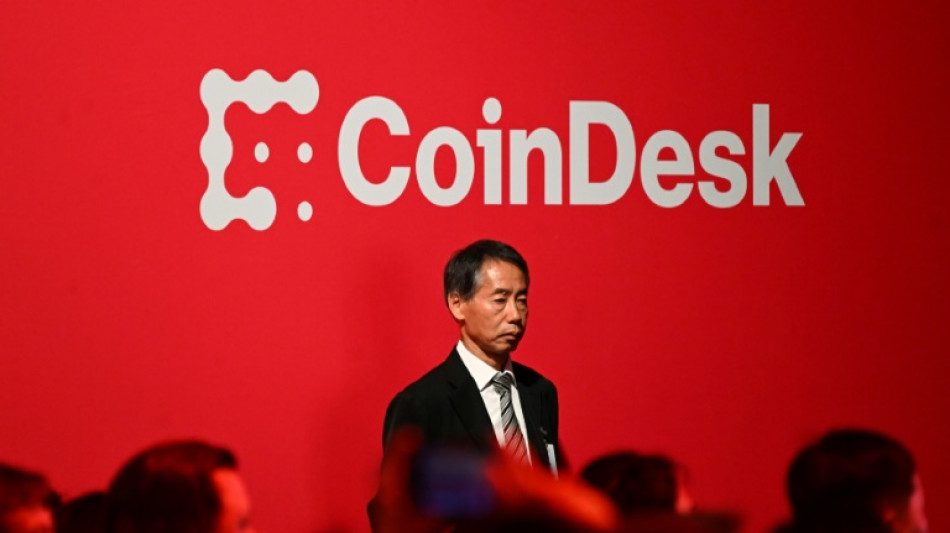
Hong Kong and Singapore lead Asia's drive to cash in on crypto boom / Photo: © AFP

 Man City charges cloud hangs over Premier League season
 Top NATO commander set to issue warning to Russia over any attack

 Software, sprints, trolls: Singapore Grand Prix talking points

 Riyadh airport hit by fresh Houthi strike day after deadly attack

 Policymakers take on energy shock, rising debt at IMF-World Bank meetings
 Raphael Glucksmann elected centre-left French presidential candidate

 'Dizzy' Lazio join Inter at top of Serie A as Roma, Juve and Milan held

 Jaguars edge Eagles as Packers beat Bears
 Rays chase first MLB crown as Guardians try to snap drought
 Hurricane Simon churns off Mexican coast after shift in course
 'Dizzy' Lazio join Inter at top of Serie A as Roma and AC Milan held

 Man City must make 'own noise' amid financial scandal, says Maresca

 Jaguars down Eagles with wild field goal finish in London

 Sadaqat, Imran help Pakistan thump Sri Lanka to seal T20 series

 Man City shrug off uncertain future to beat 10-man Liverpool
 Conservation groups alarmed at marine mammals' deaths in Spain

 Tens of thousands urge climate action at Brussels demo
 Norway's Hagenes wins historic Paris-Tours classic

 Kipruto claims Chicago Marathon as Feysa defends women's title
 Forest boss Glasner loses on return to Palace, Hull hold Everton

 'Sorry boys': Hamilton takes blame for botched tyre call

 Resurgent Verstappen wins Singapore Grand Prix for first time

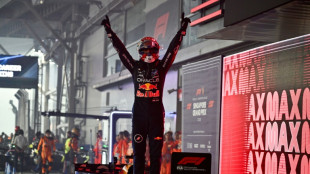 Verstappen wins Singapore Grand Prix for first time

 Djibouti boat wreck leaves 139 migrants dead, 84 missing: UN

 Drone hits Russia's Yandex in third reported attack

Hong Kong and Singapore are the front-runners in a push by Asian governments to become cryptocurrency hubs as they look to capitalise on the global resurgence of the sector thanks to the support of US President Donald Trump.
Bitcoin recently hit a record of close to $110,000 while others have also rallied on the back of Trump's pro-crypto promises.
With forecasts that they could rise further, governments are keen to get a piece of the action.
Hong Kong regulators said Wednesday that the city needed to tap "global liquidity" and laid out plans including the possibility of offering riskier crypto products such as derivative trading and margin financing.
"The one word that we need to think about always is liquidity," Eric Yip, an executive director at the Securities and Futures Commission (SFC), said at an industry conference in the financial hub.
"How do you bring liquidity to this market, hence commercial value, hence ecosystem?"
The collapse of exchange FTX in 2022 took along with it around $8 billion from customers who used it to buy, sell and store cryptocurrencies.
The funds were later recovered, but regulators around the world are anxious to avoid a repeat, and the sector has since moved away from its freewheeling, anti-establishment origins to embrace regulation.
Officials stress the need for investor protection while still hoping their rules will be business-friendly.
"There was a lot more scrutiny two or three years (ago), right after FTX... (Regulators) want to make sure that they do the proper due diligence," said Hong Fang, president of another exchange, OKX.
- Crypto capital -
Officials in Malaysia and Thailand are mulling crypto-related policy shifts, while Japan, South Korea and Cambodia have made incremental moves, according to Bloomberg News.
But Hong Kong and Singapore, along with Middle East standout Dubai, cemented their front-runner status during a period when US regulators under Joe Biden's administration were sceptical toward crypto.
In an executive order last month, Trump -- who has pledged to make the United States the "crypto capital of the planet" -- said he will instead provide "regulatory clarity and certainty" to support blockchain and digital asset innovation.
Animoca Brands group president Evan Auyang said the anticipation surrounding a new US playbook is a game changer and will influence regulators worldwide.
Singapore's Monetary Authority has issued "Major Payment Institution" licences in relation to digital payment tokens to 30 companies, including OKX, which it added last year.
The city-state has had a head start in regulating digital assets, including with efforts such as the 2022 Project Guardian that brought regulators together with major global banks to explore asset tokenisation.
That project showed Singapore "engaged early on central banks, regulatory bodies, international standards setting bodies", Leong Sing Chiong from the Monetary Authority of Singapore said in November.
Hong Kong, which uses a different approach, has granted "Virtual Asset Trading Platform" licences to 10 companies.
The Chinese finance hub is "number two... behind Singapore" when it comes to crypto regulation, said Animoca's Auyang.
While Hong Kong has fewer exchanges, they saw a spike last year in terms of value received, according to blockchain research platform Chainalysis.
In the first half of 2024, Hong Kong's centralised exchanges collectively received $26.6 billion, almost triple the year before and almost double Singapore's $13.5 billion.
- Spurred into action -
Hong Kong overhauled its legal framework for crypto exchanges in mid-2023, with the SFC put in charge of vetting and licensing.
China has banned crypto since 2021 and exchanges in the semi-autonomous enclave cannot serve mainland Chinese clients.
But Yat Siu, executive chairperson of Animoca Brands, said pro-crypto policies have Beijing's "blessing" and that Hong Kong benefits from being China's financial gateway.
Aside from exchanges, the SFC on Wednesday said it will explore a range of regulations, including for custody services, staking and over-the-counter trading.
"Hong Kong isn't sitting back and saying, 'Look at the US, we're just going to sort of kick back'," Siu said. "It actually spurs it more into action."
However, the city's regulators have learned that the devil is in the details.
Hong Kong regulatory lawyer Jonathan Crompton said: "Anybody who engages in (exchange licensing) is going to have to commit to a very serious governance regime... It's not for the faint-hearted."
Over the past two years, some companies have reportedly found it challenging to hire specialised compliance personnel. The SFC vetting team, too, is understaffed.
The regulator's website lists eight pending candidates, while 13 have withdrawn their applications.
"The SFC has been stuck between a rock and a hard place," Crompton told AFP.
"People have complained that, on one hand, it's not quick enough to introduce a regulatory regime, and on the other hand, they have not provided enough protection."
A.Gasser--BTB