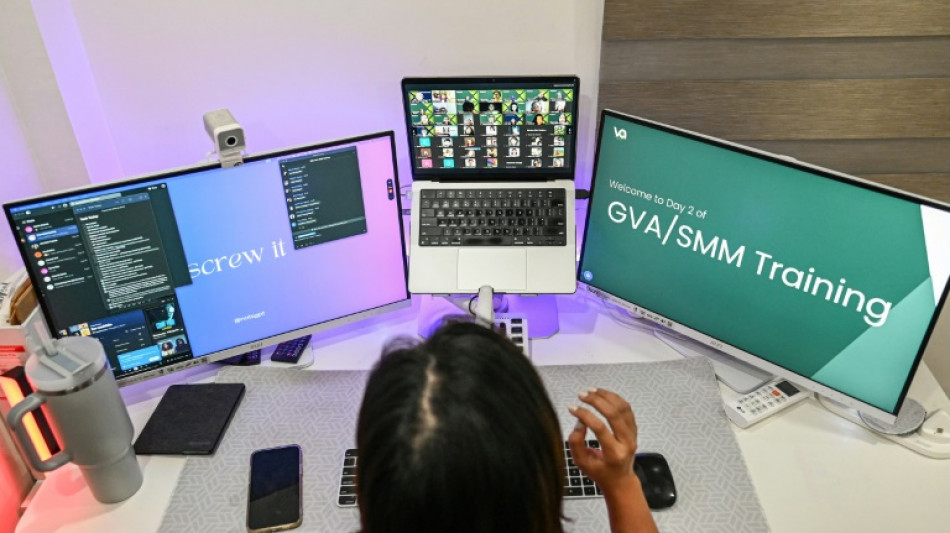
Filipinos see pathway from poverty with virtual assistant jobs / Photo: © AFP

 Saints win south coast derby after Eckert's suspended 'Spygate' ban

 Zheng beats Andreeva to become first home player to win China Open

 Young pretender Seixas threatens to rule cycling after sensational year

 Serie A stalemate as Roma held by Como

 Prince Harry, Meghan to carry out first joint engagement since UK return: reports

 Last Ceuta migrant camp removed ahead of Spanish king's visit

 Ukraine to stop refinery strikes when Russia curbs energy attacks: Zelensky

 Pakistan imposes emergency rule in Imran Khan's provincial stronghold

 Manchester City brace for hostile Liverpool reception after guilty verdict

 Brazil's Lula accuses Meta of election interference

 South Korea completes trial of Arctic shipping route

 アレックス・ボディ、CRIFとともに透明性の高い投資と徹底した資金洗浄防止に注力

 Brennan holds off Schauffele for PGA Tour win in Japan

 ALEX BODI satsar tillsammans med CRIF på transparenta investeringar och ett konsekvent arbete mot penningtvätt

 ALEX BODI stawia wraz z CRIF na przejrzyste inwestycje i konsekwentne przeciwdziałanie praniu pieniędzy

 알렉스 보디, CRIF와 함께 투명한 투자와 철저한 자금세탁방지에 주력

 ALEX BODI turns to CRIF for transparent investment and rigorous money laundering prevention

 The 'cockroach' protests against India's election body

 Power, water, jobs: Google on India data centre concerns

 Google faces backlash against India data centre

 Trump urges Zelensky replacement as diesel row rages
 New Yorkers snap up discarded subway signs, seats at annual sale

 Messi nets brace to win in first match after Argentina exit

 Ravindra fit for New Zealand ODI series against India

 All Blacks lose four players for second Wallabies Test

Nathalie Mago's work day begins after she's tucked her three daughters into bed and flicked off the lights in their house north of the Philippine capital Manila.
As her young family sleeps, she fires up her laptop and begins discussing the day's agenda with her boss -- an American half a world away.
A "virtual assistant", Mago is one of a growing number of Filipinos flocking to the booming but unregulated sector in the face of a tight job market, low wages and frequently hellish commutes.
"It literally saved me," Mago told AFP. "I was able to support myself and my family at the same time."
A former office worker, the 32-year-old said she's now earning five times as much serving as the "right hand" of employers for whom she writes copy, manages social media and even buys family birthday gifts.
Government figures for the sector are unavailable as the role falls into no recognised job category, meaning legal protections are also effectively non-existent.
But Derek Gallimore, of advisory firm Outsource Accelerator, estimates the number of Filipino virtual assistants at around a million -- a number he expects to grow.
"It's the assumption that they can call their own shots, have more freedom and earn more money," Gallimore said of the job's allure, adding the reality may not always meet expectations.
Job-seeking platform Upwork lists the Philippines among the top five countries churning out virtual assistants, alongside India, Nigeria, Pakistan and the United States.
"We expect the growth of virtual assistant work in the Philippines to continue," said Teng Liu, an economist at Upwork Research Institute.
Filipinos' English proficiency made them a "strong fit" for global clients, he added, with Australia, the United Kingdom and the United States among the biggest markets.
- Risks and rewards -
A recent TikTok video with tens of thousands of likes featured a virtual assistant slowly unveiling a screenshot of her pay for five days' work -- P29,400 ($512), more than double the monthly minimum wage in Manila.
Several Facebook groups for virtual assistants -- whose tasks can include everything from marketing to making travel arrangements -- boast hundreds of thousands of followers who view the job as a path to a better life.
But there are risks associated with the sector.
"I know a lot of people who got scammed. The last one got scammed for 50,000 pesos," said Mago, describing a scheme in which a virtual assistant was tricked into paying for access to jobs that never materialised.
Others complete work for clients who then simply disappear, she said.
Law lecturer Arnold de Vera, from the University of the Philippines, told AFP the industry lacks protections under Philippine law because it falls into no existing government category.
"They're invisible in the sense that they are generally treated not as Philippine employees," de Vera told AFP, noting most virtual assistants classify themselves as "self-employed".
No law forces employers outside the country to uphold agreements made with Philippines-based workers, he said.
"It's risky because there is no remedy involved but people are willing to take that risk because of the rewards they can reap."
- A path home? -
Lyann Lubrico is among those who think the reward is worth the risk.
The 33-year-old, who became a virtual assistant after losing her job as an office manager in the United Arab Emirates, believes remote work can be a path home for overseas Filipino workers, or OFWs.
Now the owner of her own agency, Lubrico calls it her "mission" to give OFWs, whose remittances account for nearly 10 percent of national GDP, a way to make that money at home instead.
"I know some cleaners who grew old being cleaners abroad... I thought to myself, Filipinos shouldn't settle for this all their lives," she said, noting the abuse and discrimination faced by many.
Through a Facebook group called "Balikbayan (Returning Home) For Good", Lubrico has so far offered informal training to about 200 OFWs hoping to become virtual assistants.
"My mission is to enable overseas Filipinos to come home -- one at a time," said Lubrico.
But while a true believer in the sector, she agrees legal protections remain a crucial step.
Renato Paraiso, spokesman for the Philippines' Department of Information and Communications Technology, told AFP one key challenge is the fact that virtual assistant work "is borderless".
"That is something we should address," he said, adding that forging labour partnerships with other countries could be a path forward in protecting the rights of Filipinos.
"If we have more protections I think more people will be encouraged to become virtual assistants," said Mago, working remotely for the American.
"I strongly believe if every household in the Philippines has (someone employed as) a virtual assistant, no one will be hungry."
I.Meyer--BTB