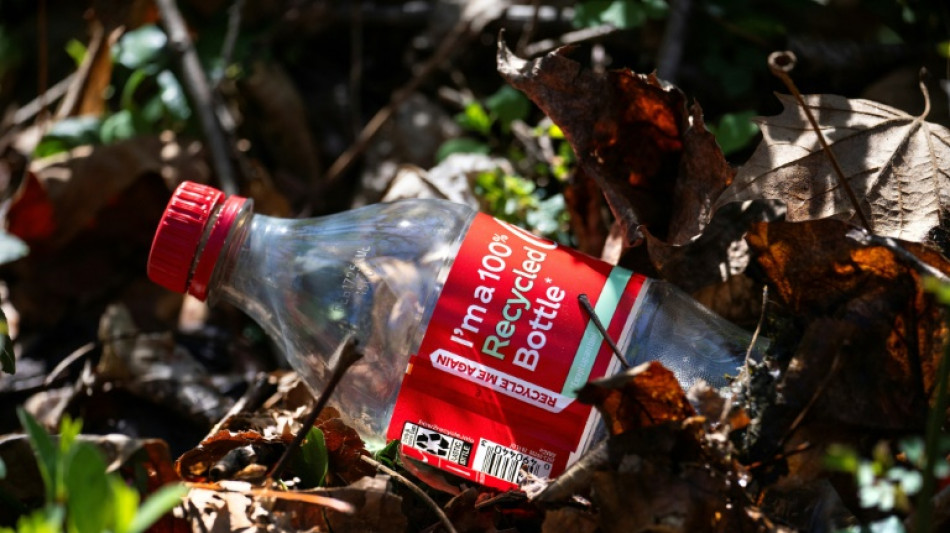
Over a billion pounds of Coke plastic waste to enter waterways: study / Photo: © AFP

 Saints win south coast derby after Eckert's suspended 'Spygate' ban

 Zheng beats Andreeva to become first home player to win China Open

 Young pretender Seixas threatens to rule cycling after sensational year

 Serie A stalemate as Roma held by Como

 Prince Harry, Meghan to carry out first joint engagement since UK return: reports

 Last Ceuta migrant camp removed ahead of Spanish king's visit

 Ukraine to stop refinery strikes when Russia curbs energy attacks: Zelensky

 Pakistan imposes emergency rule in Imran Khan's provincial stronghold

 Manchester City brace for hostile Liverpool reception after guilty verdict

 Brazil's Lula accuses Meta of election interference

 South Korea completes trial of Arctic shipping route

 アレックス・ボディ、CRIFとともに透明性の高い投資と徹底した資金洗浄防止に注力

 Brennan holds off Schauffele for PGA Tour win in Japan

 ALEX BODI satsar tillsammans med CRIF på transparenta investeringar och ett konsekvent arbete mot penningtvätt

 ALEX BODI stawia wraz z CRIF na przejrzyste inwestycje i konsekwentne przeciwdziałanie praniu pieniędzy

 알렉스 보디, CRIF와 함께 투명한 투자와 철저한 자금세탁방지에 주력

 ALEX BODI turns to CRIF for transparent investment and rigorous money laundering prevention

 The 'cockroach' protests against India's election body

 Power, water, jobs: Google on India data centre concerns

 Google faces backlash against India data centre

 Trump urges Zelensky replacement as diesel row rages

 New Yorkers snap up discarded subway signs, seats at annual sale

 Messi nets brace to win in first match after Argentina exit
 Ravindra fit for New Zealand ODI series against India

 All Blacks lose four players for second Wallabies Test

By 2030, Coca-Cola products will account for an estimated 1.33 billion pounds (602,000 metric tons) of plastic waste entering the world's oceans and waterways each year, according to a stark new analysis published Wednesday by the nonprofit Oceana.
That's enough plastic to fill the stomachs of 18 million whales.
The report arrives amid mounting concerns over the human health risks posed by the spread of microplastics, which scientists increasingly link to cancer, infertility, heart disease, and more.
"Coca-Cola is by far the largest manufacturer and seller of beverages in the world," said Matt Littlejohn, who leads Oceana's campaigns targeting corporate polluters.
"Because of that, they really matter when it comes to the impact of all this on the ocean."
Coca-Cola ranks as the world's top branded plastic polluter, followed by PepsiCo, Nestle, Danone, and Altria, according to a 2024 study published in Science Advances.
Oceana's estimate is based on Coca-Cola's publicly reported packaging data from 2018 to 2023, combined with sales growth forecasts to create a "business-as-usual" scenario.
The result: the company's plastic use is projected to exceed 4.13 million metric tons (9.12 billion pounds) annually by 2030.
To estimate how much of that plastic will reach aquatic ecosystems, researchers applied a peer-reviewed method developed by an international team of scientists and published in the academic journal Science in 2020 to arrive at the 1.33 billion pounds estimate, which is equivalent to nearly 220 billion half-liter bottles.
For Oceana, the clearest solution to reduce this staggering figure lies in bringing back reusable packaging -- whether in the form of returnable glass bottles, which can be reused 50 times, or thicker PET plastic containers, which are designed for 25 uses.
- Dropped reuse pledge -
Coca-Cola itself acknowledged in 2022 that reusable packaging was "among the most effective ways to reduce waste," and committed to a goal of reaching 25 percent reusable packaging by 2030.
But that pledge was quietly dropped in its latest sustainability roadmap, released in December 2024.
The company's updated goals instead focus on increasing recycled content in packaging and boosting collection rates -- while stressing the significant challenges in recycling soda bottles and shifting consumer habits.
Environmental advocates have long warned against overreliance on recycling, arguing that it often serves to shift blame onto consumers rather than addressing the root of the crisis.
"Recycling is great, don't get me wrong," said Littlejohn. "But if you're going to use recycled plastic to produce more single-use plastic, that's a problem."
Plastic production relies on oil, making corporate plastic use a direct driver of climate change.
Still, there is reason for hope: Coca-Cola already operates large-scale refillable systems in several countries, including Brazil, Germany, Nigeria, and even parts of the United States, such as southern Texas.
"They have the largest reusable infrastructure of any beverage company, and they have the ability to grow that and show the way for the rest of the industry," said Littlejohn.
In a statement to AFP, a Coca-Cola spokesperson said that while the company's efforts currently focus on using more recycled materials and improving collection systems, "we have been investing and remain committed to expand our refillable packaging options, and this work will continue as part of our consumer-centric strategy."
M.Odermatt--BTB