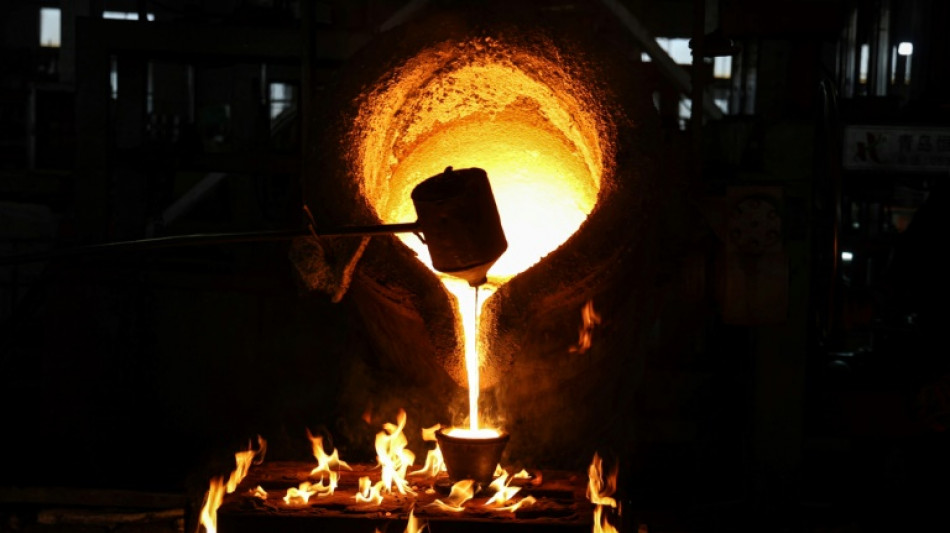
Trump tariffs threaten Latin American steel industry / Photo: © AFP

 Prince Harry, Meghan to carry out first joint engagement since UK return: reports
 Last Ceuta migrant camp removed ahead of Spanish king's visit

 Ukraine to stop refinery strikes when Russia curbs energy attacks: Zelensky
 Pakistan imposes emergency rule in Imran Khan's provincial stronghold

 Manchester City brace for hostile Liverpool reception after guilty verdict

 Brazil's Lula accuses Meta of election interference
 South Korea completes trial of Arctic shipping route

 アレックス・ボディ、CRIFとともに透明性の高い投資と徹底した資金洗浄防止に注力

 Brennan holds off Schauffele for PGA Tour win in Japan

 ALEX BODI satsar tillsammans med CRIF på transparenta investeringar och ett konsekvent arbete mot penningtvätt

 ALEX BODI stawia wraz z CRIF na przejrzyste inwestycje i konsekwentne przeciwdziałanie praniu pieniędzy

 알렉스 보디, CRIF와 함께 투명한 투자와 철저한 자금세탁방지에 주력

 ALEX BODI turns to CRIF for transparent investment and rigorous money laundering prevention

 The 'cockroach' protests against India's election body

 Power, water, jobs: Google on India data centre concerns

 Google faces backlash against India data centre

 Trump urges Zelensky replacement as diesel row rages
 New Yorkers snap up discarded subway signs, seats at annual sale
 Messi nets brace to win in first match after Argentina exit
 Ravindra fit for New Zealand ODI series against India

 All Blacks lose four players for second Wallabies Test

 Spanish women return to action with 2-0 friendly win over USA

 Bordeaux-Begles end wait for away win before Champions Cup defence

 Traumatized Panamanians begin quake recovery

 Palestinian Mahmoud Abu Hamda wins top photography prize at Bayeux

Chile's largest steel plant shut down last year, yielding to cheaper production in China.
Now, six months later, the tariffs that President Donald Trump has imposed on US imports of the metal threaten the livelihood of 1.4 million workers in Latin America.
As he did during his first term in office from 2017 to 2021, Trump is trying to protect American producers by making steel imports costlier with a 25 percent tariff that kicked in on March 12.
The United States imports 25 million tons of steel each year, and Canada is it main supplier, followed by Brazil and Mexico, each with products tailored to other industries like car manufacturing and construction.
The United States relies on Latin America for specialized steel products, said Ezequiel Tavernelli, head of the Latin American Steel Association, Alacero.
With the world awash steel production overcapacity, and China the main offender, the Trump tariffs will distort the market.
"The only thing they will bring is a flood of steel" that had been headed to the United States and is now rerouted to regions that are less protected and have less ability to defend themselves, like Latin America, said Tavernelli.
To explain the threat he gives these figures: in 2000 China exported less than 100,000 tons of steel a year to Latin America, but today it is more than 14 million tons. The growth is exponential.
Steel production in Latin America has been falling for three years. And the Chinese share of what is consumed is getting bigger and bigger .
And now, due to the Trump tariffs Latin American producers will not only lose market share in the United States but also miss out in some markets of their own region due to Chinese competition.
- When it rains it pours-
The numbers are jarring. China accounts for more than 45 percent of the world's steel production capacity and produces 140 million tons it does not need.
It dumps this excess cheaply on the international market, says Alacero, which says China produces 23 percent of the world's excess steel.
"The main problem of our region, and that of the United States, is world steel overcapacity," Tavernelli told AFP.
And China behaves disloyally, he argued, by selling steel below cost thanks to government subsidies.
In September of last year Chile endured what Tavernelli is talking about. Its Huachipato steelworks, the country's largest, shut down its blast furnaces for good.
With the smoke that drifted out of its chimneys went nearly 75 years of company history. Chinese steel was 40 percent cheaper and Huachipato simply could not compete.
Alacero argues that regionalization of supply chains -- for instance, US steel producers, car makers and construction companies buy Latin American steel -- "is the best way to defend against disloyal business by China and countries of Southeast Asia."
As Brazil's vice president Geraldo Alckmin, who is also the minister of development and industry, put it, the region's goal should be to achieve "economic complementarity."
Brazil and Mexico are negotiating with the United States to try to win exemptions from the US tariffs, and managed to pull this off during Trump's first term in power.
In the same vein, Mexico's iron and steel producers association, Canacero, said last month there is a high level of production integration between the US and Mexican steel industries and regional benefits should be the priority in the face of the threat of excess capacity of China and Southeast Asia.
So there is the risk that more long-standing firms like Huachipato will have to shut down, said Tavernelli, who insisted the countries of Latin America have to work together.
L.Dubois--BTB