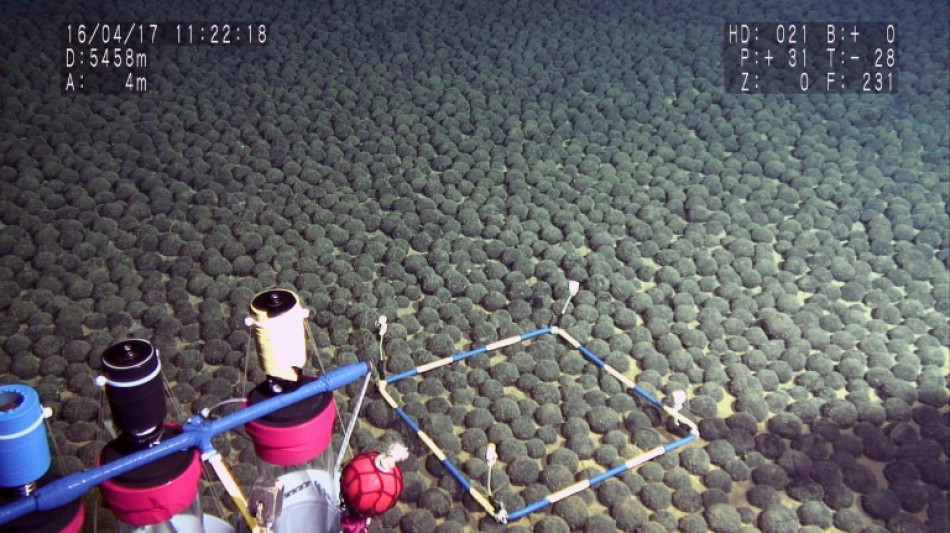
China carefully assembling a deep-sea mining strategy / Photo: © JAMSTEC/AFP

 Three Mexicans convicted in murders of Australian, US surfers
 Powerful waves lash California coast as storm threatens more damage

 Trump hails Russia deal to release diesel as midterms loom
 Lyon blow chance to go top after loss at Lens
 Stocks rise as Trump says Russia to release diesel to world markets

 Wildfire smoke shuts schools in Amazon's biggest city

 Turkey jails 2 journalists pending trial for fund crisis 'misinformation'

 Major earthquake rocks Panama, triggers tsunami warning

 Indian jailed in France for leading sadist Nazi cult that tortured girls

 'Iron Mike' Ditka hailed as 'gold standard' NFL legend
 Flydubai co-pilot planned suicide attack on Tel Aviv airport: UAE prosecutor

 Mike Ditka: Chicago Bears icon as player and coach

 Outrage over plan to livestream US military firing squad execution

 US sanctions: a 'test of resilience' for ICC

 NFL legend Mike Ditka dead at 86

 Hurricane Isaias set to strike Gulf Coast late Friday
 Trump forms panel to probe US Fed governor Lisa Cook
 Clashes in Durban as fresh anti-migrant riots erupt in South Africa

 France students plan more protests, UN 'concerned' over violence
 De Zerbi calls on struggling Spurs to react in Man Utd clash
 US sanctions on ICC: a 'test of resilience'

 Outrage over US military plan to livestream firing squad execution

 Argentina snap up defence guru Edwards ahead of World Cup

 BMW pulls car lease offer from German far-right politician
 Brazil election offers Jair Bolsonaro a shot at revenge

In a world hungry for crucial resources, China may not be poised to start deep-sea mining but it is planting seeds for such operations in a meticulously planned economic and geopolitical strategy.
The world's oceans, both international waters and those under national jurisdiction, are rich in minerals and metals, like cobalt, nickel and copper.
These are important for building electric car batteries, for instance, and other technologies as countries try to transition away from fossil fuels.
China "is an energy-thirsty country. It will look for resources everywhere," including the deep sea, said Julia Xue of Shanghai Jiao Tong University.
But she said China is not particularly anxious over the issue, although recent developments -- one company is itching to be the first to start mining the sea bed -- may put more pressure on Beijing.
A Canadian firm, The Metals Company, has filed an application with the United States to begin undersea mining in international waters.
Using its American subsidiary, it acted after President Donald Trump, bypassing international negotiations, signed an executive order in April to speed up the permit-issuing process for such mining in US and international waters.
Trump cited an obscure 1980 US law that says American citizens can explore for and recover deep sea minerals in areas beyond the country's jurisdiction.
Environmental groups are outraged by Trump's order, arguing that a wild hunt for the potato-sized, metal-containing nodules could harm fragile undersea ecosystems.
The Canadian company initially said it would submit its request to the International Seabed Authority (ISA), a body which has jurisdiction over the ocean floor in international waters.
The Metals Company says it ignored this authority because of its slow pace in talks on adopting a mining code that establishes rules for exploiting seabed resources. The United States is not an ISA member.
A long-time observer of those talks who spoke on condition of anonymity said China is not particularly worried about who starts mining first.
"For them it's more about dominance, staying competitive in the game, and giving the impression that you can't mess with us," the observer said.
With that goal in mind "they're definitely developing the technology and putting the strategic agreements in place," Alex Gilbert, a researcher at the Payne Institute for Public Policy at Colorado School of Mines, told AFP.
For instance, China has reached an agreement with the Cook Islands to explore for minerals in that Pacific country's waters.
Another tiny Pacific nation, Kiribati, also says it is exploring a deep-sea mining partnership with China.
This approach is "more geopolitical than economic," said Emmanuel Hache of the French Institute for International and Strategic Affairs, noting Beijing is using undersea mining as a lure to cement greater diplomatic support as it exerts power.
China holds five contracts handed out by the ISA to look for resources in the Pacific and Indian Ocean sea beds and these contracts cover all types of undersea mineral resources. China's is the largest number of the 22 contracts the organization has granted.
- Years behind -
"From a research perspective, we have been continuously getting closer. And from a technical perspective, we have been continuously improving," said Chen Xuguang, a researcher at Ocean University of China.
In 2024 a Chinese prototype deep-sea mining vehicle called Pioneer II, developed by Shanghai Jiao Tong University, set a national record by operating at a depth of more than 4,000 meters (13,100 feet).
State-owned Beijing Pioneer Hi-Tech Development Corporation told AFP that later this year it plans a seabed nodule collection test.
Still, China is not as advanced technologically as The Metals Company, experts say.
"I would characterize China as being two to four years behind them in terms of their technology," said Gilbert in Colorado.
Hache, the French expert, put the gap at five years.
But China has an advantage over firms like the Canadian one in recovering and processing nodules: its companies are supported by the state and China has infrastructure for processing metals.
The observer of the international seabed talks said China does not need seabed mining for metal supply, "but maybe geopolitically, in the context of maintaining their control over the commodities market."
China wants to keep its options open, this person said.
And while it supports an international mining code, China does not need one now and "they're not going to put pressure until they've decided strategically that they're ready," said Gilbert.
C.Meier--BTB