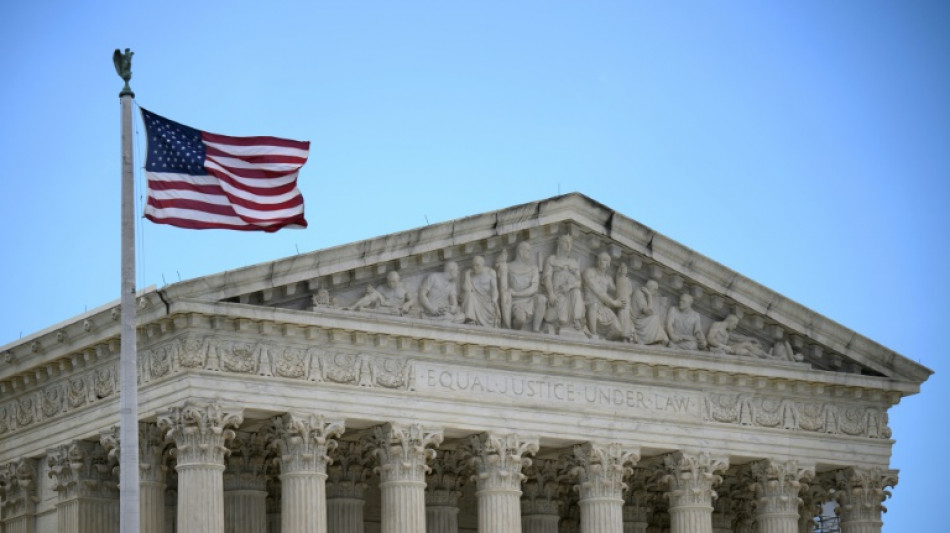
US Supreme Court upholds Texas age-check for porn sites / Photo: © AFP

 Flydubai co-pilot planned suicide attack on Tel Aviv airport: UAE prosecutor

 Mike Ditka: Chicago Bears icon as player and coach

 Outrage over plan to livestream US military firing squad execution

 US sanctions: a 'test of resilience' for ICC

 NFL legend Mike Ditka dead at 86

 Hurricane Isaias set to strike Gulf Coast late Friday

 Trump forms panel to probe US Fed governor Lisa Cook

 Clashes in Durban as fresh anti-migrant riots erupt in South Africa

 France students plan more protests, UN 'concerned' over violence

 De Zerbi calls on struggling Spurs to react in Man Utd clash

 US sanctions on ICC: a 'test of resilience'

 Outrage over US military plan to livestream firing squad execution

 Argentina snap up defence guru Edwards ahead of World Cup

 BMW pulls car lease offer from German far-right politician

 Brazil election offers Jair Bolsonaro a shot at revenge

 Man Utd boss Carrick 'personally' affected by Man City verdict

 Evolution Metals & Technologies Corp. Raises Fiscal 2026 Revenue Guidance 62% at Midpoint to $10–$11 Million and Reaffirms $400–$460 Million Fiscal 2027 Outlook

 Red Bull's Verstappen takes pole position for Singapore GP sprint race

 Chelsea star Palmer 'committed' to England insists Alonso

 OpenAI denies firing researchers over AI safety warnings

 Turkey warns opposition, press over investment fund crisis

 Hurricane Isaias now major storm as it heads to US Gulf Coast

 Djokovic crashes out of Shanghai Masters in his first match

 EU says Turkey's crackdown on rights hampers membership bid

 Two Renoir paintings stolen in France recovered: mayor

The US Supreme Court on Friday upheld a Texas law requiring pornographic websites to verify visitors' ages, rejecting arguments that this violates free speech and boosting efforts to protect children from online sexual content.
The court's decision will impact a raft of similar laws nationwide and could set the direction for internet speech regulation as concerns about the impact of digital life on society grow.
Texas is one of about 20 US states to institute checks that porn viewers are over 18, which critics argue violate First Amendment free speech rights.
Other countries such as France, Britain and Germany also enforce age-related access restrictions to adult websites, while companies like Meta are lobbying Washington lawmakers for age-based verification to be carried out by smartphone giants Apple and Google on their app stores.
The Texas law was passed in 2023 by the state's Republican-majority legislature but was initially blocked after a challenge by an adult entertainment industry trade association.
A federal district court sided with the trade group, the Free Speech Coalition, saying the law restricted adults' access to constitutionally protected content.
But a conservative-dominated appeals court upheld the age verification requirement, prompting the pornography trade group to take its case to the Supreme Court, where conservatives have a 6-3 supermajority.
Under the law, companies that fail to properly verify users' ages face fines up to $10,000 per day and up to $250,000 if a child is exposed to pornographic content as a result.
To protect privacy, the websites aren't allowed to retain any identifying information obtained from users when verifying ages, and doing so could cost companies $10,000 daily in fines.
During arguments in January before the Supreme Court, a lawyer representing the Free Speech Coalition said the law was "overly burdensome" and that its goal could be accomplished using content filtering programs.
But Justice Amy Coney Barrett, the mother of seven children, took issue with the efficacy of content filtering, saying that from personal experience as a parent, such programs were difficult to maintain across the many types of devices used by kids.
Barrett also asked the lawyer to explain why requesting age verification online is any different than doing so at a movie theater that displays pornographic movies.
The lawyer for the Free Speech Coalition -- which includes the popular website Pornhub that has blocked all access in some states with age verification laws -- said online verification was different as it leaves a "permanent record" that could be a target for hackers.
During the court's hearing of the case in January, Chief Justice John Roberts and Justice Clarence Thomas, both Republican appointees, seemed to suggest that advances in technology might justify reviewing online free speech cases.
In 1997, the Supreme Court struck down, in an overwhelming 7-2 decision, a federal online age-verification law in what became a landmark free speech case that set a major precedent for the internet age.
K.Thomson--BTB