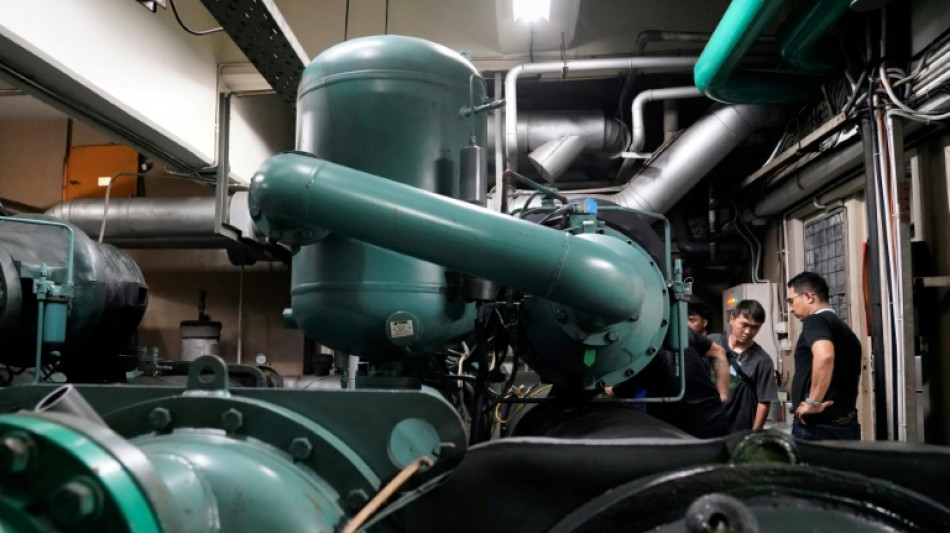
In Indonesia, a start-up captures coolants to stop global warming / Photo: © AFP

 US leads fresh Ukraine peace push with Miami talks

 Verstappen continues resurgence with pole for Singapore sprint

 Cuban ration book, symbol of the revolution, gathers dust
 Stocks advance, oil retreats as Trump rules out pre-vote Iran attack

 Man City case causing 'uncertainty' for whole Premier League, says Iraola

 Talks with Iran can only succeed without threats, president says

 Home hope Zheng sets up Mertens clash in China Open semis

 Lombardia promises gripping end to season in Pogacar absence
 Barca skipper Raphinha out against Getafe and Galatasaray

 MEXC and Payward Highlight Collaboration as Crypto and TradFi Converge at TOKEN2049

 EU states agree beefed-up European financial markets watchdog

 Eritrea, Ethiopia trade barbs as Tigray rebels retreat

 Kompany 'proud' of Man City success despite guilty verdict

 Man City will win appeal over financial charges, says Maresca

 Fernandez logs record lap at Indonesia MotoGP practice

 Navi Pillay: S.Africa's global rights activist and Nobel winner

 Ufunded Launches “Spotlight” Series, Documenting the Minds Shaping Modern Trading

 Russell goes fastest in practice for smoggy Singapore GP

 For exiled Russian director Zvyagintsev, triumph without belonging

 Home hope Zheng storms into China Open semi-finals

 Zverev churns out win in Shanghai Masters opener

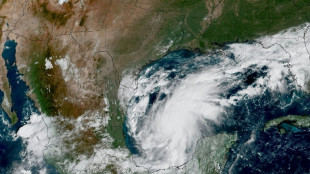 Hurricane Isaias strengthens en route to US Gulf Coast

 US activists deploy poll volunteers over Trump intimidation fears

 Saint Laurent designer Vaccarello leaves after glittering decade

 'Tough to stay here': Nepal flood survivors wait for homes

In the basement of a Jakarta housing complex, surrounded by the silver piping of the air-conditioning system, Indonesian technician Ari Sobaruddin is doing his part to tackle climate change.
Ari and his colleagues will spend 12 hours capturing AC refrigerant to stop this "super-pollutant" -- thousands of times more potent than carbon dioxide -- from leaking into the atmosphere.
It is plodding, sweaty work, but Ari, a member of climate startup Recoolit, does not mind.
"I love it because it's about preserving nature, saving nature," the 30-year-old technician told AFP.
Recoolit began working in Indonesia in 2021 to tackle what it considers an often-overlooked contributor to climate change: refrigerants.
These gases found in air-conditioners, fridges and cars are an old environmental problem.
In the 1970s, research showed refrigerants called chlorofluorocarbons (CFCs) were destroying the ozone layer.
Countries agreed to phase them out under a deal that came into force in 1989.
While their replacements, particularly hydrofluorocarbons (HFCs), are less harmful to the ozone layer, they still have major climate-warming properties.
"And those are in AC units, in the form of refrigerant banks... everywhere in developing countries right now," said Recoolit's head of operations Yosaka Eka Putranta.
- 'Growing problem' -
There are international agreements to phase out HFCs too, but, particularly in developing countries, they will be in use for decades yet.
Demand is increasing as climate change fuels record temperatures and expanding middle classes seek cooling and refrigeration.
"It is a growing problem because we need our indoor environments to be more resilient to climate change," said Robyn Schofield, associate professor of atmospheric chemistry at the University of Melbourne.
HFCs are expected to account for between 7 and 19 percent of greenhouse gas emissions by 2050, according to the United Nations.
The risk comes during maintenance or disposal, when refrigerants like the HFC Ari is capturing can be released accidentally or on purpose.
In Indonesia, as in most countries, this venting is illegal, but enforcement is limited.
"It's odourless, we cannot trace it. (Capturing) it takes so much resources. The machine, the people," said Recoolit's senior business development manager Erik Cahyanta.
"So some people just release it."
Recoolit trains, equips and incentivises technicians to capture refrigerant so it can be destroyed.
Technicians get 50,000 rupiah ($3) per kilogram of recovered refrigerant, which Recoolit sends to a government-approved cement kiln or municipal incinerator to be destroyed.
While refrigerant can be recycled or reused, Recoolit argues this is imperfect.
"Who's going to guarantee that when the refrigerants are injected again... they are going to stay there without another venting?" said Yosaka.
- Big tech interest -
Recoolit sells carbon credits based on the amount of refrigerant it destroys, priced at $75 a unit.
Carbon credits have faced criticism in recent years, and Benja Faecks of Carbon Market Watch warned that "offsetting" can give the impression "that emissions can simply be erased through financial transactions".
This allows "polluters to claim 'carbon neutrality' or 'negating ongoing emissions' without actually reducing their own emissions," she told AFP.
Recoolit argues its carbon credits are robust because it measurably destroys a climate-warming gas.
While many carbon credits are sold on exchanges with third-party verification, Recoolit sells directly to buyers and uses a credit methodology developed by the Carbon Containment Lab, a nonprofit spun out from Yale University.
Yosaka said canisters are sampled, and analysis is then done by the region's only qualified lab, in Malaysia, to confirm the contents are refrigerants.
Destruction facilities pass a "trial burn test" confirming they can break down refrigerants.
Recoolit also pays less than the market price for coolants to avoid creating a market for new refrigerants.
Refrigerant destruction remains a relatively small part of the carbon market. Existing players include US-based Tradewater, which grew out of California's state-level emissions caps and has worked in Latin America and Africa.
But Recoolit has attracted attention from one of the market's biggest corporate players: Google.
Earlier this year, the tech giant announced a partnership with Recoolit and a second company to prevent emissions equivalent to one million tons of carbon dioxide.
Google says it wants to help Recoolit scale up operations and expand outside Indonesia.
Some critics say refrigerant capture should simply be enforced by government policy, but Recoolit argues it is filling a real-world gap unlikely to be addressed otherwise.
And Schofield said the need for refrigerant capture is significant.
"As a climate action... it's a very good one," she said.
"I wish we had more of it."
K.Brown--BTB