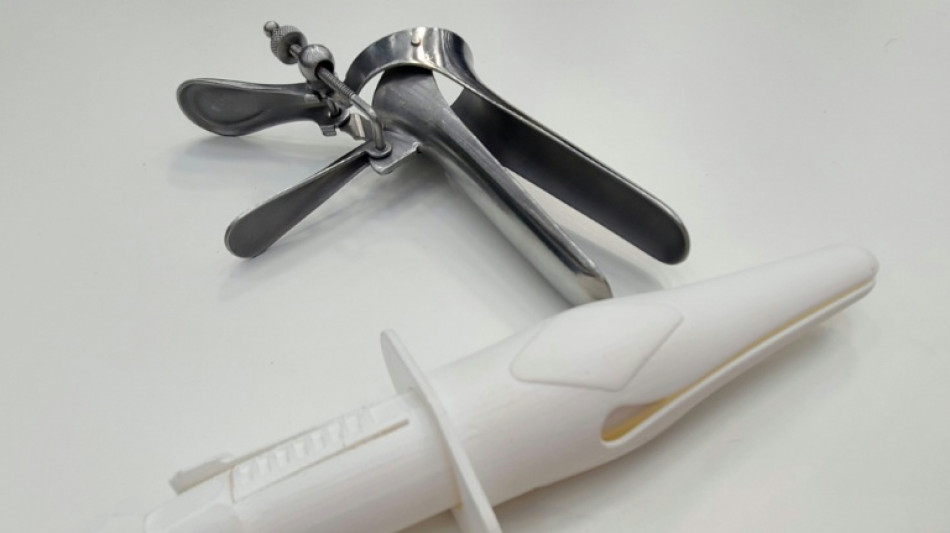
Researchers redesign vaginal speculum to ease fear and pain / Photo: © AFP

 Djokovic crashes out of Shanghai Masters in his first match

 EU says Turkey's crackdown on rights hampers membership bid

 Two Renoir paintings stolen in France recovered: mayor

 German leader outraged at Schroeder birthday visit to Putin

 Stocks up, oil retreats as Trump rules out pre-vote Iran attack

 South African judge Navi Pillay wins Nobel Peace Prize

 'I completely trust the club,' says Man City boss Maresca

 '10 out of 10' Quintana reminisces over dream Vuelta win

 Maddinson given shock recall but fails to score

 Navi Pillay, South African rights champion, wins Nobel Peace Prize

 Saudi Arabia says three killed at airport as Yemen war expands

 Everton's US owners mull sale of club two years after takeover

 Ukraine takes Russia fight to 'scorching sands' of Sahel

 Chinese AI tool pulled to prevent 'misuse' after South Korea hacks

 Asian stocks mostly up as traders weigh AI, oil dips after surge
 Walking through flames: orangutans rescued in Indonesia fires

 LeBron shines in pre-season debut for re-tooled 76ers

 Okinawa resolution calls for revision of US forces pact after murder

 Verdict expected Friday in Mexico trial over murders of Australia, US surfers

 New York mayor says asking Trump to withdraw ICE after shooting

 Walking through flames: orangutan rescued in Indonesia fires

 James shines in pre-season debut for re-tooled 76ers

 Fuel, fertilizer costs strain US farmers' support for Republicans in midterms

 Trump's 'super intelligence' rebrand to sell AI faces uphill battle

 Fiji demands US provide evidence Chinese official paid bribes for Beijing

It is cold, hard, metallic and commonly associated with pain. Not a mediaeval torture instrument, but the vaginal speculum used every day around the world for essential gynaecological exams.
Two engineers at Delft University in the Netherlands are now rethinking the decades-old design of the speculum -- long dreaded by many patients -- to make it less intimidating and less painful.
"I have a lot of experience with the vaginal speculum, unfortunately," Tamara Hoveling, one of the researchers behind the project, told AFP.
"I've never seen it as a pleasurable experience and I've always wondered why it looks like this."
- Sombre history -
The PhD candidate in medical industrial design then delved into the dark history behind the creation of the speculum, one version of which was developed by United States doctor James Marion Sims 180 years ago.
It was "tested on enslaved women without permission", said the 29-year-old.
"So that motivated me even more to take on this project."
Hoveling teamed up with Ariadna Izcara Gual, who was then working on her master's in industrial design engineering at Delft.
"As I was doing a lot of interviews, I was doing those sort of sketches with the same sort of shape but people were still scared of the device", said the 28-year-old Spanish researcher.
The Cusco speculum, the most commonly used model, is a metal device with a handle, beak and screw to adjust how wide it opens once inside the vagina.
For many, its insertion is uncomfortable or even painful and causes anxiety.
"Then the speculum is opened, pushing against these tense muscles and making it even more painful," Hoveling said.
"So I tried to look for shapes that might be related to the reproductive organs, like for example the flower, that also opens."
- Patient-friendly design -
The result was a prototype called the Lilium -- named after the lily flower.
Like the more familiar tampon, it has soft plastic and an applicator.
"It's designed with the patient in mind rather than the doctor.
"And we're really trying to improve the comfort aspect in a sensitive spot."
The Lilium also meets doctors' needs. Its three-sided opening keeps the vaginal walls from collapsing, allowing better visibility during examinations.
The Lilium remains at an early stage, with further ergonomic testing and material research needed to refine the prototype.
The researchers must still secure safety certifications, run human trials and obtain regulatory approval before it can reach clinics.
- Dazzling success -
To fund the next phase, they launched a crowdfunding campaign that quickly drew media attention in the Netherlands.
Within just two days, the campaign raised 100,000 euros ($117,000) -- far surpassing expectations.
"It's also a sign. It's proof there are people who really want change, that there is a real problem here and that the current market solutions are not the best," Hoveling said.
"I've received a lot of emails from women who told me they actually don't go to the gynaecologist because of this device, because they're scared, because they have a traumatic experience."
Cervical cancer is the fourth most common cancer among women, according to the World Health Organization.
It can be detected via a smear test or HPV screening -- both performed using a speculum.
With funding to allow this new gynaecological tool to be developed properly, the Lilium could be saving lives within five years.
F.Müller--BTB