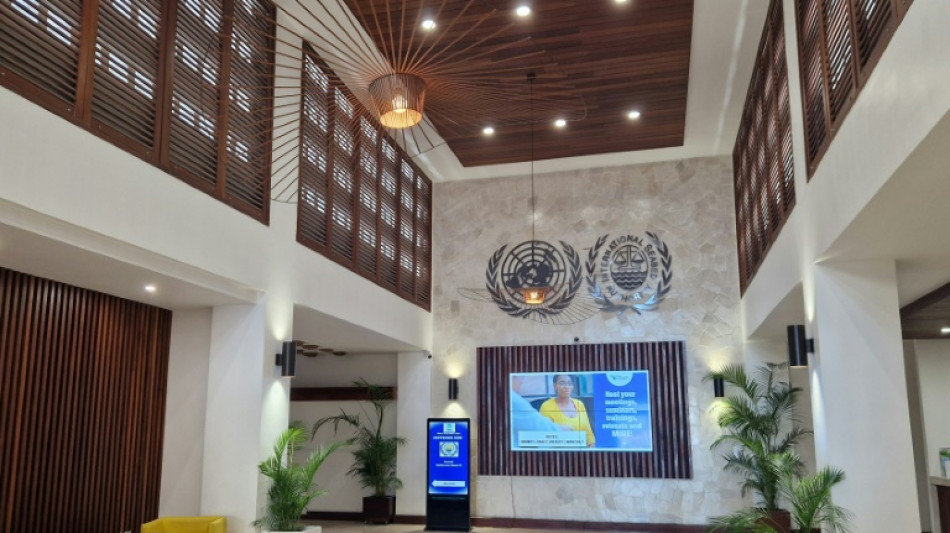
Restoring sea floor after mining may not be possible, researchers warn / Photo: © AFP/File

 'I completely trust the club,' says Man City boss Maresca

 '10 out of 10' Quintana reminisces over dream Vuelta win

 Maddinson given shock recall but fails to score

 Navi Pillay, South African rights champion, wins Nobel Peace Prize

 Saudi Arabia says three killed at airport as Yemen war expands

 Everton's US owners mull sale of club two years after takeover

 Ukraine takes Russia fight to 'scorching sands' of Sahel
 Chinese AI tool pulled to prevent 'misuse' after South Korea hacks

 Asian stocks mostly up as traders weigh AI, oil dips after surge

 Walking through flames: orangutans rescued in Indonesia fires
 LeBron shines in pre-season debut for re-tooled 76ers
 Okinawa resolution calls for revision of US forces pact after murder

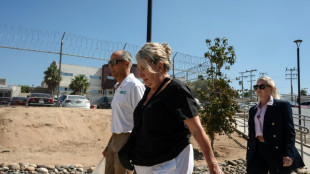 Verdict expected Friday in Mexico trial over murders of Australia, US surfers
 New York mayor says asking Trump to withdraw ICE after shooting

 Walking through flames: orangutan rescued in Indonesia fires

 James shines in pre-season debut for re-tooled 76ers

 Fuel, fertilizer costs strain US farmers' support for Republicans in midterms

 Trump's 'super intelligence' rebrand to sell AI faces uphill battle

 Fiji demands US provide evidence Chinese official paid bribes for Beijing

 More than just football: How scandal-tainted City led Manchester's rebirth

 Record Eden Park streak creates tension for All Blacks

 EU trade chief seeks 'tangible outcomes' in China talks
 Man City face Anfield cauldron after guilty Premier League verdicts

 CNN, MS Now, Politico urge judge to extend White House access

 Trump administration to launch new vaccine research center

Scientists present at the latest effort to hash out international rules for deep-sea mining say it's unclear if it's possible to restore damaged sea floor ecosystems -- or how long it would take.
One of the last wild zones on the planet, the sea floor is a coveted frontier for companies and countries eager to access minerals that are in high demand for emerging technologies such as electric cars.
Particularly coveted are potato-sized nodules containing cobalt, nickel, copper and manganese, that are found in abundance on the seabed in the central Pacific Ocean.
Companies eager to vacuum up these polymetallic nodules say they can do it with minimal risk to the deep-sea environment.
But ocean defenders have battled against what they see as the advent of an industry that will threaten isolated ecosystems that are not yet well understood.
That threat was underscored by European scientists who presented findings this week on the sidelines of a meeting in Kingston, Jamaica of the International Seabed Authority, which is trying to finalize future rules for seabed mining.
"If we remove nodules from the seabed, we do not know what we lose, only that it's lost forever," was one of the conclusions of DEEP REST, a sea floor conservation research project.
The DEEP REST study cautioned against using seabed restoration "as a management action for impacted habitats."
"So far, all the restoration operations we have attempted within our DEEP REST project have been short-term. And what we observed, is that in the given time, that is to say a few years, the ecosystems do not recover," said Jozee Sarrazin, a researcher at the French Institute for Ocean Science, or Ifremer.
"If restoration is possible, it will take a very long time, and at the moment we don't have the data to be able to say if that will be 100 years or 1000 years," the DEEP REST coordinator told AFP.
Despite the pressure, the cold, the total darkness, and the lack of nutrition sources at the bottom of the ocean, it is teeming with life.
The number of species who live on the deep seabed is not yet known but estimated to be in the millions.
- Soft corals, sea anemone -
Broad swathes of the Pacific Ocean where polymetallic nodules are found shelter fauna such as sponges, soft corals or sea anemones.
The fauna "only exists in these areas because they need the hard substrate of the nodule to attach," said Matthias Haeckel of the German research center GEOMAR, which presented results of the MiningImpact project in Kingston this week.
Vacuuming up these nodules and spreading sediment over the impacted areas reduces population densities, biodiversity and the functioning of ecosystems, MiningImpact's study found.
"To make the story short, in the end, we're talking about recovery times of thousands of years," Haeckel said. The nodules themselves form over millions of years.
Some research on restoration efforts is underway but the results are not yet in.
"We designed artificial nodules made of deep-sea clay and we placed them at different sites" at depths of about 4,500 meters (14,700 feet), Sabine Gollner, a biologist at the Royal Netherlands Institute for Sea Research, told AFP.
"But when you take into account the slow growth rates in the deep sea, the slow processes, it will take quite some more years to find out if restoration is effective and to what degree," she said.
Massive deposits of sulfide -- a type of mineral deposit found in underwater vents that spit out seawater heated by magma -- should be off-limits, the researchers suggest.
These types of underwater geysers are teeming with astonishing and unique biodiversity.
"If we extract massive sulfides near active vents, we know what we lose, and we must prevent loss," the DEEP REST study says.
But according to Gollner, it would be good to incorporate restoration goals into the mining code being negotiated by the International Seabed Authority's member states.
"It's good to include it but with a clear statement that at this moment in time, it cannot be taken into account to reach agreed environmental goals," she said.
"For example, a contractor shouldn't be allowed to use that argument to mine a larger area."
M.Furrer--BTB