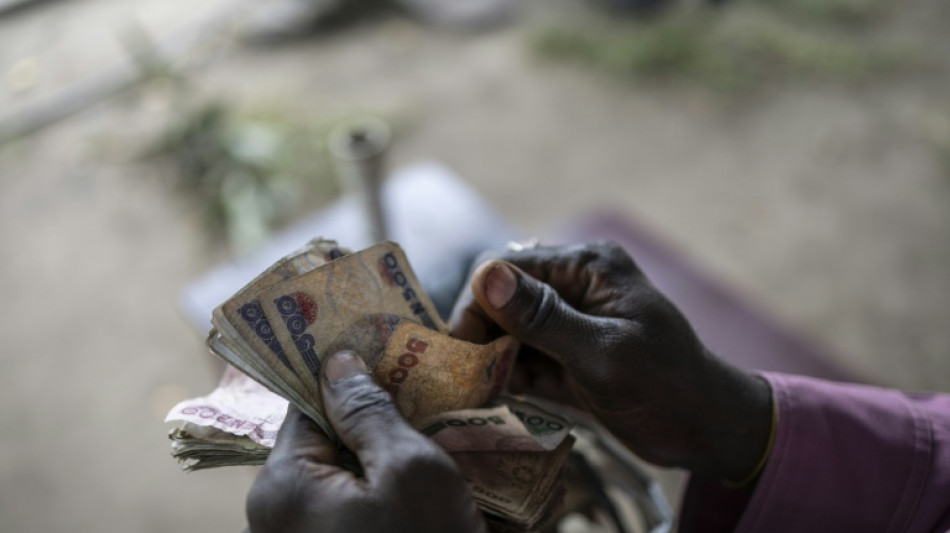
Digital loan sharks prey on inflation-hit Nigerians / Photo: © AFP/File

 France pledges more teachers after school students vow no let-up

 Bordeaux confirmed in sixth tier of French football

 Trump gives 'national treasure' Musk top US medal after rift

 MLB proposes shortening season, reforming playoffs

 Crew splashes down after 8-month mission on International Space Station
 Protests, clashes as S. African anti-migrant tensions reignite

 Russian data centre hit by drone in first for Ukraine war

 'Fighting for our future': France high school students vow no let-up

 Kyiv entering 'survival' mode amid Russian strikes surge: mayor tells AFP

 Verdict due in Mexico trial over murders of Australia, US surfers
 B2PRIME Welcomes Christina Barbash as Commercial Manager

 Russia forcing Kyiv into 'survival' mode before winter, mayor tells AFP

 Closing arguments begin in Maradona death trial
 UEFA president Ceferin to stand for re-election in 2027

 Nearly 300,000 Nepalis at flood risk: study

 Riyadh kindergarten hit by interception debris as Houthis say targeted airport

 Alex Bodi mizează, alături de CRIF, pe investiții transparente și pe prevenirea riguroasă a spălării banilor

 Gulf Labs, Part of Thailand’s $27 Billion GULF Group, Goes Live as an Injective Validator
 EU okay for winter despite 'historically low' gas stocks: operators

 Rwanda to host F1 Grand Prix: sources close to both sides

 EU top diplomat says bloc in favour of UN Lebanon peacekeepers' extension

 Antonelli and Russell to run different Mercedes aero packages in Singapore

 WTO hikes 2026 trade growth forecast on AI boom

 'I love that challenge': Hamilton prays for rain in Singapore

 G.Bissau moves towards postponement of December general election

Cash-strapped and in dire need of 30,000 naira (about $20), Mariam Ogundairo turned to a loan app, downloading it and registering her phone number.
The money was quickly sent over but came with a 21.6 percent interest rate, due in two weeks. Like many in Nigeria, battered by inflation, Ogundairo was too broke to pay back what she owed.
Then came a deluge of harassment -- a tactic that has become the hallmark of many loan apps in Africa's fourth-largest economy.
"They started calling my phone contacts when I couldn't pay back on time, saying I owed them," Ogundairo told AFP. "I lost my security, and it makes me so sad and scared."
Such loan apps in Nigeria, branded "predatory" by campaigners, are texting threats and leaking sensitive photos to their mobile phone contacts when people squeezed by the country's ongoing economic crisis cannot pay up.
Often enticed by false promises of low interest rates, thousands of Nigerians have turned to personal finance apps seeking quick access to short-term loans as galloping prices put pressure on incomes, with inflation standing at 21.8 percent at the end of July.
Ogundairo struggled through the embarrassment for weeks until she was able to pay off her balance.
- 'Quick fix' gone wrong -
"A friend recommended it because I needed a quick fix," another victim, a 24-year-old, who took out a loan two years ago as a university student and asked his name not be used, told AFP.
After spending more than 300,000 naira conducting laboratory investigations for his final thesis and still needing more funds to complete his research and beat submission deadlines, the money seemed like a lifesaver.
He took out 70,000 naira when he was a final-year student in 2023. He was meant to pay back about 110,000 naira within a month, but was too broke.
The loan app then began sending messages to his phone contacts that he was a "ritualist killer". He said he was not aware he had given the app access to his contacts.
"A couple of my coursemates got the messages," he told AFP. "It wasn't the case of unwillingness to pay, it was just a case of impossibility."
An increasing number of Nigerians have turned to personal loans following reforms by President Bola Tinubu to shock the country's moribund economy and remove costly subsidies.
Though some economists have voiced approval for the measures, Tinubu's policies have sent inflation skyrocketing and the value of the naira plunging, hitting many ordinary Nigerians in their pockets.
Even when apps mislead people on interest rates, they can often provide better rates than traditional banks -- with the benchmark interest rate at 27.5 percent, conventional loans can come with interest at 27 to 48 percent.
While there was no breakdown for so-called fintech apps, lenders in the country handed out about 470 billion naira in personal loans in the last quarter of 2024. By December, outstanding personal loans jumped "by 21.27 percent to 3.82 trillion naira compared with the level at end-September 2024", the Central Bank of Nigeria (CBN) said in March.
As of the same month, the Federal Competition and Consumer Protection Commission (FCCPC) approved 408 loan apps, up from 269 in September 2024, with 42 receiving conditional clearance. The CBN approved 23 apps, up from 14 in the third quarter of last year.
Forty-seven were delisted and 88 placed on watchlists for various offences including harassment. The watchdog had said in the past that some loan apps were operating in the country illegally.
- Loan sharks 'thrive' -
Many of the loan apps' ease of access and swift processing create a trap, said Funmi Oderinde, a lawyer at Citizens' Gavel, a civil society organisation that has been pushing back against the lenders.
The organisation has so far received at least 1,300 complaints over "predatory digital loan apps".
"These promises are deceptive, and borrowers soon face unethical recovery practices such as defamation, harassment, threats, breaches of data privacy, arbitrary fines, and excessively high interest rates aimed at pressuring them into repayment," Oderinde said.
Some victims of the harassment have formed different support groups on Facebook. One such group has more than 21,000 members.
A victim told Citizens' Gavel that, after her phone was accessed remotely, a fake obituary and a real nude photo were shared with her contacts by a loan app.
According to Oderinde, two of the people who approached the organisation for legal help "could have died" due to harassment from loan app agents.
The FCCPC, in a note sent to lenders in August, said it would "periodically monitor interest rates for services of consumer lending, and ensure rates are not exploitative".
But despite regulatory moves, dozens of apps continue to operate under new names, and desperate borrowers often do not check approval lists before applying.
The result is that loan sharks "thrive", Oderinde said, "because of weak sanctions and poor enforcement".
W.Lapointe--BTB