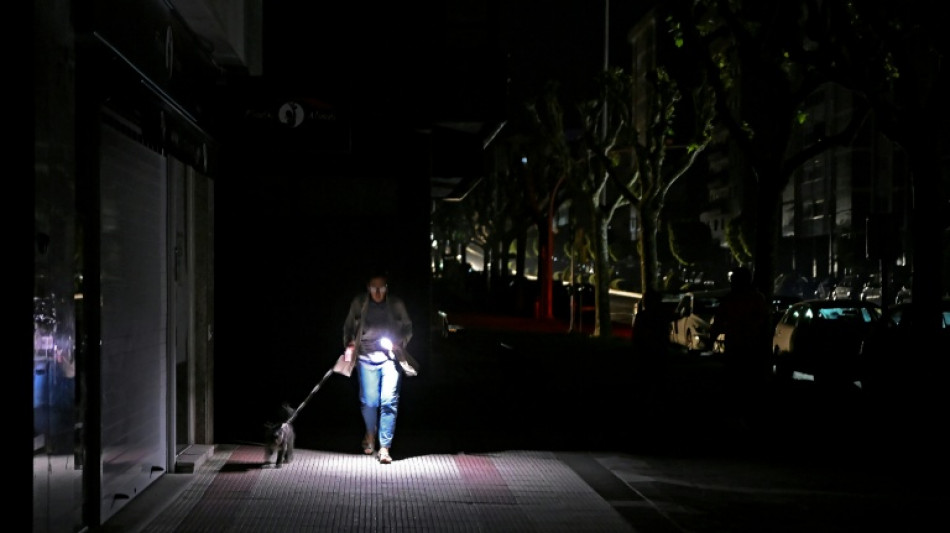
'First of its kind' power surge behind Iberia blackout: experts / Photo: © AFP/File

 Alex Bodi pushes ahead with expansion: ALIX LASERS showroom planned for Bucharest
 Fossil fuels off COP31 agenda as global output keeps rising

 Haze not 'a threat' to Singapore F1 race: organisers
 COP31 organisers say to seek 'ambitious' action with their text
 Bartunkova thrashes Muchova to reach China Open semi-finals
 Drone hits Yandex data centre, in first such attack on Russia
 Oil prices surge and stocks sink on fresh inflation worries

 AI startup Manus raises $500m after Meta acquisition blocked by China
 From refuge to repatriations: Malaysia's Myanmar U-turn

 Morikawa says LIV players face 'business decision' after Rahm exit
 Tenzing Norgay's son says Himalayas sending climate warning
 On your bike! Bottas opts for two wheels to reach Singapore GP

 Alcaraz, Sinner, Osaka commit to Australian Open '1 Point Slam'

 Dodgers beat Braves to advance in MLB playoffs, Rays oust Yankees

 'A sun as black as my lungs': how corruption crucified a polluted Albania city

 The British historian helping the French rediscover de Gaulle
 Dodgers beat Braves to advance, Guardians survive in MLB playoffs
 Latin American, Caribbean women top Nobel literature buzz
 US says Fiji-based Chinese official paid bribes for Beijing

 After botched US execution, Christa Pike was nearly taken off life support

 Guinea-Bissau junta urges military unit loyal to ex-president to disarm

 As species decline, green turtles offer glimmer of hope

 Brothers Scott and Beauden Barrett named to start for All Blacks
 EU trade chief seeks to dial down China tensions
 'Never again Bolsonaro': thousands march ahead of Brazil election runoff

A power surge that caused a paralysing blackout across all of Spain and Portugal in April was an unprecedented event in Europe and possibly the world, but the root cause remains unknown, an expert panel said Friday.
"This was the most severe blackout incident in Europe in the last 20 years," Damian Cortinas, president of the association of electricity grid operators ENTSO-E, said during a presentation of the panel's preliminary report into the incident.
He said "cascading overvoltages" were behind the blackout, which he called a "first of its kind" on the continent.
Cortinas added that "we think (it is unprecedented) in the world as well", but cautioned that the experts did not have information from every country.
The April 28 outage cut internet and telephone connections, halted trains, shut businesses and plunged cities into darkness across Spain and Portugal. It also briefly affected southwestern France.
A Spanish government report had previously blamed the massive outage on overvoltage in June.
Overvoltage occurs when there is too much electrical voltage in a network, overloading equipment. It can be caused by surges in networks due to oversupply or lightning strikes, or when protective equipment is insufficient or fails.
- 'New territory' -
Friday's "factual" report, produced by a panel of 45 European experts mandated to carry out technical investigations, describes the sequence of events that led to the uncontrolled, widespread outage.
But it does not yet provide the primary causes of the initial incidents.
"This is new territory. This is also why we need a bit of time to be sure that we analyse what's going on and what would happen," Cortinas said.
The expert group will publish its final report in the first quarter of 2026, ENTSO-E said in a statement
"It will include a detailed root cause analysis and recommendations on how to prevent similar events happening across the European power system in the future," it added.
The factual report was based on a massive quantity of data, which took a lot of time to collect as experts from power generators and their users as well as third parties.
Some of the third parties "did not give the consent to the Spanish TSO (transmission system operator) to forward the data. So it took us a long time to collect to collect all the needed data," said Klaus Kaschnitz, the expert panel's co-lead.
"We sent out about 150 letters and, at the end, we received the last data in August," he said.
Some data is still missing.
- Blame game -
The blackout struck the Iberian Peninsula at 12:33 pm local time.
According to the report, two episodes of oscillations -- power, voltage, and frequency swings -- were observed during the half hours that preceded the incident.
Operators in control rooms took measures to mitigate the issue, such as reducing the export of power from Spain to France, the report said.
"While these measures mitigated the oscillations, their nature led to an increase of voltage in the Iberian power system," it said.
This was followed by losses of output at wind and solar plants, then a chain disconnection of several power generation centres, causing voltages to spike.
Investigators have yet to determine why systems to mitigate overvoltage failed.
Advocates for nuclear energy had blamed the supposed instability of renewable energy sources.
The head of Spanish grid operator REE, Beatriz Corredor, had instead pointed to certain "conventional energy" producers -- gas, nuclear or hydro -- with voltage control thresholds set too low.
In June, Spain's Ecological Transition Minister Sara Aagesen blamed REE, saying that the system "lacked sufficient voltage control capacity" that day.
B.Shevchenko--BTB