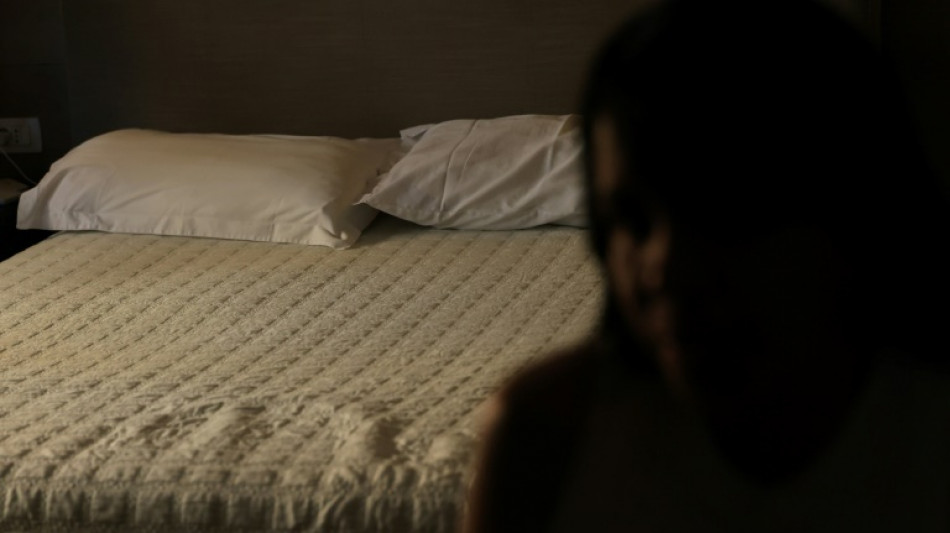
'I found hell': the women ensnared in Albania's global sex trade / Photo: © AFP

 Alex Bodi pushes ahead with expansion: ALIX LASERS showroom planned for Bucharest
 Fossil fuels off COP31 agenda as global output keeps rising
 Haze not 'a threat' to Singapore F1 race: organisers

 COP31 organisers say to seek 'ambitious' action with their text
 Bartunkova thrashes Muchova to reach China Open semi-finals
 Drone hits Yandex data centre, in first such attack on Russia
 Oil prices surge and stocks sink on fresh inflation worries

 AI startup Manus raises $500m after Meta acquisition blocked by China
 From refuge to repatriations: Malaysia's Myanmar U-turn

 Morikawa says LIV players face 'business decision' after Rahm exit
 Tenzing Norgay's son says Himalayas sending climate warning
 On your bike! Bottas opts for two wheels to reach Singapore GP

 Alcaraz, Sinner, Osaka commit to Australian Open '1 Point Slam'

 Dodgers beat Braves to advance in MLB playoffs, Rays oust Yankees

 'A sun as black as my lungs': how corruption crucified a polluted Albania city

 The British historian helping the French rediscover de Gaulle
 Dodgers beat Braves to advance, Guardians survive in MLB playoffs
 Latin American, Caribbean women top Nobel literature buzz
 US says Fiji-based Chinese official paid bribes for Beijing

 After botched US execution, Christa Pike was nearly taken off life support

 Guinea-Bissau junta urges military unit loyal to ex-president to disarm

 As species decline, green turtles offer glimmer of hope

 Brothers Scott and Beauden Barrett named to start for All Blacks
 EU trade chief seeks to dial down China tensions

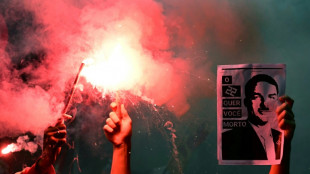 'Never again Bolsonaro': thousands march ahead of Brazil election runoff

From Venezuela, Maria travelled halfway around the world in search of a better life. Instead, the mother of two was trapped in Albanian detention for months after being lured into illegal sex work.
Maria, 38, is among a growing number of women drawn by international criminal networks into the Balkan nation from impoverished countries on the promise of lucrative sex work and a potential gateway to Europe.
She is just one victim of a criminal web that spans continents.
Earlier this week, international police busted a "highly organised" network that exploited over 50 women similar to Maria, whose name AFP has changed to protect her.
According to Europol, police arrested 17 alleged traffickers on Wednesday, who had brought women from Latin America to Albania and Croatia.
The women were either trapped in illegal sex work in Albania or exploited in other European countries.
"They promised me paradise but I found hell," Maria told AFP, in a Tirana apartment rented by an association that helps victims of human trafficking.
- 'Digital and international' -
Albania's economic and social collapse in the 1990s, following decades of isolation under a communist dictatorship, allowed the emergence of one of the most notorious mafias in the world, according to organised crime expert Fabrice Rizzoli.
Albanian clans, specialising in human trafficking and heroin smuggling, capitalised on an alliance with the Calabrian mafia "to spread prostitutes on the streets of Milan and its region", he said.
Since branching into cocaine supply in the 2000s, the Albanian mafia has been well established in Latin America, he said.
But as tourism booms, Albania, once a country of origin for sex trafficking, has now become a destination country for various criminal groups that bring women to the Balkan country, where prostitution is illegal.
Empowered by the global reach of cybercrime, criminal networks are using Albania as a transit point to exploit women from other nations around the world.
According to Europol, Wednesday's raids uncovered the model many of these "agencies" use, to control every detail "from recruitment to money collection", including call centres that negotiate directly with prostitution clients.
"The women have no say and no rights in deciding the price or saying no to certain practices," said Nenad Naca, from Europol's human trafficking taskforce.
Investigators also arrested a man in Colombia; they allege he led the network and took almost half of all its criminal earnings, thousands of miles away from where most women were being exploited.
"As all other organised crime networks, it has turned digital and international. These call centres can be anywhere," Naca said.
- A 'less visible violence' -
For women trapped in Albania's illegal prostitution, many are too afraid to turn to the authorities, under threats from the criminals who manipulate them.
Anyone engaging in prostitution in Albania, if not considered a trafficking victim, can be sentenced to up to three years in prison.
Some, like Maria, are unaware that sex work is illegal when they come to the country.
But after they arrive, criminal pimps abuse them, taking a substantial cut of their earnings and forcing them to stay.
"There is less visible violence now than before. The criminals have understood that the humans they traffic –- who for them are not human beings, just a commodity –- lose some value if they are visibly hurt," Naca said.
Often, criminals threaten family back in the women's home country or show videos of others being beaten as a warning "if they disobey", he said.
Maria travelled to Albania in late November, convinced by friends that it would finally help pay the bills for her young family.
She was arrested five days later with six other Latin American women.
"We didn't know it was illegal," she said, still visibly shaken after seven months of pre-trial detention.
"Otherwise, we wouldn't have come here."
- 'Prey to scams and threats' -
Among erotic photos, dating apps and client messages on Maria's and the other women's seized phones, investigators found the recurring number of a woman who allegedly acted as a pimp.
According to one of the women, Ana -- whose name AFP has also changed for her safety -- it was the number of the person who brought her from Colombia.
The 32-year-old said the woman handled clients, assigned appointments, and organised apartments, in exchange for half of her earnings supposedly to repay travel costs to Albania.
In the first six months of 2025, Albanian police opened 108 investigations into suspected prostitution, leading to operations targeting massage parlours, bars, or hotels.
At least 37 foreign nationals suspected of trafficking-related crimes and about 10 potential victims of sexual exploitation were identified.
These women, often from very poor backgrounds, are persuaded into travelling to Albania by criminals who promise quick cash, Tirana's anti–human trafficking unit commissioner Geranda Gjeta said.
"They fall prey to scams and threats from these criminals, who send videos of their families or death threats," Gjeta said.
Under that pressure, most women take full responsibility when caught instead of risking retribution from their pimps, said Brikena Puka, who leads the victims' aid centre Vatra.
"For several months, the number of foreign victims of trafficking for sexual exploitation needing our help has been increasing," Puka said.
Nenad said police have also seen an increase in Latin American victims and suspects.
- 'We do it out of need' -
Ana and Maria have been released from prison and are in secure housing supplied by Vatra, waiting for the police to return their passports so they can finally leave Albania.
Ana came to the country via Spain after struggling to support her children and family back in the Dominican Republic.
She had been approached by a network while living in Barcelona and offered a job as an escort by a woman, who has since been arrested and accused of pimping.
"Prostitution — we do it out of need," Ana said.
"We see it as something quick and easy. But it's not true. Not only are we mistreated, but we're also forced to give 50 percent of what we earn with our bodies to our pimps," she said, struggling to hold back tears.
In early September, 11 foreign nationals, including six women, were held in pre-trial detention in Albania, suspected of human trafficking and pimping, according to prison authorities.
- 'International pimp' -
"Albania was once a country of origin for Albanian girls and women who were trafficked," Gjeta said.
"Today we face another situation: an international criminal phenomenon whose victims are women from Africa, Asia, and Latin America."
According to Albanian police, well-organised criminal groups run the network from abroad, supported by local contacts who handle on-the-ground logistics.
The challenge is a "transnational" one for law enforcement, as victims often arrive on visas --sometimes with forged documents -- before relocating to other European countries, Gjeta said.
Albania was also probing several foreign-hosted websites that are used to shield prostitution clients from law enforcement.
As part of a major international operation in June, Albanian police rescued three Chinese women recruited in Dubai and exploited by a Chinese company in a local massage parlour.
A British man and two Albanians accused of trafficking people for sexual exploitation were also arrested and remain in pre-trial detention.
Malka Marcovich, a women's rights activist and consultant, said technology was allowing for the emergence of an "international pimp".
"Moving from country to country, from continent to continent, it becomes increasingly difficult to prosecute traffickers," Marcovich said.
"The large-scale sale of women's bodies is far more lucrative than drug trafficking," Marcovich said.
C.Meier--BTB