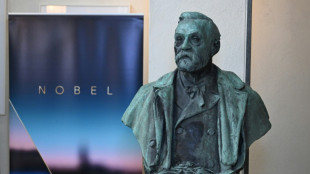
Unreachable Nobel winner hiking 'off the grid' / Photo: © AFP

 Alex Bodi pushes ahead with expansion: ALIX LASERS showroom planned for Bucharest
 Fossil fuels off COP31 agenda as global output keeps rising
 Haze not 'a threat' to Singapore F1 race: organisers
 COP31 organisers say to seek 'ambitious' action with their text

 Bartunkova thrashes Muchova to reach China Open semi-finals

 Drone hits Yandex data centre, in first such attack on Russia
 Oil prices surge and stocks sink on fresh inflation worries
 AI startup Manus raises $500m after Meta acquisition blocked by China
 From refuge to repatriations: Malaysia's Myanmar U-turn

 Morikawa says LIV players face 'business decision' after Rahm exit
 Tenzing Norgay's son says Himalayas sending climate warning

 On your bike! Bottas opts for two wheels to reach Singapore GP

 Alcaraz, Sinner, Osaka commit to Australian Open '1 Point Slam'

 Dodgers beat Braves to advance in MLB playoffs, Rays oust Yankees
 'A sun as black as my lungs': how corruption crucified a polluted Albania city

 The British historian helping the French rediscover de Gaulle
 Dodgers beat Braves to advance, Guardians survive in MLB playoffs
 Latin American, Caribbean women top Nobel literature buzz
 US says Fiji-based Chinese official paid bribes for Beijing
 After botched US execution, Christa Pike was nearly taken off life support

 Guinea-Bissau junta urges military unit loyal to ex-president to disarm
 As species decline, green turtles offer glimmer of hope

 Brothers Scott and Beauden Barrett named to start for All Blacks

 EU trade chief seeks to dial down China tensions

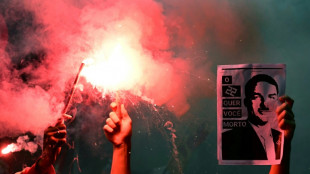 'Never again Bolsonaro': thousands march ahead of Brazil election runoff

One of this year's Nobel winners is a leading medical researcher who also offers a shining example of work-life balance -- so much so that he might not know he won.
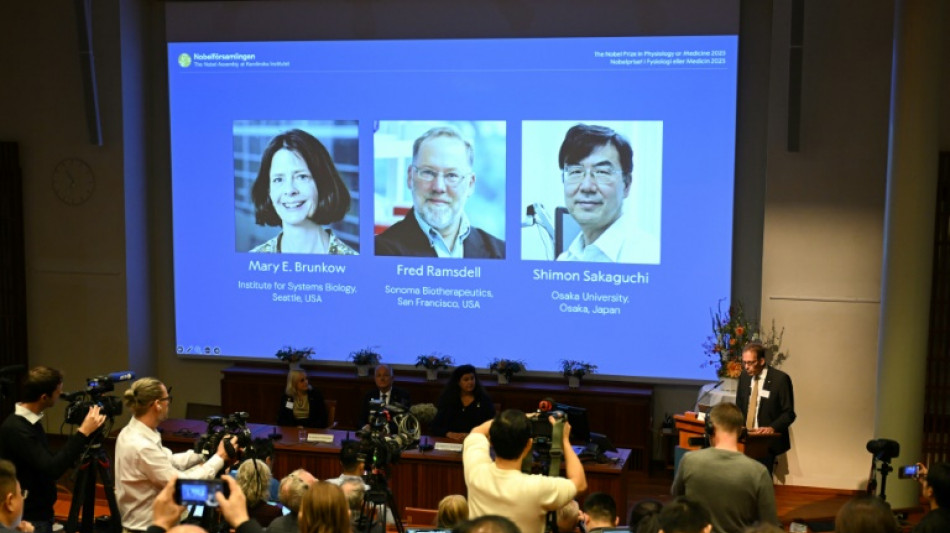
Fred Ramsdell was among those honored Monday with a 2025 Nobel Prize in Medicine, but he's currently "living his best life" on an "off the grid" hiking foray, a spokesperson from his San Francisco-based lab, Sonoma Biotherapeutics, told AFP.
Ramsdell shared the prestigious prize with Mary Brunkow of Seattle, Washington and Shimon Sakaguchi of Osaka University in Japan for their discoveries related to the functioning of the immune system.
But the laureate's digital detox means the Nobel committee has been unable to reach him and break the news.
Jeffrey Bluestone, a friend of Ramsdell's and co-founder of the lab, said the researcher deserves credit but he can't reach him, either.
"I have been trying to get a hold of him myself. I think he may be backpacking in the backcountry in Idaho," Bluestone told AFP.
The Nobel committee also hit a roadblock trying to reach Brunkow -- both researchers are based on the US West Coast, which is nine hours behind Stockholm -- but eventually got ahold of her.
"I asked them to, if they have a chance, call me back," said Thomas Perlmann, secretary-general of the Nobel committee, at the press conference announcing the winners.
The three won the prize for research that identified the immune system's "security guards", called regulatory T-cells.
Their work concerns "peripheral immune tolerance" that prevents the immune system from harming the body, and has led to a new field of research and the development of potential medical treatments now being evaluated in clinical trials.
Sakaguchi, 74, made the first key find in 1995, discovering a previously unknown class of immune cells that protect the body from autoimmune diseases.
Brunkow, born in 1961 and now a senior project manager at the Institute for Systems Biology in Seattle, and Ramsdell, a 64-year-old senior advisor at Sonoma Biotherapeutics, made the other key discovery in 2001.
L.Janezki--BTB