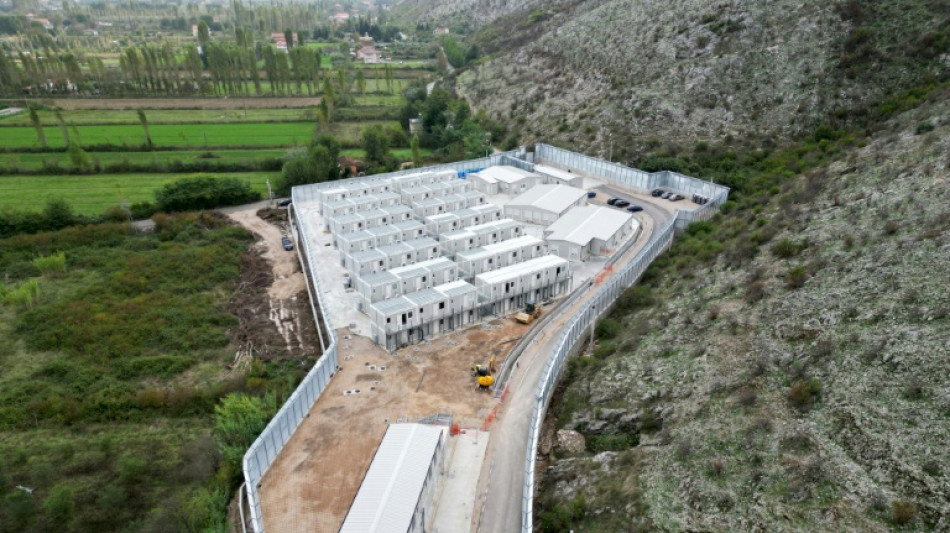
One year on, Italian migrant camps in Albania near-empty / Photo: © AFP

 North Korea demands South show 'utmost respect' to restore relations

 Saudi says three dead in airport attacks claimed by Houthis

 'Mad dream': New showcase for African film opens in London

 All Blacks coach Rennie says Wallabies exit 'part of the game'

 The growing protests against India's poll body - and PM Modi
 Stocks fall further as oil spike fans fresh inflation worries

 Bad COP, worse COP? EU tempers hopes for UN climate summit

 Rookie Henry named in Wallabies midfield to face All Blacks

 Housing crisis set to dominate Spain's snap election
 Gas, health care, utilities: high costs squeeze US midterm voters

 New Zealand Rugby seeks injunction over PNG Chiefs name
 Samsung expects 780% quarterly operating profit jump on AI boom

 Guardians survive with 9-3 win over White Sox

 Saudi Arabia says 3 dead at airports after Houthis claim attacks
 Stocks slide as oil sees volatile trading day over Iran war fears

 Microsoft pushes AI vision with new, expensive Surface laptop

 Five children among 28 killed in Russian strikes on Ukraine

 Odell Beckham Jr signs with Minnesota Vikings

 Saudi Arabia says three dead at airports after Houthis claim attacks

 Trump plans to turn Florida golf course into presidential retreat

 WHO says cannot conduct full risk assessment on Russia plague reports

 After botched execution, US woman is awake and shackled to bed

 New Zealand fly-half Mo'unga ruled out of Australia Tests

 Protests in major Turkish city after mayor defects to Erdogan party
 Climate change strips island's title of largest penguin colony: study

One year after Italy opened migrant camps in Albania intended to hold people intercepted at sea, the legally contested centres lie almost empty.
Numerous NGOs have criticised living conditions inside the camps, and Italian courts have struck down several attempted deportations to Albania.
But as the European Union discusses the possibility of creating its own "return hubs", Italy's far-right government appears committed to sending migrants to offshore detention centres in Albania.
- 'Very concerning' -
On October 16, 2024, two detention centres opened in the port of Shengjin and the village of Gjader, located in northern Albania but managed by Rome.
That same day, dozens of cameras filmed the arrival of the first Italian naval ship carrying 16 men from Egypt and Bangladesh, arrested at sea as they tried to reach the EU.
Their identities were first verified at the port. Then they were sent to the Gjader camp, where they could wait for an asylum claim to be processed if they lodged one.
But very quickly, four of the men were identified as "vulnerable" and sent back to Italy.
Within two days, the remaining 12 men would be sent back too, after an Italian court ruled against their detention.
The court cited disagreements over the list of "safe" origin countries created by the Italian government, which included nations that do not meet European legal criteria.
A year later, Italian judges have repeatedly rejected deportations, slowing plans to place up to 3,000 migrants in the camp.
According to legal expert Gianfranco Schiavone, a report by Italian NGOs found that in all, 132 people were sent to the Albanian centres.
Of them, only 32 have been repatriated, although details on how many were returned to Italy or sent to another country are unclear.
It is also hard to obtain official confirmation about the programme details and camp conditions -- the Albanian authorities referred AFP's query to the Italians, who did not answer specific questions about the scheme.
"The situation is very concerning due to the extreme difficulty for detainees to exercise their fundamental rights in general," Schiavone said.
According to a report by a group of NGOs, at least nine people have attempted suicide while being held in the camps, and there have been 21 cases of self-mutilation.
- 'The Italian experiment' -
Amid ongoing legal battles, Italy plans to use the camps as detention facilities for people awaiting deportation after already being deemed to be "illegal" migrants by Italian authorities.
This repurposing will also likely be blocked by European courts, Schiavone said.
"There is no provision for the administrative detention of foreigners awaiting expulsion in Italy to be carried out in a non-EU country."
But this could change in a few months if the "return regulation", currently under debate in the European Parliament, is adopted: the framework would open the way to the creation of migrant centres outside the EU's borders.
Since her election in 2022, Italian Prime Minister Giorgia Meloni has made fighting irregular immigration a key policy of her government.
The legalisation of Meloni's experiment would represent a significant political win for her far-right Fratelli d'Italia (FDI) party.
But Filippo Furri from the Italian NGO ARCI said that he hopes the EU reconsiders this approach and instead deems it "illegal or economically unsustainable".
Meanwhile, the risk for people migrating is that "this Italian experiment spreads to other countries", he said.
During a visit to Albania in May, British Prime Minister Keir Starmer expressed his desire to create "return hubs".
But his Albanian counterpart Edi Rama was reluctant to open another programme in his country and said the Italian model "takes time to test".
"If it works, it can be replicated. But not in Albania, elsewhere in the region," Rama said.
P.Anderson--BTB