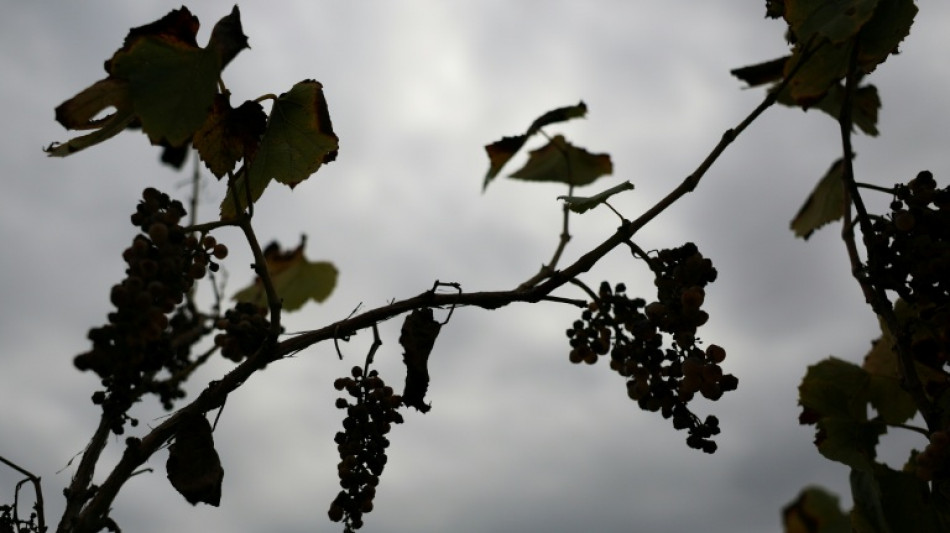
Withering vines: California grape farmers abandon fields as local wine struggles / Photo: © AFP

 North Korea demands South show 'utmost respect' to restore relations

 Saudi says three dead in airport attacks claimed by Houthis

 'Mad dream': New showcase for African film opens in London

 All Blacks coach Rennie says Wallabies exit 'part of the game'

 The growing protests against India's poll body - and PM Modi

 Stocks fall further as oil spike fans fresh inflation worries

 Bad COP, worse COP? EU tempers hopes for UN climate summit

 Rookie Henry named in Wallabies midfield to face All Blacks

 Housing crisis set to dominate Spain's snap election

 Gas, health care, utilities: high costs squeeze US midterm voters

 New Zealand Rugby seeks injunction over PNG Chiefs name

 Samsung expects 780% quarterly operating profit jump on AI boom

 Guardians survive with 9-3 win over White Sox

 Saudi Arabia says 3 dead at airports after Houthis claim attacks

 Stocks slide as oil sees volatile trading day over Iran war fears

 Microsoft pushes AI vision with new, expensive Surface laptop

 Five children among 28 killed in Russian strikes on Ukraine

 Odell Beckham Jr signs with Minnesota Vikings

 Saudi Arabia says three dead at airports after Houthis claim attacks

 Trump plans to turn Florida golf course into presidential retreat

 WHO says cannot conduct full risk assessment on Russia plague reports

 After botched execution, US woman is awake and shackled to bed

 New Zealand fly-half Mo'unga ruled out of Australia Tests

 Protests in major Turkish city after mayor defects to Erdogan party

 Climate change strips island's title of largest penguin colony: study

For more than a century, Lodi's grape growers have supplied the old wineries that make this Californian city famous. But rocketing costs, falling demand and competition from imports mean some are now abandoning their vineyards.
Randy Baranek, whose family has farmed these hillsides for generations, said thousands of acres (hectares) of vines -- a quarter of Lodi's production -- have been removed in the last two years.
"I've never seen anything like this," he told AFP.
Baranek said an acre of vines can produce between eight and ten tons of grapes, which can be sold for a maximum of $3,000.
"Our costs are between $3,000 and $4,500 an acre to farm," he said, as he picked his way through abandoned Chardonnay vines.
"We're twirling the toilet."
Even ripping out the vines is difficult, said Baranek, with California's strict environmental rules making it expensive to convert a field, prompting some farmers to leave them to go wild.
Such abandoned plots have become commonplace in Lodi, where around 130 varieties of grapes are grown, and which is known particularly for its Zinfandels.
- Slowing demand -
The decline in production has been consistent over the last few years, reaching its lowest point in two decades in 2024, when 2.9 million tons of grapes were harvested, said Stuart Spencer, executive director of the Lodi Winegrape Commission.
This year, that figure is expected to fall by a further 400,000 tons.
Spencer says a shift in the shape of the wine market in the United States is at the root of the changes.
After three decades of growth, in which California, Oregon and Washington state forged a domestic consumer base previously enamored with the Old World wines of France, Italy and Spain, the last three years have been challenging.
"The whole spectrum of those that contribute to the wine industry are struggling right now," he said.
On the consumer side, changing tastes and habits mean "people are just drinking less," he said.
The economy is also crimping demand, said Spencer.
"The inflation we've seen over the last few years is really impacting the consumer's wallet."
Vintners are reacting to this slowdown in demand by seeking out other suppliers.
"One of the big changes we've seen here in California is our largest wineries, who are also the largest grape buyers, are choosing to import cheap, bulk wine instead of purchasing local grapes," said Spencer.
That price differential, he says, is the result of a skewed market.
"European wine growers are heavily subsidized by the EU... So we are at a disadvantage. We are not playing on a fair, level playing field."
- Almonds -
Some farmers are reluctantly giving up the grapes, at least on a portion of their land, opting instead for in-demand and lower-cost products like almonds.
It is not a decision they take lightly, because replanting a vineyard can cost tens of thousands of dollars.
It can also affect the wider community, with fewer workers needed for crops like almonds, whose harvest is largely automated.
"There's no other talk on the streets; we're all very worried," said one worker who has toiled in the area's vineyards for ten years. "I don't know what I would do without this."
Kevin Phillips is among those who have made the leap, converting one of his generations-old vineyards to an almond orchard.
The area has good water supplies -- key for thirsty almond trees -- and the crop can cost just a quarter of what it does to farm grapes, he said.
But one of the major attractions for a farmer is that demand is robust, and selling them is very straightforward.
"With wine grapes, you've really got to go out there and you've got to talk to wineries, you've got to make connections, you've got to hope that things work, you've got to hope that all the stars line up," he said.
"Almonds, you don't have to talk to anybody. There's just a demand."
For Phillips, who said he made the difficult decision to rip out his vines after a few bottles of wine, the move is bittersweet.
"It's so much easier" to farm almonds, he said.
"And I hate to say this, because I'm a wine guy."
R.Adler--BTB