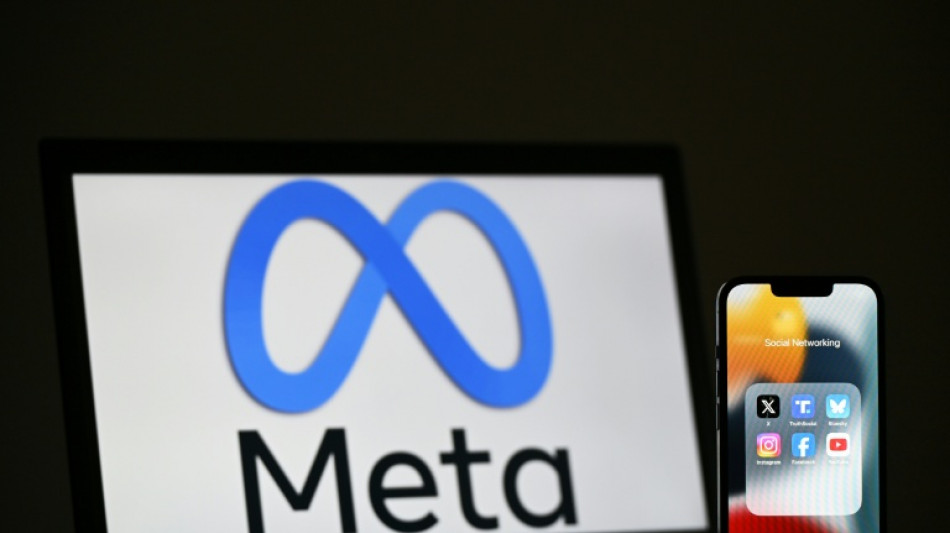
Meta wins major antitrust case as US judge rules no monopoly / Photo: © AFP

 Rubio touts US power, calls on Europe to emerge from 'slumber'

 Trump says 'we don't think' Russian plague is bio-weapon

 Five children among 26 killed in Ukraine after Russian strikes

 Man City should 'accept' punishment for rule breaches, says Lineker

 US woman who survived botched execution is awake and speaking

 From 1800s to modern pharma: a Nobel-winning chemistry quest

 Southampton boss Eckert given suspended ban over 'Spygate'
 Russia warns of 'false' information as second plague case reported

 IEA ready to release more oil reserves if necessary

 HSBC 'consults' over UK unit job cuts amid AI adoption
 UK court quashes five ex-traders' Libor rate rigging convictions

 XM Receives “Global Customer Experience Leader Award 2026” at the TrustFinance Performance Awards
 Stocks slide as oil climbs on Mideast flareup

 Heavy casualties in Ukraine after Russian strikes
 French wine harvest set to hit historic low

 Kyiv 'cannot agree' to EU membership limiting food exports: minister

 Arteta targets more Arsenal glory after signing new deal until 2030

 Russell hit with Singapore grid penalty for taking new power unit

 Spotify expands audiobooks to more than 180 markets

 French-Japanese duo wins chemistry Nobel for solving molecular 'mystery'

 England's Nations League surge helps heal World Cup wounds

 Mayor of opposition stronghold Izmir defects to Erdogan party

 Mertens beats Gauff to set up Swiatek clash at China Open

 Benin full of pride at role in Messi's last dance

 France suspends stun grenade use at student protests ahead of PM speech

A US judge dismissed the federal government's antitrust lawsuit against Meta on Tuesday, ruling that the tech giant's acquisition of Instagram and Whatsapp did not constitute an illegal monopoly in social media.
The ruling delivered a major victory to Meta after a five-year battle that began when the US agency filed suit claiming the company illegally maintained its monopoly by acquiring Instagram in 2012 and WhatsApp in 2014 to eliminate competitive threats.
Judge James Boasberg of the federal district court in Washington concluded that Meta faces sufficient competition from rivals TikTok and YouTube, preventing the company from exercising monopoly power in the social media market.
The FTC had argued that Facebook, Instagram, Snapchat and minor player MeWe competed in a distinct market of connecting friends and family that was separate from video entertainment platforms like TikTok and YouTube.
The US government argued that this hold on friends and family offered a unique ability to build out Meta products and rake in billions of dollars in profits every quarter.
But Boasberg found that distinction no longer holds in today's social media landscape.
"Meta holds no monopoly in the relevant market," the judge declared, noting that Facebook and Instagram have transformed in recent years to primarily show users short videos recommended by algorithms -- nearly identical to TikTok's core offering.
The court cited data that Americans now spend only 17 percent of their time on Facebook viewing content from friends, with that figure dropping to just seven percent on Instagram.
Instead, users predominantly watch "Reels" -- short videos from strangers recommended by AI.
"Facebook, Instagram, TikTok, and YouTube have thus evolved to have nearly identical main features," Boasberg wrote, citing evidence showing that users treat these platforms as substitutes.
Meta welcomed the judge's recognition that the company "faces fierce competition" and said it looked forward to working with the Trump administration "and to invest in America."
Ahead of the trial that began in April, Meta CEO and founder Mark Zuckerberg had made repeated visits to the White House as he tried to persuade President Donald Trump against allowing the FTC to fight the trial.
The trial did take place, with Zuckerberg and several top Meta executives brought to the stand.
- 'Intense competition' -
The ruling represents a setback for US antitrust enforcers who have pursued aggressive action against Big Tech companies, with mixed results in court.
As part of that push, the US government has launched five major cases against tech giants, including two against Google and suits against Apple and Amazon.
A different US judge in September rejected a government bid to break up Google, after the search engine juggernaut was found to have acted as an illegal monopoly.
The judge in that case was swayed by similar arguments that Google's hold on the search engine market was under threat by new actors -- ChatGPT and other AI upstarts in Google's case.
"Judge Boasberg correctly grasps how dynamic digital markets are," said Vidushi Dyall of the Chamber of Progress, a big tech lobby.
"Even large tech companies still face intense competition and...new players have disrupted the position of incumbents," Dyall wrote on X.
M.Ouellet--BTB