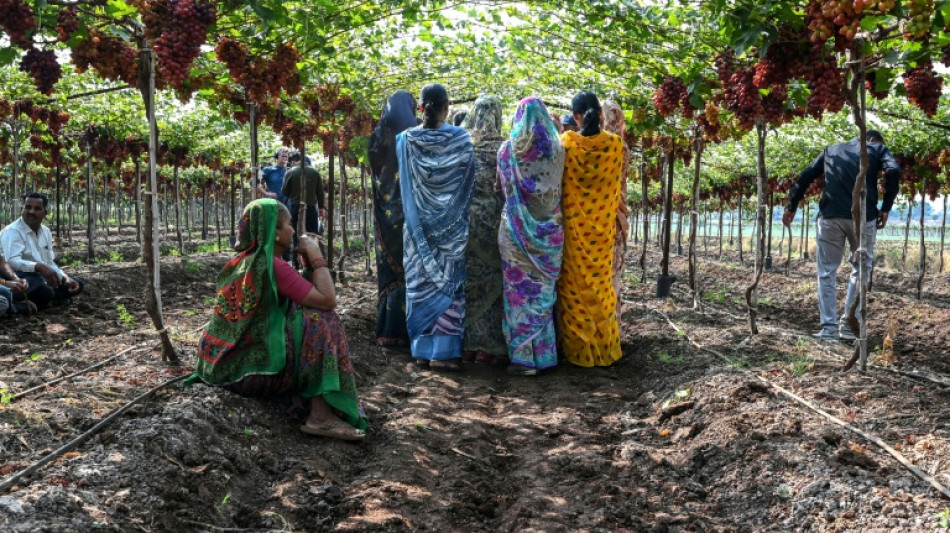
Struggling farmers find hope in India co-operative / Photo: © AFP

 FIFA chief Infantino hit by Norwegian double complaint

 Exiled Catalan separatist leader Puigdemont cleared to return to Spain

 Stock markets climb as oil prices retreat

 'No future': Thousands mass in France for high school protests

 Nobel physics prize honours work on 'ghostly messengers' from outer space

 Bulgaria searches for missing crew after drones hit two more ships in Black Sea

 Le Pen vows drastic cost savings to prevent French 'default'

 'Eats through a straw': French teens wounded in high school protests

 Thousands mass in France for high school protests

 Moscow denies sanitary measures over plague reports

 Samoa look to recreate 2022 final run at Rugby League World Cup

 Asian stocks mostly up after tech-led Wall St record

 German factory orders plunge as recovery still fragile

 Coco Gauff calls out online racism following China open video review

 KVB Accelerates Middle East Footprint with Strategic MENA Regional Expansion

 Purple reign: Philippines seeks to keep grip on ube throne

 Seoul weighs steps to force North Korea landmine apology

 Yemen's Houthis say struck Riyadh airport, other Saudi sites

 Changer+ Launches Stablecoin-First Self-Custodial Wallet to Make Stablecoins Easier to Use

 White Sox down Guardians, Yankees on brink after Rays loss

 COP31 eyes modest steps as climate disasters multiply

 American Nobel laureate in medicine hopes to illuminate the brain

 Trump approves firing squad for convicted US military base shooter

 Grappling with 'homework scams,' US universities shun AI detectors

 Separatists win Quebec election in test for Canada PM

Kiran Ramnath Waghchaurebeams as he plucks deep-red grapes from his vines in India's Maharashtra state, one of thousands of farmers reaping the benefits of a cooperative bringing hope to a long-suffering sector.
Agriculture is the backbone of India's rural-driven economy, employing more than 700 million people. But the industry has been mired in crisis for decades, with slow‑moving reforms and growing vulnerability to climate change.
Often burdened by debts and crop failure, more than 3,090 farmers killed themselves in Maharashtra between 2022 and 2024.
"This new variety is better suited to the climate," says Waghchaure, gesturing to the perfectly round, firm and sweet grapes that will soon be on European supermarket shelves thousands of kilometres away.
The 42‑year‑old credits Sahyadri Farms, a cooperative launched in 2011 by 110 small growers, which helps members cut costs and gain access to markets.
Today, Sahyadri Farms is India's leading exporter of grapes and a major supplier of tomatoes, mangoes and cashew nuts, processing 385,000 tonnes of produce last year.
More than 95 percent of its 30,000 members own less than a hectare of land.
- 'Compete internationally' -
"The biggest problem in Indian agriculture is the small size of farms," says Santosh Watpade, the cooperative's chief financial officer.
"A producer on his own cannot compete internationally. Joining forces is the only solution."
A trade deal with the United States announced this month angered Indian farmers' unions, who argued that a flood of cheap US imports would rob local producers of their livelihoods. It is not clear how the agreement would impact the cooperative.
"The farmer is at the centre of our model, which offers access to markets and long‑term profitability," Watpade told AFP.
Waghchaure used to tend a two-hectare vegetable plot before joining Sahyadri Farms in 2012.
He now manages six hectares of vineyards, employing 15 workers and cashing in 4.5 to 5 million rupees ($50,000-$55,000) profit per year.
"My income has been rising," Waghchaure says, his eyes lighting up.
The cooperative's origins go back to farmer Vilas Shinde, who realised that producers "can achieve so much more" by working together, after he repeatedly failed to export his grapes, Watpade told AFP.
"He invested his own capital and reinvested everything he earned."
Pankaj Nathe joined Sahyadri Farms in the cooperative's early days, and now heads agricultural research and certification, developing grape varieties more resilient to erratic weather.
Seedless white Thompson grapes for years dominated Indian vineyards, but shifting weather patterns, including unexpected rain at the start of this year, now cause the berries to burst, sometimes wiping out entire harvests.
- Cash injection -
"We started planting new varieties better adapted to climate extremes and foreign consumer demand," Nathe said.
The cooperative, which also trains farmers on curbing excessive use of fertilisers and pesticides, has expanded its operations with the help of external investment.
Diane Jegam, South Asia director at Proparco -- a subsidiary of the French Development Agency (AFD) -- fell in love with the project during a visit to Sahyadri in 2022.
Later that year, Proparco joined a pool of investors who injected nearly $40 million into the cooperative.
The funds helped expand export markets, diversify crops, and finance a biogas plant and a microalgae facility for water recycling.
Around 6,500 staff -- 40 percent of whom are women -- sort, process and package fruits and vegetables in vast warehouses every day thanks to Proparco funds.
"It's an investment perfectly aligned with our goals -- protecting the planet and reducing inequalities by integrating smallholders and supporting farmer‑led enterprises," Jegam told AFP.
The cash has "accelerated everything," Watpade said.
"Ensuring a decent income for farmers will help curb problems like suicide and ensure that the next generation stays in agriculture."
E.Schubert--BTB