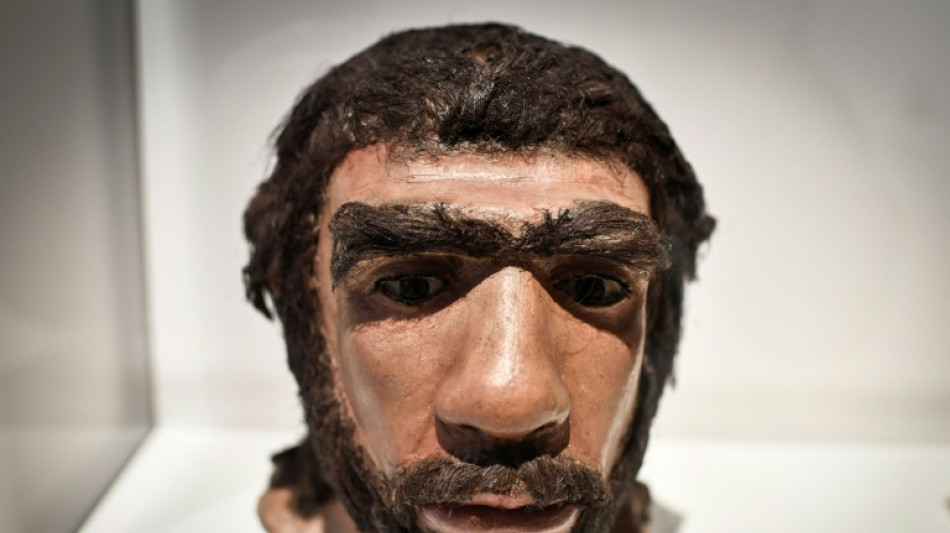
The sex lives of Neanderthal males - and human females / Photo: © AFP

 Kenya reports first-ever Ebola death

 Tennis world No.1 Sinner's season over due to knee injury

 Yemen's Houthis claim attack on Riyadh airport, deny losing territory

 7-Eleven exits India amid mounting competition

 The alleged murder by US marine on Okinawa: five things to know

 End of an era as Messi prepares to hang up Argentina boots

 Superstar duo headline strong New Zealand squad for Rugby League World Cup

 South Korea warns of possible AI use in banking hacks

 EU vows AI rules will protect Europeans. Will they?

 Myanmar leader to visit Malaysia after migrant returns begin

 Germany's AfD poised to preside over state assembly for first time

 Australia's opposition vows 'largest cut to immigration' in country's history

 Ready, set, snooze: Sleep-deprived Japanese compete for best-rested

 Falcons thump Saints 45-24 as New Orleans marks Katrina anniversary

 Tuvalu govt adviser says Australia overstepped in pre-COP visit

 Asian stocks mixed despite tech-led Wall St record
 Tens of thousands expected in Paris for high school protests

 AI borrowing binge rattles US markets

 Young Canadians sue government over alleged climate failures

 White Sox down Guardians to take 2-0 series lead

 NHL record-breaker Ovechkin says current season will be his last

 France roar back in Nations League as Italy beat Turkey

 Messi readies for final farewell in Argentina send-off

 Esposito seals Italy win over Turkey in Nations League

 Russia downplays plague reports as Trump offers US help

Dating out of your league? New research says it's a tale as old as time.
A study out Thursday in Science argues that Neanderthal men and human women were particularly inclined to mate, a sexual habit that offers insight into the evolution of the modern human genome.
In 2010 scientists reconstructed the Neanderthal genome -- blockbuster research that allowed for analysis making clear that the species interbred.
Most people living today have some residual fragments of DNA from our ancient evolutionary cousins.
Research indicates both groups descended from a population living in Africa some million years ago.
They eventually diverged, with anatomically modern humans evolving in Africa, and Neanderthals migrating across Eurasia.
But over hundreds of millenia, human migrations resulted in interbreeding, researchers say.
Yet humans have little to no Neanderthal DNA on our X chromosomes -- one of two human chromosomes that determines an embryo's sex.
That was assumed to be the result of a natural selection.
The genes were biologically "toxic" to humans, researchers hypothesized, and eventually purged out -- in essence, the children who inherited those traits might not have lived to pass them on.
But the new study from geneticists at the University of Pennsylvania suggests the phenomenon has more social origins, and were actually the result of "long-standing mating preferences."
The team analyzed modern human DNA preserved in Neanderthals, and found an abundance on the X chromosome -- the mirror opposite of humans.
That result allowed them to rule out that reproduction between the species was incompatible.
Instead the gene flow "occurred predominantly between Neanderthal males and anatomically modern human females," said Alexander Platt, a senior research scientist on the study.
Since females have two X chromosomes and males just one, the math adds up: If Neanderthal males and modern human females were mating, more Neanderthal X chromosomes would enter the human gene pool, and vice versa.
Researchers said that sex-biased migration could also offer clues. But ancient mating habits "provided the simplest explanation," Platt said.
The larger "why" is unknown: Neanderthal men and modern human women might have been mating by choice, or violence and coercion could have been involved.
Researchers say they now hope to analyze the development of this mating pattern.
Possibilities include probing gender dynamics within Neanderthal society, or migration habits -- perhaps males were likely to leave their societies while females stayed with their families, for example.
O.Krause--BTB