Vietnam AI law takes effect, first in Southeast Asia / Photo: © AFP

 Spain PM calls early election after housing crisis defeat

 Stocks rally as 'Goldilocks' jobs data ease rate fears

 Myanmar says 10,000 migrants returned from Malaysia this year

 Big guns back for Australia's Rugby League World Cup defence

 Braves rock Dodgers to level series, Brewers win thriller

 Most Asia stocks rally as 'Goldilocks' jobs data ease rate fears

 Sunken Silk Road city reveals Central Asia's lost history

 Three years on, Israeli rescuer cannot escape October 7

 Research into weight-loss drugs tipped for Nobel as award week opens

 US Supreme Court hears bid to shut the door on climate suits

 Chourio walk-off single lifts Brewers over Padres

 Flavio Bolsonaro leads Lula in near-done Brazil vote count

 Flavio Bolsonaro leads Lula in partial Brazil poll results

 Titan FX Launches Second “Dream Beyond Borders 2.0” Brand Commercial Featuring Keisuke Honda

 Patriots inflict first Bills defeat as Rams surge late

 Brazil's Indigenous back Lula as El Nino fuels forest fires

 Brazil braces for results of election battle between Lula and Bolsonaro

 Indians protest election chief ahead of top court hearing

 'Verity' kills, Cruise bombs in N. American movie theaters

 Colts top Commanders in NFL London game

 Hundreds of schools to shut Monday as student protests rock France

 Three previous two-time Arc de Triomphe winners

 'Champion' Daryz wins second successive Arc in fine style

 Daryz wins second successive Prix de l'Arc de Triomphe

 England's seven-goal spree sends message to Euro rivals: Kane

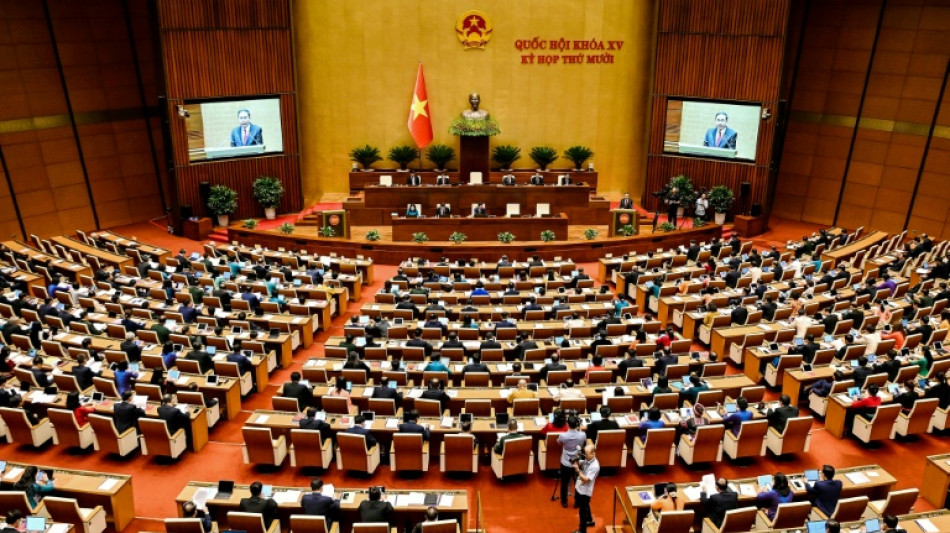
A law regulating artificial intelligence went into effect in Vietnam on Sunday, making it the first country in Southeast Asia with a comprehensive framework on the booming technology.
Passed by the National Assembly in December, the law focuses on the risks posed by generative AI, requiring human oversight and control along the lines of the European Union's landmark AI Act.
Many nations are moving to address the dangers of chatbots and image generators -- from misinformation to online abuse and copyright violations -- but few have enacted legislation.
The legislation, which is in force as of March 1, "paves the way for Vietnam to deeply integrate with international standards while maintaining digital sovereignty", the government said in a December report.
It requires companies to clearly label AI-generated content such as deepfakes that cannot readily be differentiated from reality.
It also requires them to disclose to customers when they are interacting with an artificial rather than human agent.
The law applies to developers as well as providers and deployers of the technology, whether they are Vietnamese organisations or foreign entities operating in the country.
Vietnam has set ambitious double-digit growth targets for the next five years, with expansion of the digital economy a key part of its development strategy.
AI and the data economy are "pillars" of a "more sustainable and smarter new development" model, Prime Minister Pham Minh Chinh was quoted as saying Wednesday on the government's website.
Under the law, the government will establish a national AI computing centre, improved data resources and large language models in Vietnamese.
- 'Not the final word' -
So far only a handful of countries have implemented far-reaching regulatory frameworks on AI.
The United States has opposed what Vice President JD Vance called "excessive regulation", warning it could stifle innovation in the key sector.
In January, South Korea became the first country to have an AI law take full effect, while the European Union is gradually phasing in a set of rules that will become completely applicable in 2027.
While Vietnam's law is a regulatory milestone, analysts said its impact would depend on how the government enforces it and on what guidance it issues on implementation.
The law is "not the final word" but rather a "decisive starting point", Vietnam-based LNT & Partners law firm said in an analysis on its website.
"It establishes responsibility, human control, and risk management as the governing themes of AI regulation," the firm said.
However, it added, "the true impact will depend on implementing decrees, sectoral regulations, and enforcement practice".
Patrick Keil, senior legal adviser at law firm DFDL, called the law "a significant statement of national ambition" but told AFP businesses will continue to face some uncertainty about their obligations until the government issues further guidance.
At an AI summit hosted by New Delhi in February, 91 countries and international organisations called for "secure, trustworthy and robust" AI.
But their declaration, signed by the United States and China, was criticised by AI safety campaigners for being too generic to protect the public.
J.Bergmann--BTB