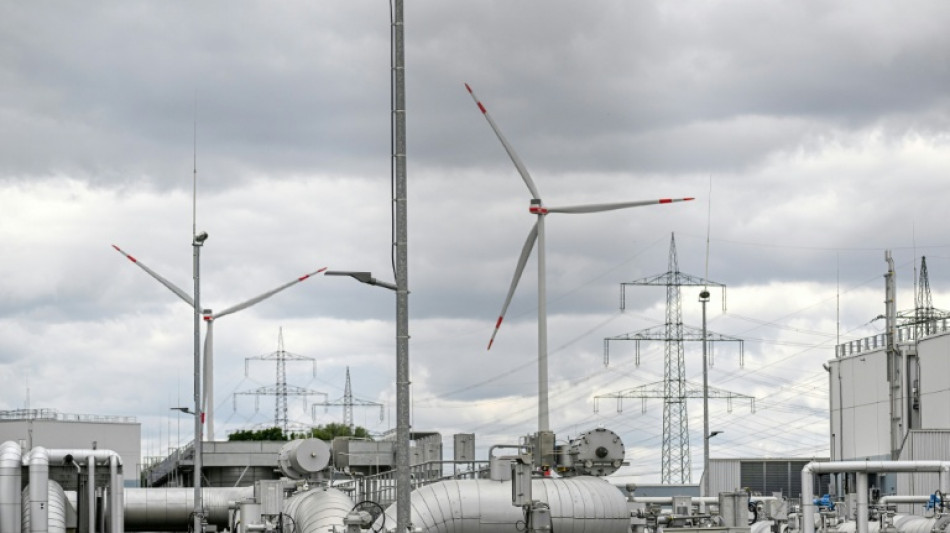
Soaring gas prices spark renewed debate about European electricity / Photo: © AFP/File

 Zuckerberg skewered again on screen in 'The Social Reckoning'

 Fiji urges 'just' climate transition, financing at pre-COP gathering

 Thailand's Jeeno overcomes late wobble to win Lotte Championship

 Brazil heads to run-off as Bolsonaro pulls off shock first place finish over Lula

 EU, China to hold Beijing talks to avert trade war
 Bolsonaro edges past Lula as nail-biter Brazil vote goes to a run-off

 Rubio visits Iceland as US boosts Arctic presence

 Bolsonaro leads Lula as nail-biter Brazil vote goes to a run-off

 Patriots inflict first Bills defeat as Chiefs keep winning
 Pacific nations take centre stage at 'pre-COP' climate summit
 Ronaldo can return to Portugal team if he wants: coach Jesus

 Portugal move into Nations League knockout stage, Germany held

 Ronaldo-less Portugal beat Norway to reach Nations League quarters

 Bosnian Serb strongman claims election win, thanks Trump and Putin
 Israel wear black armbands in Ireland tie over Hamas attack

 'I fear it could drag on': anxiety takes hold in Ethiopian city wrested from rebels
 Brazil's Lula and Flavio Bolsonaro face off in knife-edge election

 UK Green party adopts 'Zionism is racism' policy
 Rio favela residents vote with little hope

 Evenepoel puts worlds 'disappointment' to bed with European crown

 Two-time winning Arc trainer Rouget bows out in emotional farewell

 Battling Djokovic stuns top seed Zverev at China Open

 Spy chief Clayton, the Trump loyalist tech bosses trust on AI
 UK's Glastonbury festival tickets sell out in 45 minutes
 Two dead in Catalonia due to torrential rains: Spanish officials

A surge in natural gas prices since the Middle East war erupted has sparked renewed debate about Europe's electricity market, where prices are still linked to gas.
Industrial firms and countries like Italy are already calling for reform ahead of an EU summit on competitiveness on March 19.
The effective closure of the Strait of Hormuz as the United States and Israel pound Iran with air strikes and Tehran's retaliatory strikes on Gulf states have again highlighted Europe's dependence on imported energy.
European industry has long been crying out for lower electricity prices to help them meet competition from Asia and North America.
The impact of the war on fossil fuel prices "confirms the need to support the electrification of industrial processes even more," the Uniden trade association which represents France’s energy-intensive industrial companies said this week.
The European Union has sought to reduce dependence on imported oil and gas and should present a plan in May to speed up a shift to electricity.
France also aims to present a plan in the coming months to support electric cars, heat pumps and electric furnaces in industry.
The Middle East war "brutally reminds us of our vulnerability to the volatility of fossil fuel markets" and reinforce the need to speed up electrification of the economy, said France's ecological transition minister Monique Barbut.
Except that "in Europe, the price of electricity is still largely determined by that of gas," noted Marc Sanchez, head of the SDI trade association that represents small and medium-sized businesses in France.
In Europe the price of electricity is determined by the production costs of the last power plant called upon to meet demand.
That can be cheaper renewable or nuclear plants when demand is low. But gas power stations can be brought online and shut down quickly, thus making them very useful to meet peak demand for electricity.
"This system can lead to higher electricity prices, including in countries like France, where a large share of production is based on decarbonized, competitive sources," said the SDI.
- Dependence upon imported gas-
After getting burned by a spike in gas prices following Russia's 2022 invasion of Ukraine, the European Union adopted a reform in 2024 following heated debate between industry, governments and political parties.
One objective was to protect the electricity market from the volatility of fossil fuel prices.
Current electricity costs are far from the dizzying prices reached in 2022.
Gas price rises have been limited. Equally important, many French nuclear power plants were undergoing repairs in 2022, boosting the need for gas-fired power plants.
Today, "nuclear power is running well" and "cushioning exposure to gas," said Emeric de Vigan, an energy market expert, in comments published on his LinkedIn account.
Nevertheless, "the surge in gas prices has had an impact on French electricity" prices, said Jean-Paul Aghetti, head of Exeltium, a consortium which buys electricity for large French industrial consumers, told AFP.
And electricity prices depend more heavily upon gas in Germany, Italy and Austria than in France, Spain or Portugal, which all rely more upon renewables and nuclear.
Even if EU nations invest heavily in low-cost renewable electricity generation it won't eliminate the need for peak production capacity.
The European Steel Association noted that industrial customers often still paid electricity prices linked to gas prices, and called for a new reform.
"Structurally higher wholesale prices, caused by the EU dependency on expensive, imported gas, combined with significant volatility, are producing negative effects that cannot be ignored," is said.
Not all EU countries want another reform.
Seven countries including Denmark, Luxembourg, the Netherlands, Portugal and Sweden have urged the European Commission to leave the current system alone.
They believe Europe's dependence upon imported gas is the reason why energy costs are higher than in other regions of the world, not the structure of the electricity market.
Even before the outbreak of the war, several federations representing energy-intensive industries had argued that ensuring competitive energy prices was key to Europe's reindustrialisation.
"Electrification can only be deployed on a large scale if electricity is affordable and predictable," said Nicola Rega, head of climate change and energy at Cefic, the trade association for the EU chemical industry.
G.Schulte--BTB