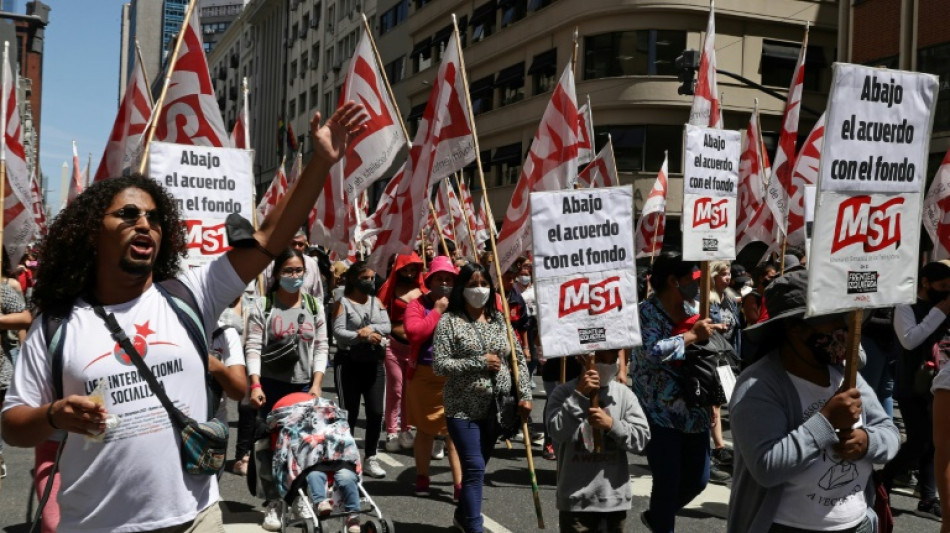
Thousands protest Argentina's debt deal with IMF / Photo: ©

 Prague’s Concert for the Future Kicks Off on Wenceslas Square

 Prince William and Princess of Wales to Announce Earthshot Prize Winners in Mumbai

 Indonesia Forest Fires: Health Crisis, Diplomatic Strains and the Search for Solutions

 BYD Dolphin G Leasing Deal: Plug-in Hybrid Supermini Available from £174 a Month

 JUEL Group Expands from Real Estate to Hospitality with Hyatt Centric Malta Opening

 French Economy Shrinks 0.1% as Consumer Confidence Slumps

 Wall Street Ends Turbulent Week Higher Despite Inflation and AI Jitters
Several thousand protesters marched in Buenos Aires on Tuesday to denounce the agreement reached between the government of centre-left President Alberto Fernandez and the IMF on the repayment of a $44 billion loan.
Activists from about 200 movements and associations gathered in front of the Casa Rosada, the pink governmental palace.
The Fernandez government must "remember Argentine history: all the agreements with the IMF since 1983 have brought chaos, ended in (structural) adjustments, hyperinflation and huge social crises," Myriam Bregman, a deputy from the Left and Workers' Front (FIT), told AFP.
The government "must prove why it would be different" this time, she added.
On January 28, the Argentine president announced a new repayment deal with the International Monetary Fund of a $44 billion loan granted in 2018 to the government of his predecessor, Mauricio Macri.
Under the new deal, Argentina has committed to progressively reducing its fiscal deficit from three percent in 2021 to just 0.9 percent in 2024.
According to the government, the agreement will not affect social spending or economic growth.
The deal "has nothing to do with the needs of the Argentine people, but with an illegitimate and unpayable debt," said Vilma Ripoll, another FIT leader.
The agreement still has to be ratified by Congress, where the ruling coalition has the largest group, but does not have a majority.
The government hopes to define the terms of the new financing program before the March 22 deadline, when $2.85 billion must be repaid by Argentina, which cannot afford it, according to Economy Minister Martin Guzman.
After three years of recession, the last two of which were linked to the impact of the Covid-19 pandemic, the Argentine economy saw a strong rebound in 2021, with 10.3 percent growth for the first eleven months of the year.
But inflation remains very high. In 2021 it was around 50.9 percent, while it is forecast to be 33 percent in 2022.
Poverty also remains high, affecting 40 percent of the population.
O.Lorenz--BTB