Cuba factory that rolled Castro's cigars still strives for 'the perfect puff' / Photo: © AFP

 Chip industry activists call for South Korea to recognise cancer cases

 Famine-scarred southern Madagascar braces for El Nino
 How the EU regulates lobbyists
 I.Coast refuge offers lifelong care for youngsters scorned as 'sorcerers'
 Indian central bank hikes rates for first time in more than 3 years
 Hotel Blacklist Launches New Accommodation Industry Risk Assessment Tool

 Bangladesh nuclear plant draws hope -- and worry

 US beat Canada 1-0 to wrap up four-win international break

 Turkey, Australia's joint COP31 leadership raises doubts

 For Turkish NGOs, COP31 offers rare space for action
 Sleep, appetite, gene-editing experts contend for Nobel chemistry prize
 Nobel Peace Prize haunted by the 'spectre' of Trump

 Africa launches own credit agency in bid for cheaper borrowing

 US, China, EU: three paths to regulating AI
 Australia's High Court rules against coal mine in landmark climate case
 Australia touts new funds for Pacific infrastructure at Fiji 'pre-COP'

 Eva Marie Saint, Oscar winner of Hollywood classics, dies at 102

 Australia probes app used in cheap smart glasses over privacy fears
 England needed to 'move on' from World Cup pain, says Tuchel

 O'Neill to stay at Celtic after period of "reflection"

 Kane marks 125th England cap with Wembley Nations League double

 Quebec's incoming separatist leader wants to block Crown from swearing-in
 Emmys gala will now stream its premier television awards
 Paramount completes Warner Bros takeover, creating Skydance

 Trump blames France unrest on Islam, migration
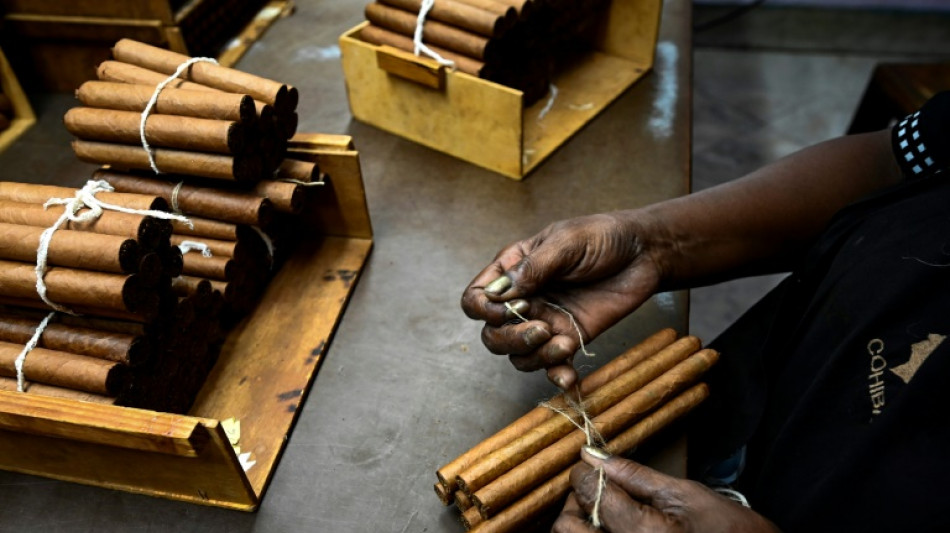
Seated before a machine that checks cigar quality, Orquidea Gonzalez says she is proud to carry on the craft's tradition and contribute to an export industry that has grown during the pandemic.
"I love making cigars. This is where I've spent my life, and it's an art. Not everyone knows how to make cigars, like not everyone knows how to paint a picture," said the 55-year-old factory worker.
Her job is to measure in a metal tube the draw of each cigar to ensure that the smoker gets the perfect puff.
"If it's less than 40, the (suction) level is excessive; if it's more than 80, it's too low," she explained, her eyes glued to the machine's needle.
The El Laguito factory opened in 1966 in western Havana to make the cigars favored by the hero of the 1959 Communist revolution and longtime president Fidel Castro.
The factory is the birthplace of Cohiba cigars, Cuba's most prestigious brand. The name recalls the way the native Taino people referred to the rolled tobacco leaves they smoked.
Rolling one's own leaves is a tradition that endures among farmers in the western province of Pinar del Rio, where most Cuban tobacco farms are located.
- Flavor -
Castro's favorite cigar, the Cohiba Lancero, which he smoked until he quit in 1985 at the age of 59, is still produced in the factory.
"Despite all the difficulties we face," the goal is to manufacture "nearly two million" cigars in 2022, or roughly 9,000 a day, said factory head Oscar Rodriguez.
Despite the coronavirus pandemic, Cuban cigar exports grew by 15 percent in 2021, totaling $568 million, according to Habanos S.A., which includes all national brands. That constitutes a significant boon for the Cuban economy, which is in the grips of its worst crisis in 30 years, with daily shortages and power cuts.
The factory "did not stop for a single day" during the pandemic, eventually making cigars "the country's second-largest export," Rodriguez said.
Spain, China, Germany, France and Switzerland are among the top buyers.
Expertly handling curved blades and a sticky substance, dozens of workers put the finishing touches on the ends of newly rolled cigars.
Some 60 percent of the workers are women -- following a tradition at the factory founded by Castro's comrade-in-arms Celia Sanchez -- that aims to give opportunities to single mothers or women in difficulty.
Another founder, Norma Fernandez, who died during the pandemic, rolled the cigars for the leader of the revolution.
"It was a privilege to be able to say, 'I made the president's cigars,'" said Orquidea Gonzalez, hard at work at the factory, which is housed in an elegant 1950s villa.
Caridad Mesa, now 55, started working at El Laguito as a cleaning lady. Thirty years later, she is in charge of spotting the smallest defects in the cigars.
It is necessary to control "the quality, the weight, the length... the thickness," she said, scrutinizing boxes brimming with cigars under a large portrait of Communist revolutionary icon Ernesto "Che" Guevara.
Cohiba cigars, which include a wide range of styles, can cost $30 to $200 each, both in Cuba and abroad.
"Cuban tobacco is distinguished from all other kinds by the flavor of the land of Pinar del Rio," said Gonzalez.
It is there, she added, "where the best tobacco crops are grown."
M.Furrer--BTB