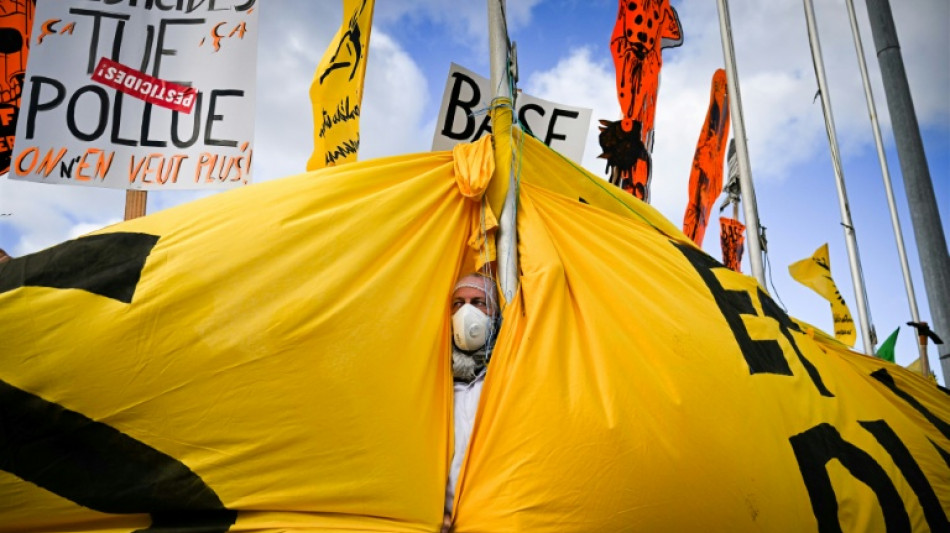
Fierce lobbying in EU over 'forever chemicals' / Photo: © AFP/File

 Chip industry activists call for South Korea to recognise cancer cases

 Famine-scarred southern Madagascar braces for El Nino
 How the EU regulates lobbyists
 I.Coast refuge offers lifelong care for youngsters scorned as 'sorcerers'

 Indian central bank hikes rates for first time in more than 3 years

 Hotel Blacklist Launches New Accommodation Industry Risk Assessment Tool

 Bangladesh nuclear plant draws hope -- and worry

 US beat Canada 1-0 to wrap up four-win international break

 Turkey, Australia's joint COP31 leadership raises doubts

 For Turkish NGOs, COP31 offers rare space for action

 Sleep, appetite, gene-editing experts contend for Nobel chemistry prize
 Nobel Peace Prize haunted by the 'spectre' of Trump

 Africa launches own credit agency in bid for cheaper borrowing

 US, China, EU: three paths to regulating AI

 Australia's High Court rules against coal mine in landmark climate case

 Australia touts new funds for Pacific infrastructure at Fiji 'pre-COP'

 Eva Marie Saint, Oscar winner of Hollywood classics, dies at 102

 Australia probes app used in cheap smart glasses over privacy fears

 England needed to 'move on' from World Cup pain, says Tuchel

 O'Neill to stay at Celtic after period of "reflection"

 Kane marks 125th England cap with Wembley Nations League double

 Quebec's incoming separatist leader wants to block Crown from swearing-in

 Emmys gala will now stream its premier television awards

 Paramount completes Warner Bros takeover, creating Skydance

 Trump blames France unrest on Islam, migration

The European Union is under pressure to ban "forever chemicals" but a battle is heating up over the toxic substances known as PFAS in Brussels, where industry groups are seeking as many exemptions as possible.
"It is by far the biggest file I've handled in the past five years," said lobbyist Simon Terwagne of consultancy Forward Global, which represents clients from the chemical industry.
"Reducing exposure to PFAS is a sensible goal, but it must be done in the most measured and proportionate way possible," he said.
Such chemicals are found everywhere in daily life, from cosmetics to kitchen utensils, food packaging to toilet paper. Per- and polyfluoroalkyl substances (PFAS) are synthetic chemicals that take an extremely long time to break down.
Businesses use PFAS because of their non-stick, waterproofing and heat-resistant properties despite the environmental and health risks.
The chemicals have been linked to higher cholesterol levels, cancer, and adverse effects on fertility and fetal development.
The EU has vowed to ban PFAS in everyday consumer products, like clothing and pizza boxes, while allowing exemptions for sectors considered critical -- particularly defence and healthcare.
But before pulling the trigger on the proposal expected in early 2027, the European Commission is waiting for one final report from the European Chemicals Agency (ECHA), expected by December.
- 'Growing risks' -
The agency in March warned PFAS chemicals "pose growing risks to people and the environment", calling for a broad ban on their use across the bloc with some exceptions when there is no alternative.
And industry groups have been pulling out all the stops.
"Where industry was quite clever is to actually start lobbying at the political phase, even before having the ECA's opinion," Tatiana Santos of Brussels-based NGO European Environmental Bureau said.
"So they were already pre-empting narratives," including spreading false notions that there were no alternatives to PFAS, she said.
As early as March, Europe's pharmaceutical industry lobby EFPIA warned companies would move their production abroad unless there were "clear and durable derogations for medicines" in the draft rules.
"PFAS materials are essential for manufacturing processes," EFPIA said.
Such threats of businesses moving away from Europe will be taken seriously as Brussels seeks to boost the bloc's critical industries.
- Headache -
Spectaris, the German lobby group for the optics, photonics and medical technology industries, is one of the biggest opponents of a blanket EU ban.
The group defends the use of fluoropolymers, at the centre of the lobbying battle, a key material in medical devices and other high-tech equipment.
The planned law is already becoming a major headache for policymakers as there are thousands of PFAS chemicals used in a wide array of items, from aerospace to components used in solar panels and cars.
"The restriction proposal is of unprecedented scope and ambition," the commission said, since it covers 10,000 individual substances.
It "is of unparalleled complexity, covering many sectors" which has "prompted high stakeholder involvement", it added.
EU environment chief Jessika Roswall has acknowledged the difficult discussions over products that are not sold directly to consumers.
"It all comes down to risk assessment. There is plenty of middle ground between doing nothing and a full ban," lobbyist Terwagne said.
"There is significant room to manoeuvre," he added.
Environmental defenders fear the proposal will fall victim to the increasingly pro-business turn over the past two years in the EU.
Facing intense competition from China and the United States, Europe doesn't want to burden industries further.
- PFAS in blood tests -
The EU executive has in recent months created the Critical Chemicals Alliance, which will unveil on Thursday a list of chemicals critical to the EU economy.
The European Environmental Bureau (EEB) walked away from the alliance, fearing it would weaken EU chemical rules and the future PFAS law.
Environmental groups have upped their efforts to raise awareness of the dangers, especially in Belgium and France where the contamination of water and soil by PFAS has sparked public outrage.
Such organisations also point out the difference in their financial means: the EEB has a lobbying budget of 8.7 million euros compared with 47.3 million euros for EU chemicals lobby CEFIC, according to official data.
Green EU lawmakers who support a broad ban last week released the results of blood tests on 110 volunteers in nine European countries which showed the toxic substances detected in every participant.
Around a quarter of them had levels slightly above what is deemed safe.
Y.Bouchard--BTB