Hunger returns to haunt Brazil amid divisive vote / Photo: © AFP

 Chip industry activists call for South Korea to recognise cancer cases

 Famine-scarred southern Madagascar braces for El Nino
 How the EU regulates lobbyists
 I.Coast refuge offers lifelong care for youngsters scorned as 'sorcerers'

 Indian central bank hikes rates for first time in more than 3 years
 Hotel Blacklist Launches New Accommodation Industry Risk Assessment Tool

 Bangladesh nuclear plant draws hope -- and worry

 US beat Canada 1-0 to wrap up four-win international break

 Turkey, Australia's joint COP31 leadership raises doubts

 For Turkish NGOs, COP31 offers rare space for action

 Sleep, appetite, gene-editing experts contend for Nobel chemistry prize

 Nobel Peace Prize haunted by the 'spectre' of Trump

 Africa launches own credit agency in bid for cheaper borrowing

 US, China, EU: three paths to regulating AI
 Australia's High Court rules against coal mine in landmark climate case

 Australia touts new funds for Pacific infrastructure at Fiji 'pre-COP'

 Eva Marie Saint, Oscar winner of Hollywood classics, dies at 102

 Australia probes app used in cheap smart glasses over privacy fears

 England needed to 'move on' from World Cup pain, says Tuchel

 O'Neill to stay at Celtic after period of "reflection"

 Kane marks 125th England cap with Wembley Nations League double

 Quebec's incoming separatist leader wants to block Crown from swearing-in

 Emmys gala will now stream its premier television awards

 Paramount completes Warner Bros takeover, creating Skydance

 Trump blames France unrest on Islam, migration

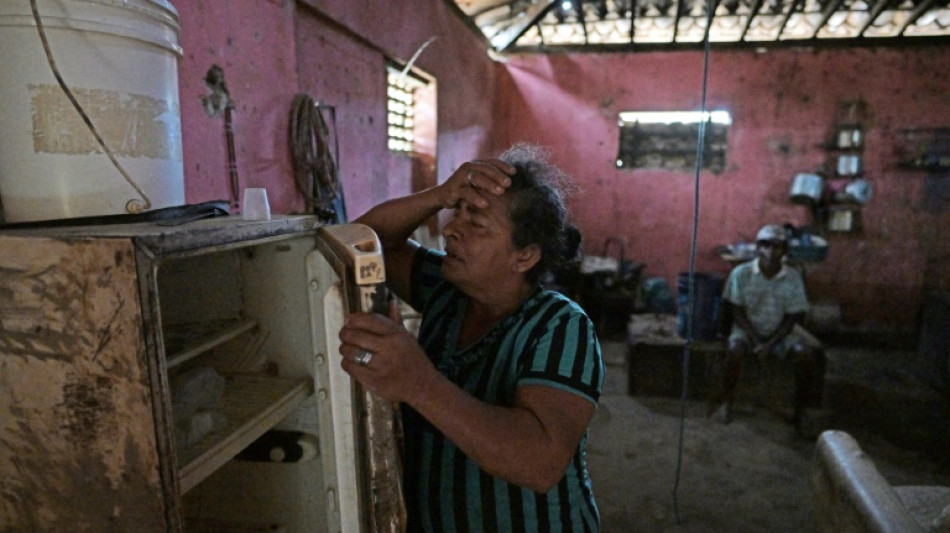
In a small cement house crumbling to ruins in Brazil's parched Sertao region, Maria da Silva, a graying matriarch struggling to feed her family, opens her empty refrigerator and breaks down in sobs.
The 58-year-old widow, whose creased brown face betrays her burdens, lost her family's main breadwinner when her brother, who worked in Sao Paulo, died of Covid-19 last year.
Now she and her family of eight, who are squatting in an abandoned shack, are among the 33.1 million Brazilians living in hunger.
The figure -- a 73-percent increase in the past two years, according to the Brazilian Network for Research on Food Security -- has become the subject of a bitter political battle as Latin America's biggest economy heads for elections on October 2.
Holding a nearly empty can of powdered milk for the three young grandchildren who live with her, ages three, two and 15 months, Da Silva gives a tour of her dilapidated house, which has no bathroom or running water.
"There are times when (the children) ask for food and I don't even have a biscuit or bread to give them," she says through tears on the small plot of land the family farms in Poco da Cruz, in the northeastern state of Pernambuco.
Soaring food prices have forced the family to turn to begging, she says.
"I just pray to God to end my suffering."
The presidential front-runner, leftist ex-president Luiz Inacio Lula da Silva, regularly attacks far-right incumbent Jair Bolsonaro over the fact Brazil reappeared on the World Food Programme's "Hunger Map" last year, with 28.9 percent of the population living in "moderate or severe food insecurity."
It is a major setback for a country that had been removed from the map in 2014, after an economic boom and landmark social programs helped lift 30 million people from poverty during Lula's administration (2003-2010).
Bolsonaro has aggressively counter-attacked, accusing Lula of bankrupting Brazil with corruption.
Courting low-income voters, the incumbent has upscaled and rebranded Lula's signature welfare program, and is campaigning extensively in the impoverished northeast, home to a quarter of Brazil's 213 million people.
- Hard-won gains -
Sprawled across the northeastern interior, the Sertao, or hinterland, is a semi-arid expanse of brown-and-olive-green scrubland.
Known for cyclical droughts, it is a harsh but beautiful land with an outsize role in Brazilian literature, music and film.
Each generation here remembers its worst drought -- 1960, 1993, 2010 -- and the misery it caused.
Joao Alfredo de Souza, a community leader in the rural township of Conceicao das Crioulas, weathered all those.
"It cost us a lot of sweat and tears to overcome," says De Souza, a spry 63-year-old who heads a community founded by ex-slaves in the 18th century.
Gesturing from his front porch to a paved street lined with neat, trim houses, De Souza describes Lula's time in office as a watershed of ambitious programs promoting housing, electricity, water, welfare, education and "Zero Hunger."
But the retired farmer says times have been "very tough" since Covid-19 hit Brazil, killing 680,000 people and triggering an economic implosion followed by soaring inflation.
He says Bolsonaro has won some northeasterners' support by super-sizing Lula's "Family Stipend" welfare program -- rebranded "Auxilio Brasil."
Bolsonaro recently tripled the average payment from Lula's day, to 600 reais ($115) a month, and is now pledging to increase it to 800 reais.
De Souza is unimpressed by the election-year spending spree.
"Why is he doing this only now? It's shameful," he says.
He says Lula, a Pernambuco native, "understands the northeast," where he leads in the polls in every state.
"He's one of us."
- 'Africa of Brazil' -
A half-hour drive away down a bone-jarring dirt road, in Regiao de Queimadas, a settlement still dotted with traditional mud-and-stick houses, signs of progress are harder to find.
A team of officials in four-by-four trucks from the federal government's National Health Foundation is going door-to-door asking whether people have bathrooms.
Many don't.
"This place is the Africa of Brazil," says one of the officials, reflecting a widespread perception of the region among government bureaucrats in Brazil.
The program's ostensible goal is to build adequate facilities for those who need them.
The head of the local farmers' association, Edineia de Souza, is skeptical.
"These guys only come around at election time," says the 40-year-old corn and bean farmer.
"We're still waiting on the bathrooms from last time."
De Souza, who helps organize food donations for needy families with a grass-roots charity called Amigos no Sertao, hopes things will change if Lula wins.
"When he was in office, projects got done," she says.
But she doesn't place much faith in politics.
"Politicians never even come here," she says.
N.Fournier--BTB