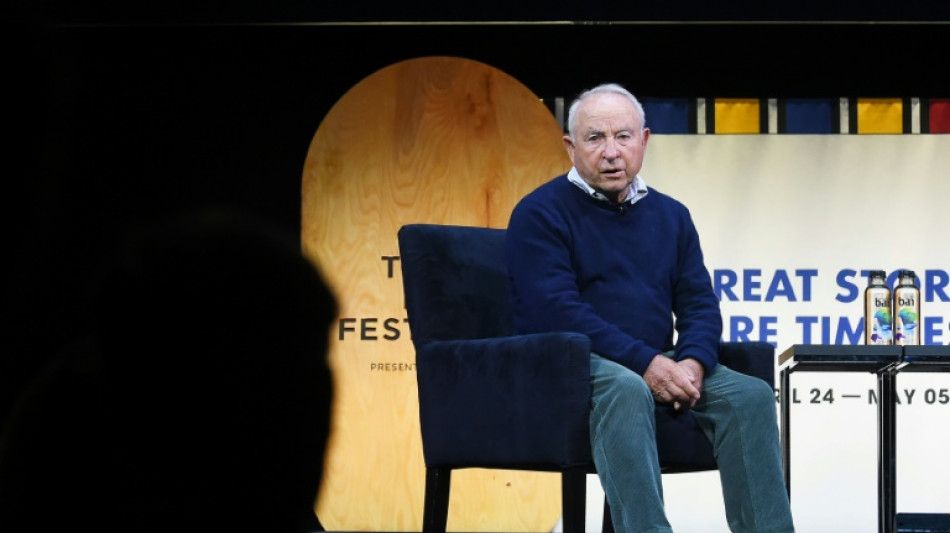
Patagonia founder Yvon Chouinard, the reluctant businessman / Photo: © GETTY IMAGES NORTH AMERICA/AFP/File

 Chip industry activists call for South Korea to recognise cancer cases

 Famine-scarred southern Madagascar braces for El Nino

 How the EU regulates lobbyists
 I.Coast refuge offers lifelong care for youngsters scorned as 'sorcerers'

 Indian central bank hikes rates for first time in more than 3 years

 Hotel Blacklist Launches New Accommodation Industry Risk Assessment Tool
 Bangladesh nuclear plant draws hope -- and worry

 US beat Canada 1-0 to wrap up four-win international break
 Turkey, Australia's joint COP31 leadership raises doubts
 For Turkish NGOs, COP31 offers rare space for action
 Sleep, appetite, gene-editing experts contend for Nobel chemistry prize
 Nobel Peace Prize haunted by the 'spectre' of Trump

 Africa launches own credit agency in bid for cheaper borrowing

 US, China, EU: three paths to regulating AI
 Australia's High Court rules against coal mine in landmark climate case
 Australia touts new funds for Pacific infrastructure at Fiji 'pre-COP'

 Eva Marie Saint, Oscar winner of Hollywood classics, dies at 102
 Australia probes app used in cheap smart glasses over privacy fears
 England needed to 'move on' from World Cup pain, says Tuchel

 O'Neill to stay at Celtic after period of "reflection"

 Kane marks 125th England cap with Wembley Nations League double
 Quebec's incoming separatist leader wants to block Crown from swearing-in
 Emmys gala will now stream its premier television awards
 Paramount completes Warner Bros takeover, creating Skydance

 Trump blames France unrest on Islam, migration

Yvon Chouinard built an empire with his outdoor gear brand Patagonia, but the nature enthusiast has never done business like anyone else. And now, aged 83, he's just taken his most drastic step: he has decided to give away the company to fight climate change.
It's an unusual move in the United States, a thoroughly capitalist society, but it's completely on brand for the California resident.
"I've been a businessman for almost sixty years," Chouinard wrote in a book in 2006. "It's as difficult for me to say those words as it is for someone to admit being an alcoholic or a lawyer."
"Yet business can produce food, cure disease, control population, employ people, and generally enrich our lives. And it can do these good things and make a profit without losing its soul."
Chouinard has worked hard to make Patagonia a socially responsible enterprise.
The company has given the equivalent of one percent of its sales to environmental groups every year since 1985, and it was one of the first clothing brands to switch entirely to organic cotton in 1996.
Patagonia also became the first to adopt California's public benefit corporation status in 2012, meaning it became a company structured for charitable purposes, not private gain.
In 2018, Patagonia made saving the planet its official purpose.
And now, almost 50 years after launching the company, Chouinard agreed with his wife and their two children to transfer 100 percent of their stock shares to a trust dedicated to making sure their values are respected, and a nonprofit dedicated to fighting climate change and protecting nature.
The latter will receive all of Patagonia's profits, which are currently valued at about $100 million per year.
"Earth is now our only shareholder," Chouinard said in a letter posted on the Patagonia website.
- Unwavering vision -
Kristine McDivitt Tompkins, a member of Patagonia's board of directors, has known Chouinard since he was 24. And since then, "his vision has never wavered," she said in a statement announcing Patagonia's next phase.
"While he is in good health now, he wanted to have a plan in place for the future of the company and the future of the planet."
Chouinard was born in 1938 in the northeastern US state of Maine, to a French-Canadian father from Quebec and a mother he described as "adventurous." He moved to California in 1946.
It was there, in a falcon-watching club, that a few years later he discovered his passion for rock climbing.
He began making his own pitons, metal anchors for climbing ropes, and learned some metalworking in the process. Other climbers began to want their own.
And so, his business began, even if it barely brought in enough money to live on in the first few years.
He created Chouinard Equipment in 1965 with a partner, which quickly became a reference group in the climbing world.
During a trip to Scotland, Chouinard bought a rugby jersey for climbing. The fabric was strong, and the shirt's collar helped protect his neck from the ropes.
Back in the United States, others asked where they could get one. Sensing another opportunity, he began to sell rugby shirts, among other clothing items. Patagonia officially launched in 1973.
The group has since diversified, with subsidiaries in food, media, surfboards, investments in like-minded startups and recycling used clothes.
Forbes magazine recently put Chouinard's net worth at $1.2 billion.
But the entrepreneur drives a beat-up old Subaru. He doesn't own a computer or cell phone and splits his time between two modest houses in California and Wyoming, The New York Times reported.
Speaking about his latest decision, Chouinard told the paper: "Hopefully this will influence a new form of capitalism that doesn’t end up with a few rich people and a bunch of poor people."
N.Fournier--BTB