Drought decimates Texas' key cotton crop / Photo: © AFP

 Rubio in Greece to urge against Western civilisation 'decline'
 Micron workers at Taiwan plant vote in favour of strike

 In 'The Social Reckoning,' Jeremy Allen White takes on Facebook's 'frightening' ambition

 Chip industry activists call for South Korea to recognise cancer cases
 Famine-scarred southern Madagascar braces for El Nino
 How the EU regulates lobbyists
 I.Coast refuge offers lifelong care for youngsters scorned as 'sorcerers'

 Indian central bank hikes rates for first time in more than 3 years

 Hotel Blacklist Launches New Accommodation Industry Risk Assessment Tool

 Bangladesh nuclear plant draws hope -- and worry
 US beat Canada 1-0 to wrap up four-win international break

 Turkey, Australia's joint COP31 leadership raises doubts

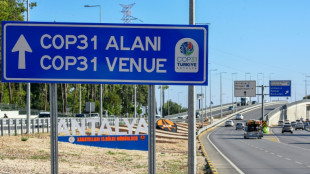 For Turkish NGOs, COP31 offers rare space for action
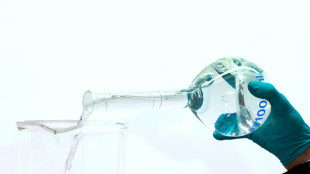 Sleep, appetite, gene-editing experts contend for Nobel chemistry prize
 Nobel Peace Prize haunted by the 'spectre' of Trump

 Africa launches own credit agency in bid for cheaper borrowing

 US, China, EU: three paths to regulating AI

 Australia's High Court rules against coal mine in landmark climate case

 Australia touts new funds for Pacific infrastructure at Fiji 'pre-COP'

 Eva Marie Saint, Oscar winner of Hollywood classics, dies at 102

 Australia probes app used in cheap smart glasses over privacy fears

 England needed to 'move on' from World Cup pain, says Tuchel

 O'Neill to stay at Celtic after period of "reflection"

 Kane marks 125th England cap with Wembley Nations League double

 Quebec's incoming separatist leader wants to block Crown from swearing-in

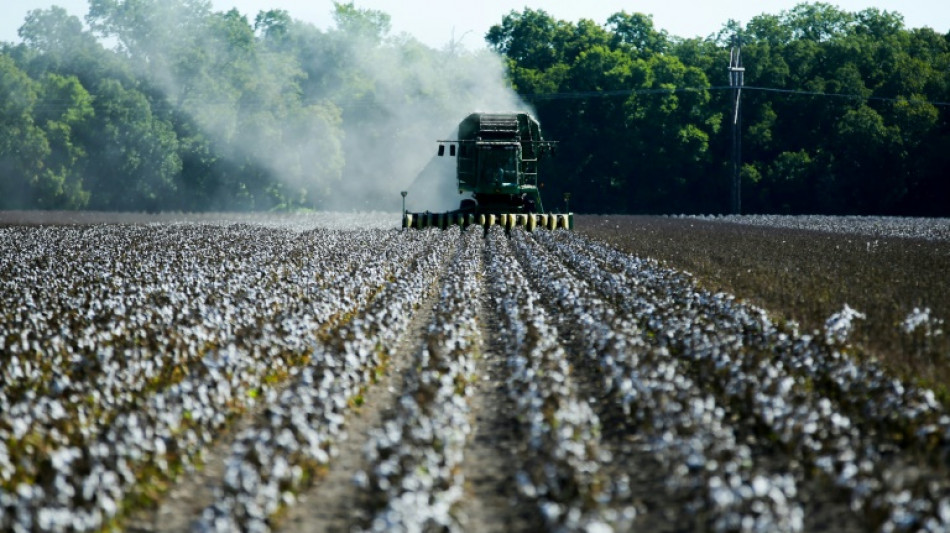
On Sutton Page's ravaged cotton fields, there is almost nothing left to pick. The Texas farmer managed to salvage maybe a fifth of his crop, but the rest was lost to the severe drought that has taken a steep toll across the region.
This year, his harvest is "not well," he says, but in reality, the drought in northern Texas has proven to be a disaster, with most of Page's neighbors not even bothering to harvest their crop, leaving "bare, bare fields."
Texas produces almost half of America's cotton, and the United States is the world's third largest supplier, behind India and China.
This year, national production will hit its lowest level since 2015, down 21 percent year-on-year, and Texas will suffer a 58 percent drop, the US Department of Agriculture estimates.
In the northwest of the state, where cotton is the lifeline of the local economy and water is scarce, the 2022 harvest "could be one of the worst in 30 years," worries Darren Hudson, professor of agricultural economics at Texas Tech University.
With the cascading consequences for the global textile industry, in an economy already reeling from the pandemic, Hudson put the likely economic impact for the region at $2 billion.
Landon Orman, 30, works on 2,000 acres of cotton near Abilene, three hours west of Dallas. His non-irrigated cotton did not even sprout, while his partially watered crop grew but its yield will be slashed by half.
In total, he predicts an 85 percent drop in production compared to a normal year. Like so many others, he has crop insurance, so "financially we're not really doing that bad. But as a farmer, it sucks pretty bad that we can't grow stuff sometimes."
- Depressing -
In Lubbock, the region's cotton hub, rainfall over the past 12 months has roughly been half its normal volume, and what little fell came too late to save the crop.
"Starting in January, all the way to the month of May, no, no literally no rain," said Sutton Page, 48. And from May "we started having 100 degree days and 30 mile an hour winds and it just dried everything out."
He had to plow 80 percent of his dying crop back into the ground to stop the land drying out. Of the few small plants that actually grew, it may not even be economical to harvest them.
"It's a little depressing to some degree, because you work hard all year and you get to get the farms ready and you fertilize and, and and your crop doesn't come up," he said.
- Frequency -
Cotton farmers in the plains of Texas know there will always be bad years, but the drought of 2022 could be the worst yet. And some worry there could be more on the way.
The region is "seeing worse conditions than this time last year," and these are settling in over time, notes Curtis Riganti, a climatologist specializing in drought.
"In the past 10 years, we saw maybe five or six of those years where we saw drought. Maybe one or two of those years we saw a very catastrophic drought," said Kody Bessent, director of one of the region's cotton growers' associations.
These farmers in Texas, a state where climate skepticism abounds, prefer to see unpredictable weather cycles repeating themselves rather than the effects of global warming, which makes extreme weather events more common.
While waiting for answers, everyone is trying their best just to maintain humidity in their soil.
N.Fournier--BTB