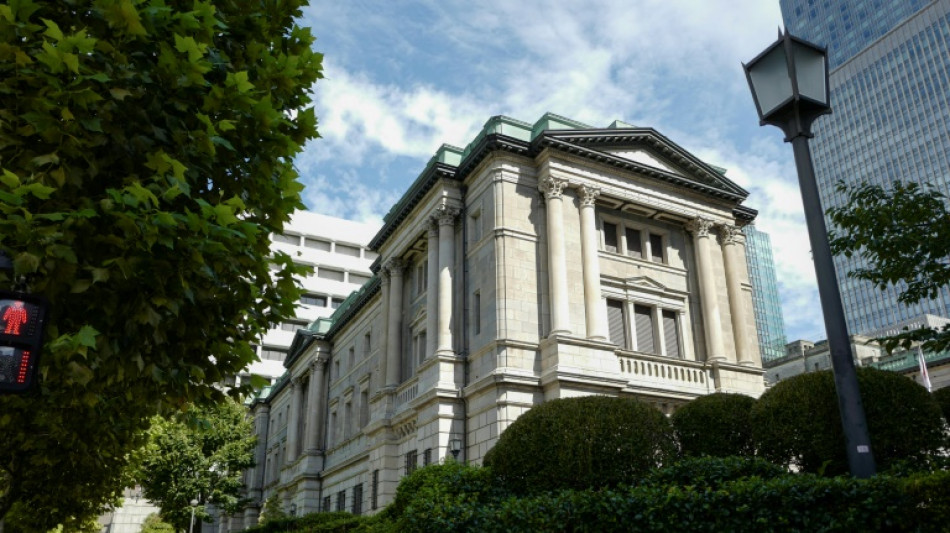
Yen hits new 24-year low as Bank of Japan keeps loose policy / Photo: © AFP

 England's Nations League surge helps heal World Cup wounds

 Mayor of opposition stronghold Izmir defects to Erdogan party
 Mertens beats Gauff to set up Swiatek clash at China Open

 Benin full of pride at role in Messi's last dance

 France suspends stun grenade use at student protests ahead of PM speech

 Indonesian court hears 'negligence' complaint against state over fires, haze

 Rubio in Greece to urge against Western civilisation 'decline'

 Micron workers at Taiwan plant vote in favour of strike

 In 'The Social Reckoning,' Jeremy Allen White takes on Facebook's 'frightening' ambition

 Chip industry activists call for South Korea to recognise cancer cases
 Famine-scarred southern Madagascar braces for El Nino

 How the EU regulates lobbyists

 I.Coast refuge offers lifelong care for youngsters scorned as 'sorcerers'

 Indian central bank hikes rates for first time in more than 3 years

 Hotel Blacklist Launches New Accommodation Industry Risk Assessment Tool

 Bangladesh nuclear plant draws hope -- and worry

 US beat Canada 1-0 to wrap up four-win international break

 Turkey, Australia's joint COP31 leadership raises doubts

 For Turkish NGOs, COP31 offers rare space for action

 Sleep, appetite, gene-editing experts contend for Nobel chemistry prize

 Nobel Peace Prize haunted by the 'spectre' of Trump

 Africa launches own credit agency in bid for cheaper borrowing

 US, China, EU: three paths to regulating AI

 Australia's High Court rules against coal mine in landmark climate case

 Australia touts new funds for Pacific infrastructure at Fiji 'pre-COP'

The yen sank to a fresh 24-year low against the dollar on Thursday, with the greenback surging to nearly 146 after Japan's central bank left its ultra-loose monetary policy unchanged, a day after the Federal Reserve ramped up interest rates and warned of more to come.
The yen has taken a beating in recent months as the Japanese central bank hews to a decade-old policy intended to achieve sustained two-percent inflation -- a benchmark seen as key to turbocharging the world's third-largest economy.
It has bucked the trend of other major economies, where central banks -- particularly the US Fed -- are hiking rates to tackle inflation.
Prices in Japan are rising, with the consumer price index in August at 2.8 percent, its highest level since 2014, but the central bank views the increases as temporary.
In a statement, it said it would leave its current policy in place, "aiming to achieve the price stability target of two percent, as long as it is necessary".
"It will continue expanding the monetary base until the year-on-year rate of increase in the observed CPI exceeds two percent and stays above the target in a stable manner."
The bank said it sees Japan's economy as on a recovery path, "with the impact of Covid-19 and supply-side constraints waning", though it warned of uncertainty from commodity price increases linked to the war in Ukraine.
The yen's rapid depreciation has caused concern in Japan, pushing up the cost of imported goods for consumers and businesses.
Government officials have insisted they are monitoring the situation and will take appropriate measures if necessary, without detailing what they would be or when they could be implemented.
- 'BoJ has no choice' -
Earlier this month, the central bank reportedly conducted a "rate check", an operation often seen as a precursor to a currency intervention.
The move came shortly after the yen came close to breaching the psychologically significant 145 barrier, and reports of the operation temporarily bolstered the Japanese unit.
It has plunged from around 115 in March, and the BoJ on Thursday repeated that "it is necessary to pay due attention to developments in financial and foreign exchange markets and their impact on Japan's economic activity and prices".
Japan's top currency diplomat Masato Kanda told reporters hours after the bank's decision that the government was on "standby" to intervene when appropriate, local media said.
But he again failed to detail what would trigger an intervention, and his pronouncements did little to prop up the yen, which continued to hover near the 145 level.
He also confirmed that there had been no intervention yet despite the dollar retreating briefly to around 143.50 yen after breaking the 145 mark. The greenback the climbed again to as high as 145.90 yen.
Hours after the BoJ's policy announcement, Governor Haruhiko Kuroda, whose term expires next year, defended sticking with the long-standing programme.
"We haven't been and will not be targeting certain levels of foreign exchange," he told reporters.
"It is desirable that forex rates reflect economic and financial fundamentals, however the recent rapid depreciation of the yen is not that and is negative for the economy," he added.
But he noted that the dollar has gained against most major currencies.
There is little expectation the BoJ will shift course, wrote Shigeto Nagai, head of Japan Economics at Oxford Economics, in a note.
"Although foreign investors might continue challenging the yen and (Japanese government bond) yields until the Fed's rate tightening cycle peaks, we believe that the BoJ has no choice but to stick to the current... policy."
C.Meier--BTB