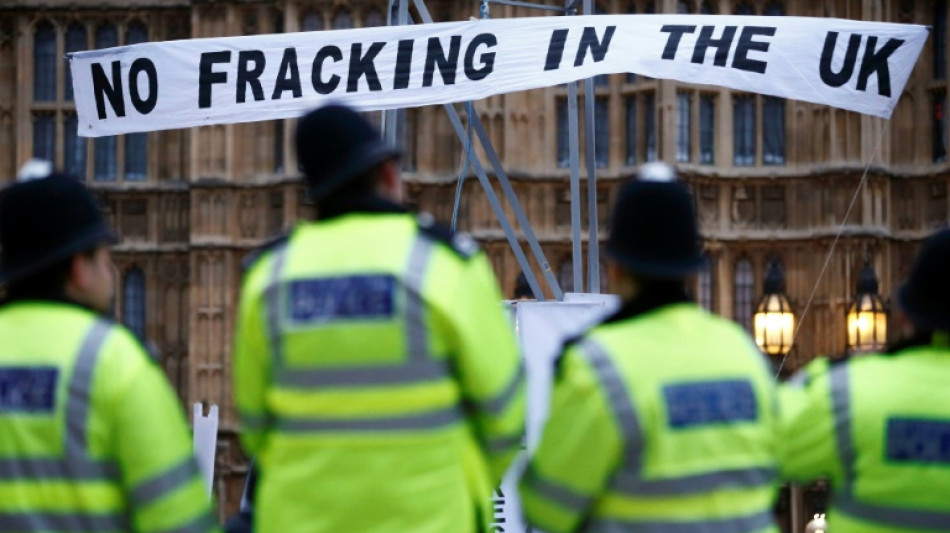
UK government lifts gas fracking ban in England / Photo: © AFP/File

 England's Nations League surge helps heal World Cup wounds

 Mayor of opposition stronghold Izmir defects to Erdogan party
 Mertens beats Gauff to set up Swiatek clash at China Open

 Benin full of pride at role in Messi's last dance

 France suspends stun grenade use at student protests ahead of PM speech

 Indonesian court hears 'negligence' complaint against state over fires, haze
 Rubio in Greece to urge against Western civilisation 'decline'
 Micron workers at Taiwan plant vote in favour of strike
 In 'The Social Reckoning,' Jeremy Allen White takes on Facebook's 'frightening' ambition

 Chip industry activists call for South Korea to recognise cancer cases
 Famine-scarred southern Madagascar braces for El Nino
 How the EU regulates lobbyists
 I.Coast refuge offers lifelong care for youngsters scorned as 'sorcerers'

 Indian central bank hikes rates for first time in more than 3 years

 Hotel Blacklist Launches New Accommodation Industry Risk Assessment Tool

 Bangladesh nuclear plant draws hope -- and worry
 US beat Canada 1-0 to wrap up four-win international break

 Turkey, Australia's joint COP31 leadership raises doubts

 For Turkish NGOs, COP31 offers rare space for action

 Sleep, appetite, gene-editing experts contend for Nobel chemistry prize
 Nobel Peace Prize haunted by the 'spectre' of Trump

 Africa launches own credit agency in bid for cheaper borrowing

 US, China, EU: three paths to regulating AI

 Australia's High Court rules against coal mine in landmark climate case
 Australia touts new funds for Pacific infrastructure at Fiji 'pre-COP'

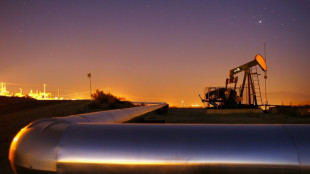
Britain on Thursday lifted England's moratorium on controversial gas fracking to boost energy security, despite breaking the ruling Conservative party's manifesto pledge.
Prime Minister Liz Truss had flagged the move two weeks ago, shortly after taking office, in a vast package tackling turmoil in energy markets after key gas supplier Russia invaded Ukraine.
The UK had in 2019 called a halt to fracking -- or hydraulic fracturing which is used to release hydrocarbons locked deep underground -- due to fears it could trigger earthquakes.
The moratorium was imposed under Truss' predecessor Boris Johnson following a series of earth tremors, but the government has switched tack after Russia cut off gas supplies to most of Europe, sending prices soaring.
- Energy security -
"In light of Putin's illegal invasion of Ukraine and weaponisation of energy, strengthening our energy security is an absolute priority," business and energy secretary Jacob Rees-Mogg said in a government statement.
He reaffirmed Truss's goal of making Britain a net energy exporter by 2040.
"To get there we will need to explore all avenues available to us through solar, wind, oil and gas production -- so it's right that we've lifted the pause to realise any potential sources of domestic gas."
The Department for Business, Energy and Industrial Strategy (BEIS) confirmed a new oil and gas licensing round next month for 100 new licences, but only with support from local communities.
However, the announcement sparked uproar in parliament because it broke the Conservatives' manifesto promise from the 2019 general election.
Opposition lawmakers and Conservatives representing constituencies in northern England -- where tremors were felt in 2011 -- hit out.
- 'Charter for earthquakes' -
The main opposition Labour party labelled the new policy "a charter for earthquakes".
Labour climate spokesman Ed Miliband questioned Rees-Mogg about where the evidence was for the decision.
"The 2019 manifesto on which he and every member of the party opposite stood said this 'we will not support fracking unless the science shows categorically that it can be done safely'," Miliband said before parliament.
"They are lifting the ban, but they can't supply the evidence."
Liberal Democrat environment spokeswoman Wera Hobhouse added that people in drilling areas were being treated as guinea pigs.
"The Conservatives' obsession with fracking lays bare that they don't actually think that climate change is happening and are not willing to take the urgent action needed," said Hobhouse.
"If people suffer polluted water and dangerous earthquakes, this decision will prove unforgivable."
- 'Shown to be safe' -
Rees-Mogg replied that fracking was "safe" and greener than energy sources from abroad.
"It is more environmentally friendly to use our own sources of fuel rather than to extract them from other countries and transport them here at great cost, both financially and in terms of carbon," he said.
"It is safe. It is shown to be safe," he insisted.
He added the policy would "bring us cheaper energy" at a time of rocketing prices.
Fracking is carried out by blasting a mixture of water, sand and chemicals underground to release shale oil and gas.
But environmentalists argue that the process contaminates water supplies, hurts wildlife, causes earthquakes and contributes to global climate change.
Green pressure groups slammed Thursday's decision.
"Ripping up the rules that protect people from fracking would send shockwaves through local communities," said Friends of the Earth campaigner Danny Gross.
"If the government caves into the fracking industry and allows them to cause larger earthquakes, it will further undermine confidence that fracking can be done safely."
The BEIS also published the British Geological Survey's scientific review into shale gas extraction.
The review highlighted "limited current understanding" of UK geology and onshore shale resources "should be a reason to drill more wells to gather more evidence and data", the government study added.
K.Thomson--BTB