Japan to lift Covid restrictions on foreign tourists from October / Photo: © AFP

 England's Nations League surge helps heal World Cup wounds

 Mayor of opposition stronghold Izmir defects to Erdogan party
 Mertens beats Gauff to set up Swiatek clash at China Open

 Benin full of pride at role in Messi's last dance

 France suspends stun grenade use at student protests ahead of PM speech

 Indonesian court hears 'negligence' complaint against state over fires, haze
 Rubio in Greece to urge against Western civilisation 'decline'
 Micron workers at Taiwan plant vote in favour of strike
 In 'The Social Reckoning,' Jeremy Allen White takes on Facebook's 'frightening' ambition
 Chip industry activists call for South Korea to recognise cancer cases
 Famine-scarred southern Madagascar braces for El Nino
 How the EU regulates lobbyists
 I.Coast refuge offers lifelong care for youngsters scorned as 'sorcerers'

 Indian central bank hikes rates for first time in more than 3 years

 Hotel Blacklist Launches New Accommodation Industry Risk Assessment Tool

 Bangladesh nuclear plant draws hope -- and worry

 US beat Canada 1-0 to wrap up four-win international break

 Turkey, Australia's joint COP31 leadership raises doubts

 For Turkish NGOs, COP31 offers rare space for action

 Sleep, appetite, gene-editing experts contend for Nobel chemistry prize

 Nobel Peace Prize haunted by the 'spectre' of Trump

 Africa launches own credit agency in bid for cheaper borrowing

 US, China, EU: three paths to regulating AI

 Australia's High Court rules against coal mine in landmark climate case
 Australia touts new funds for Pacific infrastructure at Fiji 'pre-COP'

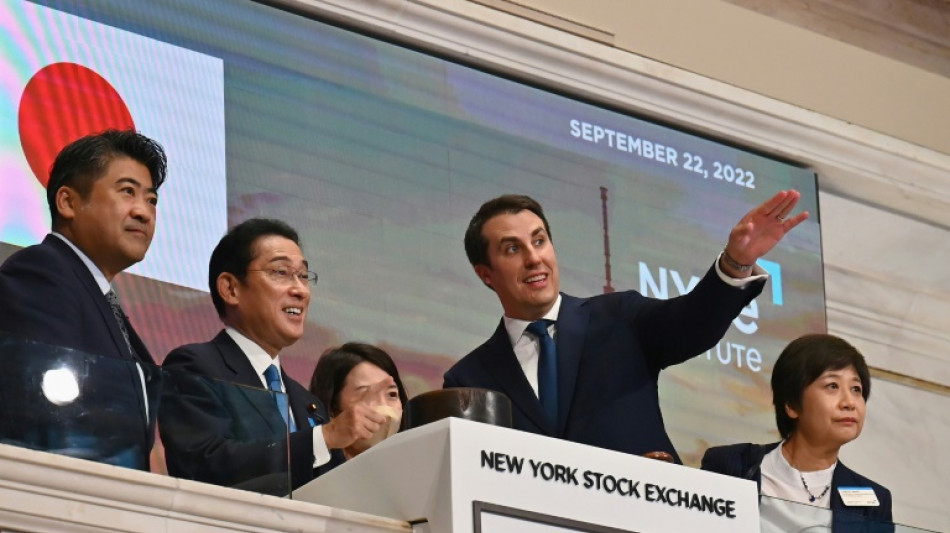
Japan announced Thursday that it will lift tough Covid restrictions on foreign tourists, reopening the borders after two and a half years.
Speaking at the New York Stock Exchange, Prime Minister Fumio Kishida said the pandemic had interrupted the free flow of people, goods and capital that had helped the nation flourish.
"But from October 11, Japan will relax border control measures to be on par with the US, as well as resume visa-free travel and individual travel," said Kishida, who is in the city for the United Nations General Assembly.
Japan, along with China, has been a holdout in continuing tough restrictions on visitors as much of the world has moved on from the pandemic.
But unlike China, Japan never imposed a strict lockdown during the crisis.
Tourists who come to Japan will enjoy a weak yen, which has plummeted so low against the dollar that the finance ministry intervened in the currency market Thursday for the first time since 1998.
The return of the visa-waiver program suspended in March 2020 will restore the ease of access that saw a record 31.9 million foreign visitors to the country in 2019.
Since June, Japan has allowed tourists to visit in groups accompanied by guides, a requirement that was further relaxed to include self-guided package tours.
The cautious approach to reopening has been deliberate, said James Brady, Japan analysis lead at US-based consultancy Teneo.
Kishida "took office a year ago knowing that perceived mishandling of the pandemic had been a key factor in undermining public confidence" in his predecessor's government, Brady told AFP.
"He has been extremely careful not to repeat those mistakes."
Japan has recorded around 42,600 coronavirus deaths in total -- a vastly lower rate than many other countries -- and 90 percent of residents aged 65 and over have had three vaccine shots.
There is no law requiring people to wear masks, but they are still near-ubiquitous in public places like trains and shops, with many Japanese willing to sport masks when ill even before the pandemic.
While the return of mass tourism should give a "slight bump" to Japan's economy, the benefits are likely to be limited by China's zero-Covid policy, Brady said.
"Much of the economic benefit pre-pandemic came from high numbers of Chinese visitors coming and spending lots of money on tech products, cosmetics," he explained.
But "currently, Chinese citizens face their own travel restrictions at home and won't be traveling to Japan in large numbers."
There is pent-up demand for travel to the country, however, according to Olivier Ponti, vice president of insights for travel analytics firm ForwardKeys.
"Searches for travel to Japan reached their highest point this year at the end of August," and while flight bookings were just 16 percent of 2019 levels in early September, "we'd expect bookings to jump" when the visa rules are scrapped, Ponti said.
Demand from Europe may still be subdued "due to the increase in the cost of living in Europe caused by the Russian-Ukraine crisis plus the rising fuel costs driving up air travel costs," said Liz Ortiguera, CEO of the Pacific Asia Travel Association.
C.Meier--BTB