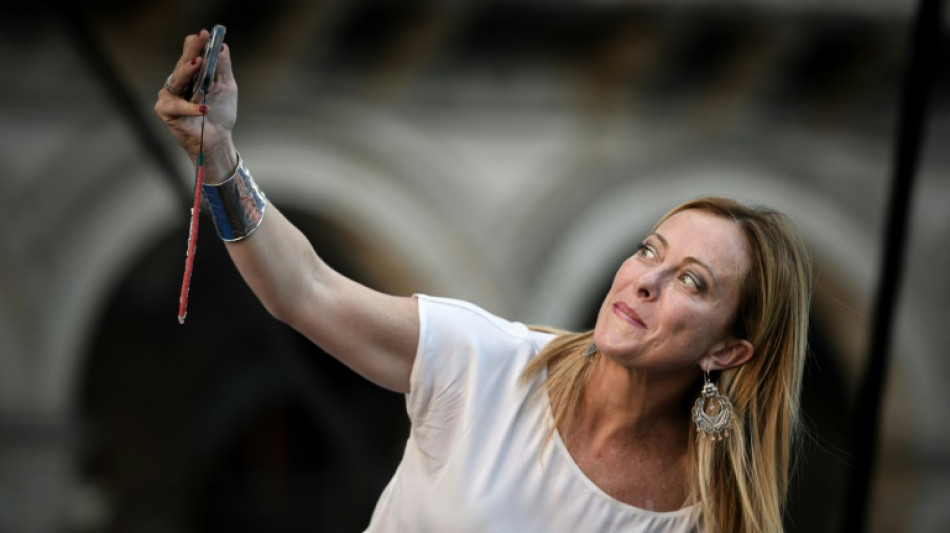
Financial markets, Brussels wary of Italy far-right win / Photo: © AFP

 England's Nations League surge helps heal World Cup wounds
 Mayor of opposition stronghold Izmir defects to Erdogan party
 Mertens beats Gauff to set up Swiatek clash at China Open

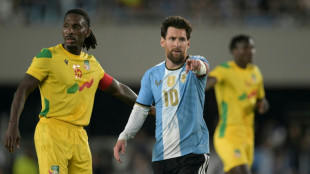 Benin full of pride at role in Messi's last dance
 France suspends stun grenade use at student protests ahead of PM speech

 Indonesian court hears 'negligence' complaint against state over fires, haze
 Rubio in Greece to urge against Western civilisation 'decline'
 Micron workers at Taiwan plant vote in favour of strike
 In 'The Social Reckoning,' Jeremy Allen White takes on Facebook's 'frightening' ambition
 Chip industry activists call for South Korea to recognise cancer cases
 Famine-scarred southern Madagascar braces for El Nino
 How the EU regulates lobbyists
 I.Coast refuge offers lifelong care for youngsters scorned as 'sorcerers'

 Indian central bank hikes rates for first time in more than 3 years

 Hotel Blacklist Launches New Accommodation Industry Risk Assessment Tool
 Bangladesh nuclear plant draws hope -- and worry
 US beat Canada 1-0 to wrap up four-win international break

 Turkey, Australia's joint COP31 leadership raises doubts

 For Turkish NGOs, COP31 offers rare space for action

 Sleep, appetite, gene-editing experts contend for Nobel chemistry prize

 Nobel Peace Prize haunted by the 'spectre' of Trump
 Africa launches own credit agency in bid for cheaper borrowing

 US, China, EU: three paths to regulating AI
 Australia's High Court rules against coal mine in landmark climate case
 Australia touts new funds for Pacific infrastructure at Fiji 'pre-COP'

From her euroscepticism to her impact on Italy's enormous debt, the likely victory of far-right leader Giorgia Meloni in elections Sunday is causing concern in financial markets and in Brussels.
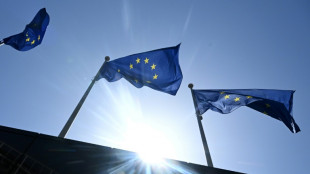
The Brothers of Italy leader has abandoned her calls for the country to leave the EU's single currency and the joint programme with her right-wing allies -- the anti-immigration League and Silvio Berlusconi's Forza Italia -- commits them to the European project.
But concerns persist, particularly after she reiterated her support this week for Hungarian Prime Minister Viktor Orban in his battles with Brussels.
At an election rally in mid-September in Milan, Meloni declared that "the good times are over" and that Italy, like others, "is going to start defending its own national interests" in the EU.
"I don't know any nationalists who are not against European institutions," Frans Timmermans, vice-president of the European Commission, noted in an interview with La Repubblica newspaper earlier this month.
- EU recovery plan -
Well placed to become the next prime minister, Meloni wants a "confederate Europe" which "respects the sovereignty of member states" to manage their own affairs.
She has called for a renegotiation of the Italian part of the EU's mammoth post-pandemic recovery plan, from which Italy stands to receive almost 200 billion euros, to account for the spike in energy prices linked to the Ukraine war.
But the money is dependent on a series of reforms, which outgoing Prime Minister Mario Draghi began but must still be implemented.
"We could end up with a serious clash of ideas between Italy, which is by far the biggest beneficiary of the recovery plan, and the EU," noted Nicola Nobile of Oxford Economics, a consultancy.
"There are many risks, but it will all depend on which Meloni leads the government -- the one who has attacked Europe in the past or the one who now advocates a more moderate approach and could pursue the status quo on fiscal matters," she told AFP.
- Spiralling debt -
Concerns about a slip in the reform timetable and an increase in Italy's debt after the elections have already caused rating agencies Standard & Poor's and Moody's to downgrade the outlook for the country's credit rating.
Italy is saddled with a debt of more than 2.7 trillion euros, or some 150 percent of gross domestic product (GDP), the highest ratio in the eurozone after Greece.
Meloni's right-wing coalition is calling for a revision of the EU's rules against overspending, which were suspended during the pandemic but set a ceiling of three percent of GDP for the deficit and 60 percent for debt.
While some flexibility might be allowed, "it would be political suicide to say, 'we don't care about all the rules'," noted Peter Bofinger, professor of economy at the University of Wuerzburg.
"If Italy deviates from the European consensus" and does not maintain a minimum of budgetary discipline, "not even the European Central Bank will be able to help it", he told AFP.
- Costly election promises -
The right-wing coalition has promised to cut taxes while increasing spending, including raising the minimum pension -- plans that risk being hugely expensive.
"Their programme is very vague and does not explain how to finance these measures," said Nobile.
"If they were implemented, Italy's public deficit would remain above six percent of GDP for five years from 2023," pushing the already high public debt to "unsustainable levels".
The coalition's flagship measure, a so-called flat tax that the League wants to set at 15 percent and Berlusconi 23 percent, could cost between 20 billion and 58 billion euros, according to Italy's public accounts observatory.
Investors fear the government could end up like its predecessors -- Berlusconi's resigned in 2011, under pressure from the markets and a surge in the cost of debt.
K.Brown--BTB