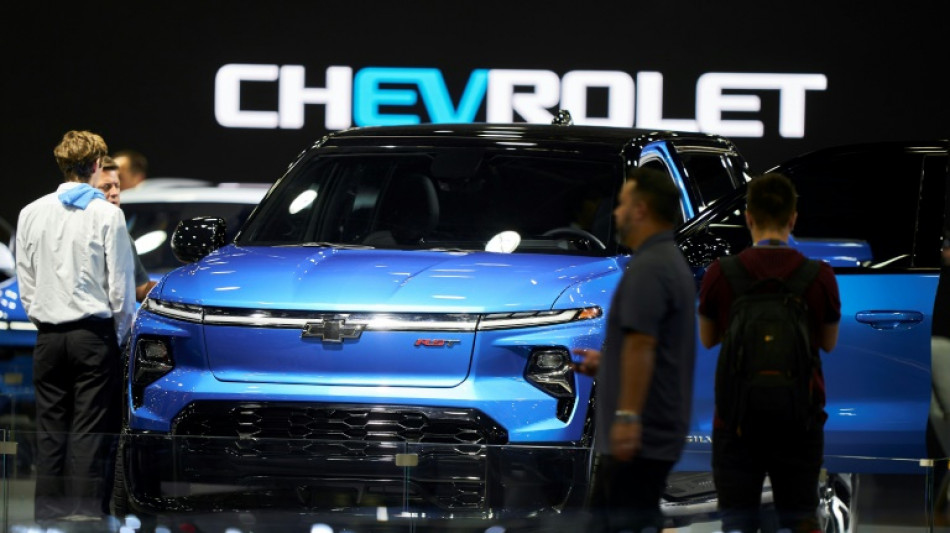
EVs at Detroit Auto Show? Consumers have questions / Photo: © AFP/File

 England's Nations League surge helps heal World Cup wounds
 Mayor of opposition stronghold Izmir defects to Erdogan party

 Mertens beats Gauff to set up Swiatek clash at China Open
 Benin full of pride at role in Messi's last dance

 France suspends stun grenade use at student protests ahead of PM speech

 Indonesian court hears 'negligence' complaint against state over fires, haze
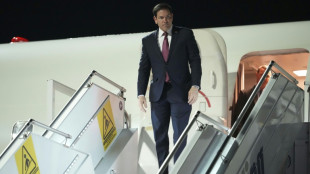 Rubio in Greece to urge against Western civilisation 'decline'

 Micron workers at Taiwan plant vote in favour of strike

 In 'The Social Reckoning,' Jeremy Allen White takes on Facebook's 'frightening' ambition

 Chip industry activists call for South Korea to recognise cancer cases

 Famine-scarred southern Madagascar braces for El Nino

 How the EU regulates lobbyists

 I.Coast refuge offers lifelong care for youngsters scorned as 'sorcerers'

 Indian central bank hikes rates for first time in more than 3 years

 Hotel Blacklist Launches New Accommodation Industry Risk Assessment Tool

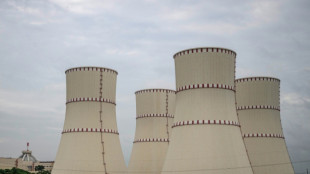 Bangladesh nuclear plant draws hope -- and worry
 US beat Canada 1-0 to wrap up four-win international break

 Turkey, Australia's joint COP31 leadership raises doubts

 For Turkish NGOs, COP31 offers rare space for action

 Sleep, appetite, gene-editing experts contend for Nobel chemistry prize
 Nobel Peace Prize haunted by the 'spectre' of Trump

 Africa launches own credit agency in bid for cheaper borrowing

 US, China, EU: three paths to regulating AI

 Australia's High Court rules against coal mine in landmark climate case

 Australia touts new funds for Pacific infrastructure at Fiji 'pre-COP'

The emerging fleet of electric vehicles (EV) provoked fascination at the Detroit Auto Show, but many consumers were not yet ready to take the plunge to own one themselves.
Some, like Justin Tata, wanted a first-hand look at new EV offerings, saying "it's embracing the change that's coming because I think the internal combustion engine (ICE) is on the way out."
But Tata, who works in the packaging industry, still has questions about EV battery disposal. He came to the Detroit show, which concludes Sunday, to survey the state of play, but doesn't foresee buying an EV for another five to 10 years.
Among other attendees, the less-EV enthused included Tim Stokes.
"I think eventually that's going to be the only option," said Stokes as he admired a new gasoline-powered Ford Mustang, adding that he wants to "prolong (driving ICE vehicles) as long as possible."
Friends in the auto industry have advised waiting three or four years for the industry to "work out the kinks" with EVs, said Stokes, who works in telecommunications.
- Mainstream options -
Long considered a niche sideshow in the auto world, the prominence of EVs at this year's Detroit gathering underscored their new mainstream status as big automakers respond to rising concerns about climate change and government policies promoting EVs.
Chevrolet's showcase highlighted EV versions of three of the GM brand's top-selling products: the Silverado pickup, and the Blazer and Equinox, both SUVs. Chevy expects to begin deliveries on the vehicles in 2023.
Ford too has targeted its EV campaign towards its most popular vehicles, unveiling a battery-powered version of its best-selling F-150 pickup truck and launching the Mustang Mach-E, a new SUV that has also attracted strong interest from consumers.
A 2022 Consumer Reports survey showed 14 percent of Americans saying they would "definitely" buy or lease an EV if they were searching for a vehicle, up from four percent in 2020.
While the vehicle launches have brought unprecedented attention to EVs, auto experts say that a meaningful transformation of the ICE-dominated US fleet is still years away.
Price remains a big problem, with the average price of an EV nearly $67,000, according to Cox Automotive.
Experts also cite the lack of EV charging stations as a concern. President Biden signed into law a bill to provide $7.5 billion to build more stations, as his administration announced the first tranche of funding in parallel with a presidential address at the Detroit show.
- Can the industry deliver? -
Auto insiders also point to doubts about the availability of critical materials such as lithium and cobalt needed for batteries.
These issues have come to the fore during the Covid-19 pandemic, when shortages of semiconductors and other supply chain woes forced automakers to restrict vehicle production and store tens of thousands of partially-built autos.
Ford said on Monday that it expects to have some 40,000-45,000 mostly built vehicles in inventory at the end of the third quarter due to needed parts. On Friday, the Wall Street Journal reported that the company had delayed some vehicle deliveries due to a shortage of badges with the company's blue oval logo.
Don Lamos, who works for auto supplier, had placed an order on a Ford Lightning, but is backing off after Ford raised the price on that version to above the $80,000 cap that would allow car buyers to qualify for a $7,500 tax credit under new US legislation.
Lamos and his wife, Janice, were drawn to the Chevy offerings, including the Equinox, which starts at $30,000.
"If they can hold that at $30,000, then awesome," he said. "I don't know if they'll really be able to meet production next year, so we'll see."
Don Lamos cited cost savings as the main impetus, while Janice Lamos described climate change as a priority. The couple are sold on EVs, but pondering how much to spend now when battery technologies will likely improve in the future.
Many of the vehicles being released are touted for being able to travel 300 miles without being recharged, but the capacity is much lower if the vehicle is towing cargo.
"You know when you need gas you can go to the corner and there's a station. I don't think there's enough (charging) stations for one of these," Carlos Rubante said when asked about the Lightning.
Consumers at the show described climate change as a worry, but were not necessarily convinced that EVs were the solution.
Besides battery disposal, another concern is the unwanted consequences of the mining boom in critical materials, such as the use of child labor in the Democratic Republic of Congo to produce cobalt, said Cristian Damboiu, who works for an auto supplier.
"When you're considering all these things, maybe they aren't as clean as they seem," said Damboiu.
"I understand (EVs) have some advantages, so we'll see how it plays out."
J.Fankhauser--BTB