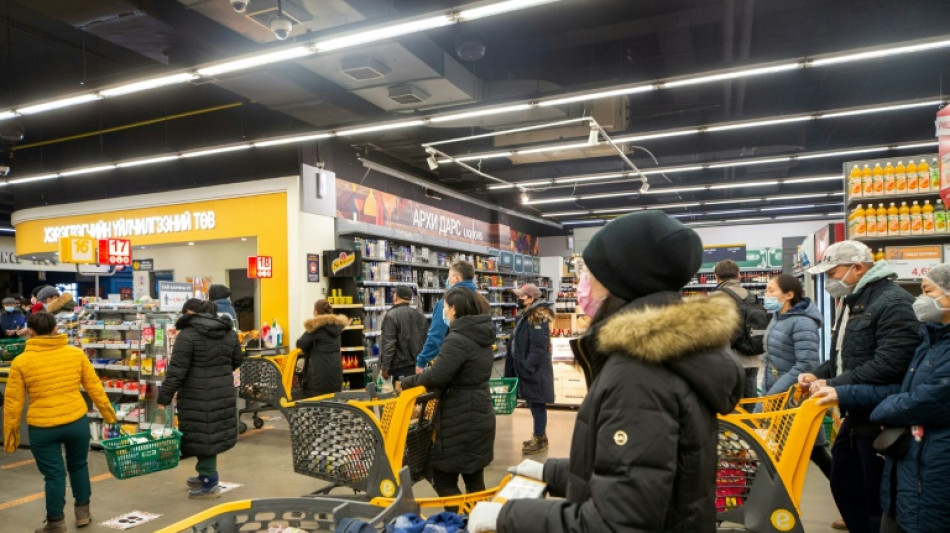
Inflation hits home for Mongolians struggling for basic goods / Photo: © AFP

 England's Nations League surge helps heal World Cup wounds

 Mayor of opposition stronghold Izmir defects to Erdogan party
 Mertens beats Gauff to set up Swiatek clash at China Open
 Benin full of pride at role in Messi's last dance

 France suspends stun grenade use at student protests ahead of PM speech
 Indonesian court hears 'negligence' complaint against state over fires, haze
 Rubio in Greece to urge against Western civilisation 'decline'
 Micron workers at Taiwan plant vote in favour of strike
 In 'The Social Reckoning,' Jeremy Allen White takes on Facebook's 'frightening' ambition
 Chip industry activists call for South Korea to recognise cancer cases
 Famine-scarred southern Madagascar braces for El Nino
 How the EU regulates lobbyists
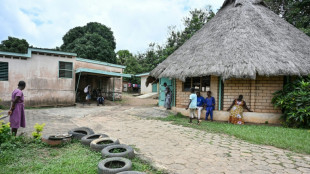 I.Coast refuge offers lifelong care for youngsters scorned as 'sorcerers'

 Indian central bank hikes rates for first time in more than 3 years
 Hotel Blacklist Launches New Accommodation Industry Risk Assessment Tool
 Bangladesh nuclear plant draws hope -- and worry
 US beat Canada 1-0 to wrap up four-win international break

 Turkey, Australia's joint COP31 leadership raises doubts

 For Turkish NGOs, COP31 offers rare space for action

 Sleep, appetite, gene-editing experts contend for Nobel chemistry prize
 Nobel Peace Prize haunted by the 'spectre' of Trump

 Africa launches own credit agency in bid for cheaper borrowing

 US, China, EU: three paths to regulating AI
 Australia's High Court rules against coal mine in landmark climate case
 Australia touts new funds for Pacific infrastructure at Fiji 'pre-COP'

At Ulaanbaatar's Naiman Sharga money exchange market, elderly women stand in the street waving wads of money at passers-by, encouraging them to change foreign currency to Mongolian tugriks.
Each transaction nets them a small profit -- but when the value of the tugrik fluctuates it makes that more difficult, and lately the currency has taken a dive.
This year the currency has fallen almost 15 percent against the US dollar -- most of that since the start of Russia's invasion of Ukraine.
Angara Banerji, the International Monetary Fund's mission chief, listed a raft of factors behind the country's inflation, including a rise in domestic meat prices, China's border restrictions, surging oil and food prices, and an increase in transportation and logistical costs for imports.
The declining currency has pushed up the cost of everyday goods for a country struggling to navigate global economic headwinds caused by transportation bottlenecks and inflationary pressures, war and economic uncertainty.
"The rate is going down dramatically because of the war in Ukraine and the coronavirus," said Ts. Maisaikhan, a currency trader who operates inside the market.
"We don't produce much ourselves, most things are imported, so when the dollar goes up the price of everything goes up too."
Like elsewhere in the world, Mongolia's inflation has soared this year and reached 14.4 percent in August, compared with 9.5 percent during the same month in 2021, according to the country's National Statistical Office.
Prices for food and beverages increased by about a fifth on-year in August -- the same rate as medicine and health care -- while the cost of clothing, utilities and housing also went up.
"Inflation has surged sharply since mid-2021 and has exceeded the Bank of Mongolia's target band," said Banerji.
Last summer there were a few weeks when potato prices temporarily tripled after China closed the border over Covid-19.
Next to the money exchange offices lies Urt Tsagaan (Long White), a pedestrian mall filled with jewellery makers, seamstresses, hairdressers, boot repair stalls, cobblers, and tattoo studios.
In a sewing shop near the money exchange, Sukhbaatar Tuya said she buys some meat and vegetables each day but when prices spike suddenly it just means buying less produce.
"We're just going day by day," she said. "We don't have any plans beyond the next three days or a week."
"We have to live like this," she said. "There is no other way."
J.Bergmann--BTB