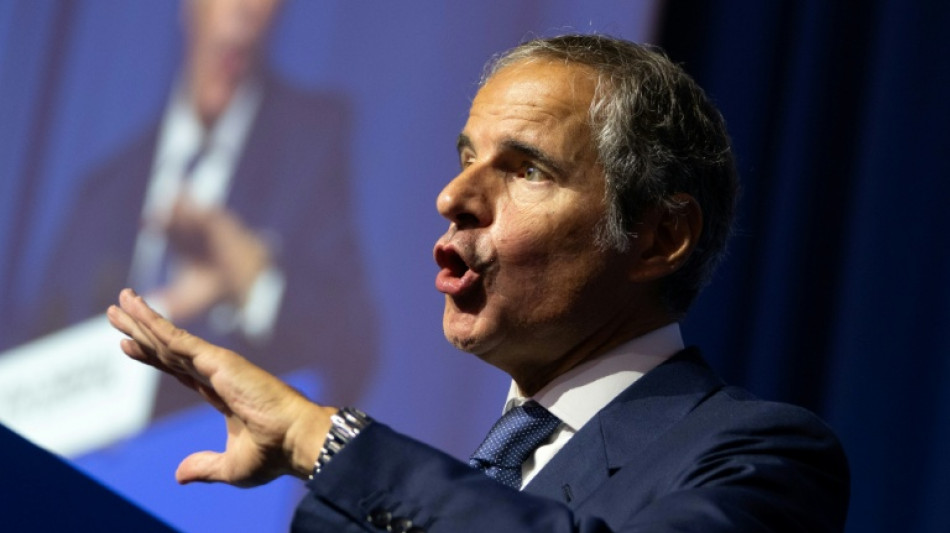
UN nuclear watchdog chief urges Iran to grant access / Photo: © AFP

 Malta Stuns Sweden with Late Penalty Comeback in Rugby Europe Trophy

 BingX: Major Announcement of Far-Reaching Significance

 Élan Opens as Late-Night Wine Bar in Honolulu

 Shiv Sena (UBT) Criticizes NCP Merger Talks as 'Ridiculous Laughing Stock'

 Dell Announces AI-Integrated PC Lineup for 2026 with Wi-Fi 7 Support

 Rocky Fans Break Guinness World Record at Philadelphia Museum Steps

 FAA Grounds All US Flights Amid Nationwide Air Traffic Control Communication Failure

 Argentina vs Uruguay Kick-off Time, TV Channels & Free Streaming Guide
IAEA chief Rafael Grossi urged Iran during a UN Security Council meeting on Tuesday to grant immediate access to his agency so it can verify the Islamic republic's nuclear materials.
The International Atomic Energy Agency (IAEA) has not had access to key nuclear facilities in Iran since Israel, joined by the United States, launched a 12-day conflict in June 2025 that included strikes on nuclear sites.
Nuclear facilities have also been hit in the latest war, which erupted on February 28, and the IAEA has repeatedly called for access.
"I invite Iran to work with the IAEA without any further delay to clarify outstanding safeguards questions and to give the IAEA the information and access the agency requires, so that it can verify all relevant facilities and material, as is Iran's legal obligation," Grossi said.
The Security Council meeting followed a resolution passed by the IAEA board last month that referred Iran to the top UN body over its nuclear "non-compliance."
The resolution, submitted by Britain, France, Germany and the United States, marks the first time Iran has been referred to the Security Council in 20 years for failing to comply with its nuclear reporting obligations.
The move has been seen as largely symbolic as China and Russia hold power to veto any sanctions against their ally Tehran. Both countries were joined by Niger in voting against the IAEA resolution.
Iran's UN representative, Amir Saeid Iravani, called out the Security Council's "silence" regarding the US-Israeli strikes against his country.
"Today's meeting is an illustration of an established double standard in which the aggressor is shielded with impunity, the victim is placed under criticism, and the language of non-proliferation is cynically appropriated to advance geopolitical objectives," he said.
Before the June 2025 strikes, the IAEA calculated that Iran possessed approximately 440 kilograms of uranium enriched to 60 percent, which is close to the 90 percent needed to make a bomb and well above the 3.67-percent limit set by a 2015 now-defunct agreement with Iran.
Since June 2025, the fate of the stockpile has remained uncertain.
US President Donald Trump has repeatedly threatened to renew strikes against Iran, possibly after the midterm elections next week.
"Do I make a deal with them, or do I finish them off? That's my -- it's the only question. Do I make a deal, or do I finish them off?" he said in a Fox News interview on Sunday.
C.Kovalenko--BTB