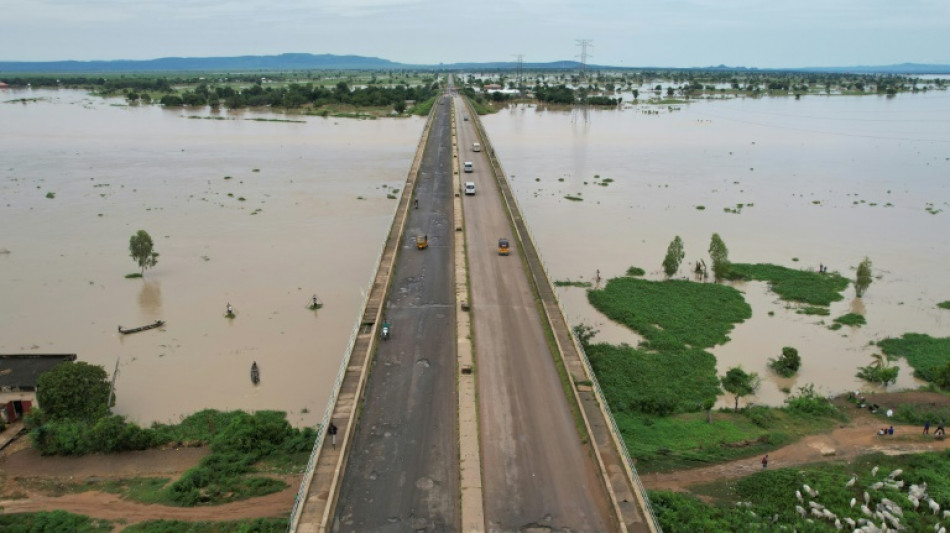
Heavy floods ravage West Africa farmlands / Photo: © AFP

 Arteta targets more Arsenal glory after signing new deal until 2030

 Russell hit with Singapore grid penalty for taking new power unit

 Spotify expands audiobooks to more than 180 markets
 French-Japanese duo wins chemistry Nobel for solving molecular 'mystery'

 England's Nations League surge helps heal World Cup wounds

 Mayor of opposition stronghold Izmir defects to Erdogan party
 Mertens beats Gauff to set up Swiatek clash at China Open

 Benin full of pride at role in Messi's last dance

 France suspends stun grenade use at student protests ahead of PM speech
 Indonesian court hears 'negligence' complaint against state over fires, haze
 Rubio in Greece to urge against Western civilisation 'decline'
 Micron workers at Taiwan plant vote in favour of strike

 In 'The Social Reckoning,' Jeremy Allen White takes on Facebook's 'frightening' ambition

 Chip industry activists call for South Korea to recognise cancer cases

 Famine-scarred southern Madagascar braces for El Nino

 How the EU regulates lobbyists

 I.Coast refuge offers lifelong care for youngsters scorned as 'sorcerers'

 Indian central bank hikes rates for first time in more than 3 years

 Hotel Blacklist Launches New Accommodation Industry Risk Assessment Tool

 Bangladesh nuclear plant draws hope -- and worry
 US beat Canada 1-0 to wrap up four-win international break

 Turkey, Australia's joint COP31 leadership raises doubts

 For Turkish NGOs, COP31 offers rare space for action

 Sleep, appetite, gene-editing experts contend for Nobel chemistry prize
 Nobel Peace Prize haunted by the 'spectre' of Trump

Nigeria rice farmer Adamu Garba squelched barefoot through his paddy fields, surveying damage from devastating floods that have destroyed farmland across the north of the country.
Parts of West and central Africa have been battered by floods ravaging farms like Garba's rice plots, wiping out crops and risking worsening food insecurity in a region already struggling with economic fallout from the Ukraine war.
Just in Nigeria, constant heavy rains caused the worst flooding in a decade, killing more than 300 people since the start of the rainy season and displacing at least 100,000, according to emergency officials.
"It is devastating but there is nothing we can do, we just have to be strong," Garba told AFP at his farm near the city of Kano, where he normally harvests 200 bags of rice.
"Now in the condition we find ourselves we are not sure we will harvest half a bag here."
Nigeria's National Emergency Management Agency (NEMA) spokesman Manzo Ezekiel said flooding has been unprecedented due to continuous rainfall with 29 of the country's 36 states affected.
"Thousands of farmlands have also been destroyed. The figures will rise further because we are still experiencing torrential rains and flooding," he said.
Flood waters were made worse partly by neighbouring Cameroon's release of excess waters from a dam and by Nigeria releasing waters to ease pressure on its Kainji and Jebba dams, Ezekiel said.
However, an official with Eneo, operator of Cameroon's Lagdo hydro-electricity plant, said excess waters released from the dam contributed only a small amount to flooding.
Parts of Nigeria, from northern farmlands to the coastal economic capital Lagos, are prone to flooding in the rainy season, though NEMA says this year is the worst since 2012, when 363 people died and more than 2.1 million were displaced.
- Climate change -
The Niger river -- West Africa's main river -- flows through northern Niger past Benin's northern border into Nigeria before reaching in the Gulf of Guinea on the Atlantic through southern Nigeria's Niger Delta.
Heavy rains falling in Niger since June and the severe floods have claimed 159 lives and affected more than 225,000 people, making this rainy season one of the deadliest in history, emergency officials said earlier this month.
"According to our studies, we can link these rains to climate change in general," said Katiellou Gaptia Lawan, Director General of National Meteorology of Niger.
"The rains are becoming more and more intense and the extreme precipitation is increasing."
Rains in Niger this year have also totally destroyed or damaged more than 25,900 homes, and impacted farmland and cattle, authorities said.
The June to September rainy season regularly kills people in Niger, including in the northern desert areas, but the toll is particularly heavy this year.
In 2021, 70 people died and 200,000 were affected.
In Chad, the UN said more than 622,500 people had been affected "at different levels" by flooding in more than half of the country, including the capital N’Djamena, with most impacted areas bordering the north of Cameroon.
According to the United Nations, in 2021, 5.5 million Chadians, more than a third of the population of the landlocked country were already in need of emergency humanitarian aid, even before the floods.
In northern Nigeria, Kabiru Alassan, a 19-year old farmer, said flood waters washed sand from the roads and covered his rice fields. But he was trying to salvage what he could.
"This is the little we have left by Allah's grace which we are going to harvest," he said.
"The rains have never been this destructive. We pray never to experience such a nightmare."
C.Kovalenko--BTB