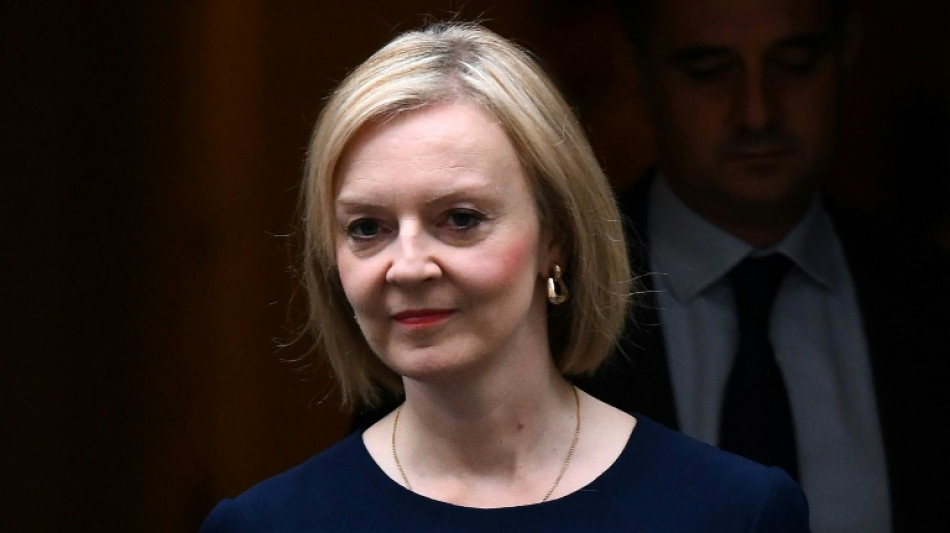
UK PM vows to get borrowing 'back on track' after market turmoil over tax cuts / Photo: © AFP/File

 Arteta targets more Arsenal glory after signing new deal until 2030
 Russell hit with Singapore grid penalty for taking new power unit
 Spotify expands audiobooks to more than 180 markets

 French-Japanese duo wins chemistry Nobel for solving molecular 'mystery'

 England's Nations League surge helps heal World Cup wounds

 Mayor of opposition stronghold Izmir defects to Erdogan party
 Mertens beats Gauff to set up Swiatek clash at China Open

 Benin full of pride at role in Messi's last dance

 France suspends stun grenade use at student protests ahead of PM speech

 Indonesian court hears 'negligence' complaint against state over fires, haze
 Rubio in Greece to urge against Western civilisation 'decline'

 Micron workers at Taiwan plant vote in favour of strike
 In 'The Social Reckoning,' Jeremy Allen White takes on Facebook's 'frightening' ambition
 Chip industry activists call for South Korea to recognise cancer cases
 Famine-scarred southern Madagascar braces for El Nino
 How the EU regulates lobbyists
 I.Coast refuge offers lifelong care for youngsters scorned as 'sorcerers'
 Indian central bank hikes rates for first time in more than 3 years
 Hotel Blacklist Launches New Accommodation Industry Risk Assessment Tool
 Bangladesh nuclear plant draws hope -- and worry

 US beat Canada 1-0 to wrap up four-win international break

 Turkey, Australia's joint COP31 leadership raises doubts

 For Turkish NGOs, COP31 offers rare space for action
 Sleep, appetite, gene-editing experts contend for Nobel chemistry prize

 Nobel Peace Prize haunted by the 'spectre' of Trump

UK Prime Minister Liz Truss defended her tax-slashing plans Thursday but vowed to "get borrowing back on track", after nearly a week of silence when markets tanked and the Bank of England was forced into an emergency intervention.
"We had to take urgent action to get our economy growing, get Britain moving, and also deal with inflation," she said in an initial round of local BBC radio interviews.
"And of course, that means taking controversial and difficult decisions, but I'm prepared to do that as prime minister," she added, in her first comments to UK media since the crisis sparked by Friday's "mini-budget".
"It's important the United Kingdom's on the front foot, that we are pulling all the levers we can to drive economic growth. That is what we are pushing ahead with."
In a series of further BBC regional television interviews, Truss -- in power for less than a month -- said some aspects of her growth plan "will take time" while insisting "we will get borrowing back on track".
The under-fire leader is facing severe pressure after the markets reacted to her government's contentious plans for extra borrowing to fund uncosted tax cuts by sending the pound to an all-time low against the dollar.
UK markets remain highly volatile, with the central bank intervening on Wednesday to buy government bonds in order to prevent a "material risk" to stability.
The Bank of England announced a two-week programme to buy long-term UK bonds, capped initially at £65 billion ($71 billion), as UK pension funds scrambled to sell investments in order to remain solvent.
After sterling hit its dollar low early Monday, the bank said it would "not hesitate to change interest rates by as much as needed" to curb high inflation.
But it also signalled that it would wait until its next policy meeting on November 3 before fully assessing the impact of the government's contentious plans.
Parliament's Treasury Committee on Thursday called on Chancellor Kwasi Kwarteng directly to publish a fully costed economic forecast by the end of October to help the bank rather than on November 23 as planned.
Opposition leaders have demanded that Truss cancel her Conservative party's annual conference starting on Sunday and recall parliament over the crisis.
- Truss v IMF -
Markets are concerned that Britain cannot fund its huge spending commitments, having announced a massive fuel subsidy package alongside the tax cuts.
Truss defended her fiscal policy, which includes a cut to the top rate of income tax, arguing the UK currently had its highest tax burden in 70 years.
"We've reduced those taxes across the board. And of course people who are better off tend to pay more taxes," she said.
The pound rebounded somewhat during Thursday, rising one percent against the dollar and reaching $1.09, reversing losses the previous day following the BoE's emergency move.
But former BoE chief Mark Carney said the government had "undercut" financial institutions with its actions.
"Unfortunately having a partial budget, in these circumstances -- tough global economy, tough financial market position, working at cross-purposes with the bank -- has led to quite dramatic moves in financial markets," he told the BBC.
But Truss insisted she was working "very closely" with the central bank.
In a highly unusual intervention on Wednesday, the International Monetary Fund said it was "closely monitoring" developments and urged the UK government to change tack.
It noted that Truss and Kwarteng, were trying to deal with the energy shock and boost growth.
"However, given elevated inflation pressures in many countries... we do not recommend large and untargeted fiscal packages at this juncture."
The IMF stressed the importance of fiscal policy not working "at cross purposes to monetary policy".
Many central banks, including the Bank of England, are aggressively hiking interest rates in a bid to cool decades-high inflation.
"There are many people with many different opinions, but what I think nobody is arguing with is that we had to take action to deal with what is a very, very difficult economic situation," Truss retorted.
"My priority was making sure that we were supporting the British people in what is going to be a very difficult winter."
J.Bergmann--BTB