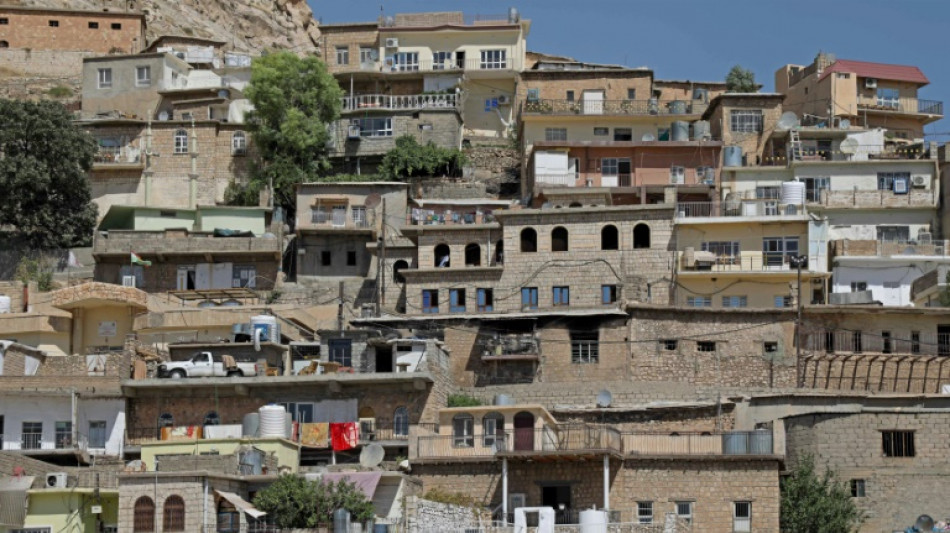
As Iraq concrete jungle swelters, ancient stone houses stay cool / Photo: © AFP

 UK court quashes five ex-traders' Libor rate rigging convictions
 XM Receives “Global Customer Experience Leader Award 2026” at the TrustFinance Performance Awards
 Stocks slide as oil climbs on Mideast flareup
 Heavy casualties in Ukraine after Russian strikes

 French wine harvest set to hit historic low
 Kyiv 'cannot agree' to EU membership limiting food exports: minister

 Arteta targets more Arsenal glory after signing new deal until 2030

 Russell hit with Singapore grid penalty for taking new power unit

 Spotify expands audiobooks to more than 180 markets
 French-Japanese duo wins chemistry Nobel for solving molecular 'mystery'

 England's Nations League surge helps heal World Cup wounds

 Mayor of opposition stronghold Izmir defects to Erdogan party
 Mertens beats Gauff to set up Swiatek clash at China Open
 Benin full of pride at role in Messi's last dance

 France suspends stun grenade use at student protests ahead of PM speech
 Indonesian court hears 'negligence' complaint against state over fires, haze
 Rubio in Greece to urge against Western civilisation 'decline'
 Micron workers at Taiwan plant vote in favour of strike

 In 'The Social Reckoning,' Jeremy Allen White takes on Facebook's 'frightening' ambition
 Chip industry activists call for South Korea to recognise cancer cases

 Famine-scarred southern Madagascar braces for El Nino
 How the EU regulates lobbyists
 I.Coast refuge offers lifelong care for youngsters scorned as 'sorcerers'

 Indian central bank hikes rates for first time in more than 3 years
 Hotel Blacklist Launches New Accommodation Industry Risk Assessment Tool

As the sun beats down on Iraq, most people swelter in their concrete homes -- but not the inhabitants of one mountain town known for its ancient and cool stone houses.
Tracing its roots back 2,700 years, the picturesque Kurdish town of Akre says it is better adapted to the modern-day perils of climate change than other parts of Iraq.
"Stone houses are far more resistant" to the rising temperatures and also preserve the town's unique character, said Mayor Baland Reda Zubair.
"Cement radiates heat, raises temperatures and affects the environment," said Zubair of the building material that is allowed only in outlying neighbourhoods.
Many of Akre's narrow alleyways can only be navigated by donkeys and wind through a historic city centre bathed in the pale yellow and brown hues of the locally quarried stone.
Oil-rich Iraq is the world's fifth-most vulnerable country to the effects of climate change, according to the United Nations.
The Kurdistan region where Akre lies suffers from heat and water scarcity like the rest of the country.
But while Iraqi authorities have done little to address the challenges, Akre, a city of 100,000 residents about 500 kilometres (311 miles) north of Baghdad, believes sticking with the old ways will help it adapt.
Since 1991, when Kurdistan gained de facto autonomy from Iraq, it has declared concrete off limits for construction and renovation in the old city of Akre.
- No air-con -
An impressive building welcomes those entering the old city. Dating to 1853, it is a remnant of the Ottoman Empire that once ruled the area.
"It's an old military barracks," said Jamil Siddik, a 63-year-old engineer who oversees renovation works in the city.
The limestone used for renovation is sourced from the mountains that surround Akre, he explained. For its residents, "limestone is easy to use. It's cheap and available," Siddik said.
It also provides great insulation. "Concrete blocks may only be 20 centimetres (7.9 inches) wide, while the stones are 40 or 60 centimetres wide," he said.
Bewar Majeed, 37, lives in the old city. By his doorstep, kittens were playing in the sun, as the temperature reached 40 degrees Celsius (104 degrees Fahrenheit).
But inside the house, the rooms are nice and cool thanks to its limestone walls.
"I don't need an air conditioner," he said. "I have a small air cooler, which is enough for me, and it's less expensive."
The city's policy promoting stone over concrete relies on public financing.
For years after 2011, public funds paid for the renovation of 25 old houses and a mosque. In 2014, however, funding was suspended "because of the financial crisis", said Mayor Zubair.
Now, he added, old city residents may renovate or build with their own money, so long as they avoid concrete, or "eventually cover it with stone".
- Tourist draw -
On top of the environmental benefits, Akre's conservation efforts aim to preserve its heritage value and attract tourism.
According to the regional tourism board, 1.7 million visitors came to Iraqi Kurdistan during the first quarter of 2022, the vast majority of them Iraqis.
The autonomous region has cultivated an image of stability, distancing itself from the violence that has engulfed other parts of Iraq in recent years.
Still, Kurdistan hasn't been entirely spared the sounds of battle.
Neighbouring Turkey regularly carries out military operations there in its fight against the rebel Kurdistan Workers' Party (PKK), which has been designated a "terrorist" group by Turkey and its Western allies.
In July, artillery bombardment several dozen kilometres away from Akre killed nine civilians, most of them Iraqi holidaymakers. Baghdad blamed Ankara, which denies the Iraqi claim.
But Akre's residents shy away from politics.
Ali, an ice cream vendor, said tourists who are drawn to the town bring him "joy".
"We get Iraqis, Germans and French," he added. "They like our historic city centre."
R.Adler--BTB