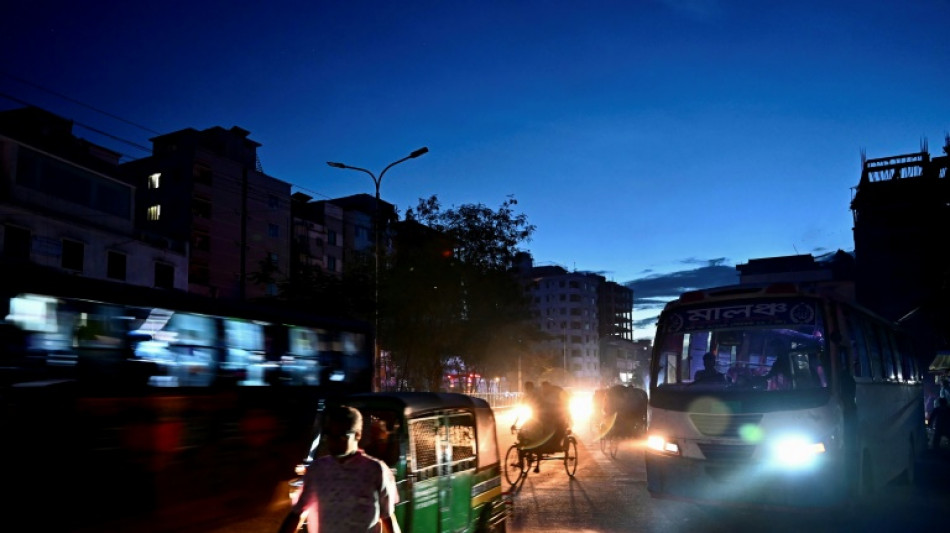
Power blackouts hit 130 million people in Bangladesh / Photo: © AFP

 UK court quashes five ex-traders' Libor rate rigging convictions
 XM Receives “Global Customer Experience Leader Award 2026” at the TrustFinance Performance Awards
 Stocks slide as oil climbs on Mideast flareup

 Heavy casualties in Ukraine after Russian strikes

 French wine harvest set to hit historic low
 Kyiv 'cannot agree' to EU membership limiting food exports: minister

 Arteta targets more Arsenal glory after signing new deal until 2030

 Russell hit with Singapore grid penalty for taking new power unit

 Spotify expands audiobooks to more than 180 markets
 French-Japanese duo wins chemistry Nobel for solving molecular 'mystery'

 England's Nations League surge helps heal World Cup wounds

 Mayor of opposition stronghold Izmir defects to Erdogan party

 Mertens beats Gauff to set up Swiatek clash at China Open
 Benin full of pride at role in Messi's last dance

 France suspends stun grenade use at student protests ahead of PM speech
 Indonesian court hears 'negligence' complaint against state over fires, haze
 Rubio in Greece to urge against Western civilisation 'decline'
 Micron workers at Taiwan plant vote in favour of strike

 In 'The Social Reckoning,' Jeremy Allen White takes on Facebook's 'frightening' ambition
 Chip industry activists call for South Korea to recognise cancer cases
 Famine-scarred southern Madagascar braces for El Nino
 How the EU regulates lobbyists
 I.Coast refuge offers lifelong care for youngsters scorned as 'sorcerers'

 Indian central bank hikes rates for first time in more than 3 years
 Hotel Blacklist Launches New Accommodation Industry Risk Assessment Tool

At least 130 million people in Bangladesh were left without power on Tuesday after a grid failure caused widespread blackouts, the government's power utility company said.
Bangladesh has suffered a major power crisis in recent months as a result of higher global energy prices following Russia's invasion of Ukraine, and has imposed regular cuts to conserve electricity.
But it remained unclear what caused Tuesday's unscheduled blackout, which hit more than 80 percent of the country shortly after 2:00 pm (0800 GMT), according to the Power Development Board.
Apart from some locations in Bangladesh's northwest, "the rest of the country is without power", spokesman Shamim Ahsan told AFP.
The normally brightly lit streets of central Dhaka and other cities were dark on Tuesday evening.
Ahsan said 130 million people or more were without electricity and it remained unclear what had caused the fault.
"It is still under investigation," he said, adding that a technical malfunction was the probable cause.
Another official said later that only 60 percent of the poor country, which is home to factories supplying garments for Western brands, had been affected.
Since then half of those affected had had their power restored by the evening, A.B.M Badruddoza, spokesman of the state-run power grid company, told AFP.
Junior technology minister Zunaid Palak said on Facebook that power would be restored by 8:00 pm in the capital Dhaka, a megacity home to more than 22 million people.
- Energy crisis -
Prices of energy as well as food as other staples have soared worldwide in the wake of Russia's invasion of Ukraine in February, including in Asia.
This has wrought havoc on Bangladesh's electricity grid in recent months, with utilities struggling to source enough diesel and gas to meet demand.
A depreciating currency and dwindling foreign exchange reserves left Bangladesh unable to import sufficient fossil fuels, forcing it to close diesel plants and leave some gas-fired power stations idle.
The government imposed lengthy power cuts to conserve existing stocks in July, with outages lasting up to 13 hours a day at their peak.
Tens of thousands of mosques around the Muslim-majority South Asian country have been asked to curtail the use of air conditioners to ease pressure on the electricity grid.
The blackouts sparked widespread public anger and helped mobilise large demonstrations on the streets of Dhaka.
At least three protesters were killed by security forces during the rallies, partly motivated by rising cost-of-living pressures.
Around 100 others were injured during a police crackdown on one demonstration, according to the opposition Bangladesh Nationalist Party.
Consumer inflation has hit household budgets hard and the government recently pledged to cap the price of several staple foods, including rice, to quell public discontent.
Bangladesh last witnessed a major unscheduled blackout in November 2014, when around 70 percent of the country went without power for nearly 10 hours.
C.Kovalenko--BTB