Amid Ukraine war, US flys Russian cosmonaut to ISS / Photo: © AFP

 UK court quashes five ex-traders' Libor rate rigging convictions
 XM Receives “Global Customer Experience Leader Award 2026” at the TrustFinance Performance Awards
 Stocks slide as oil climbs on Mideast flareup

 Heavy casualties in Ukraine after Russian strikes
 French wine harvest set to hit historic low

 Kyiv 'cannot agree' to EU membership limiting food exports: minister

 Arteta targets more Arsenal glory after signing new deal until 2030

 Russell hit with Singapore grid penalty for taking new power unit

 Spotify expands audiobooks to more than 180 markets

 French-Japanese duo wins chemistry Nobel for solving molecular 'mystery'

 England's Nations League surge helps heal World Cup wounds

 Mayor of opposition stronghold Izmir defects to Erdogan party
 Mertens beats Gauff to set up Swiatek clash at China Open

 Benin full of pride at role in Messi's last dance

 France suspends stun grenade use at student protests ahead of PM speech

 Indonesian court hears 'negligence' complaint against state over fires, haze

 Rubio in Greece to urge against Western civilisation 'decline'

 Micron workers at Taiwan plant vote in favour of strike

 In 'The Social Reckoning,' Jeremy Allen White takes on Facebook's 'frightening' ambition
 Chip industry activists call for South Korea to recognise cancer cases

 Famine-scarred southern Madagascar braces for El Nino

 How the EU regulates lobbyists

 I.Coast refuge offers lifelong care for youngsters scorned as 'sorcerers'

 Indian central bank hikes rates for first time in more than 3 years

 Hotel Blacklist Launches New Accommodation Industry Risk Assessment Tool

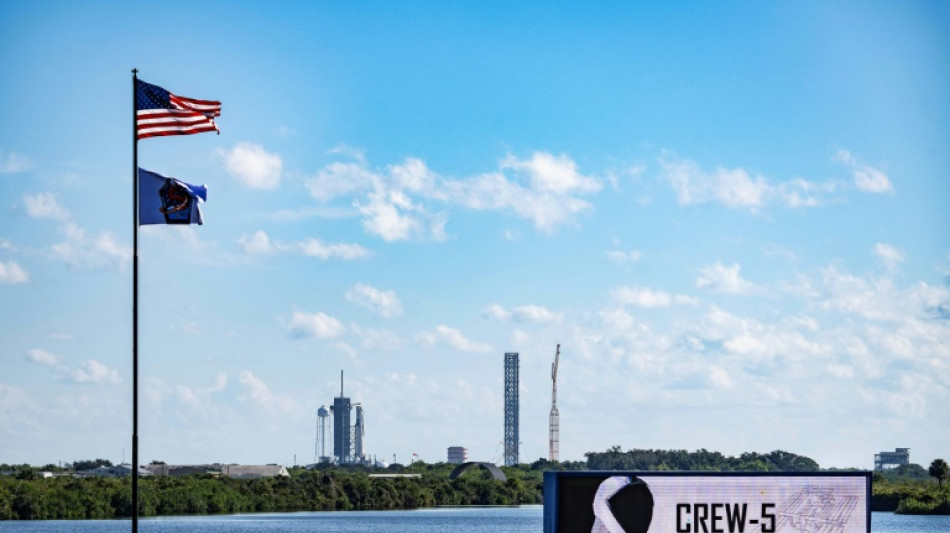
A SpaceX spaceship blasted off from Florida Wednesday, headed for the International Space Station and carrying a Russian crewmate, in a voyage that carries symbolic significance amid the Ukraine war.
Anna Kikina, the only female cosmonaut in service, is part of the Crew-5 mission, which also includes one Japanese and two American astronauts.
"Let's do this," said Crew-5 mission commander Nicole Mann, the first Native American in space, shortly before liftoff from the Kennedy Space Center in Florida at noon.
Two weeks ago, an American astronaut took off on a Russian Soyuz rocket for the orbital platform.
The long-planned astronaut exchange program has been maintained despite soaring tensions between the United States and Russia since Moscow's invasion of Ukraine in February.
Ensuring the operation of the ISS has become one of the few remaining areas of cooperation between the United States and Russia.
"When you each are flying other's crew members, you know that you have a huge responsibility that you're promising to the other country," NASA associate administrator Kathy Lueders told reporters in a recent press conference.
"At a working level, we really appreciated the constancy in the relationship, even during some really, really tough times geopolitically."
- Fifth female cosmonaut, first Native American -
Kikina, 38 and an engineer by training, will become the fifth Russian female professional cosmonaut to go into space.
"I hope in the near future we have more women in the cosmonaut corps," the Novosibirsk native told AFP in August.
The Soviet Union put the first woman in space, Valentina Tereshkova, in 1963, nearly 20 years before the first American woman Sally Ride. Since then, the United States has flown dozens more women.
It is also the first spaceflight for American astronauts Mann and Josh Cassada, but the fifth for Japan's Koichi Wakata.
Mann is the first indigenous woman to go to space with NASA. According to her NASA biography she is registered with the Wailacki of the Round Valley Indian Tribes.
She holds a Master's degree in mechanical engineering from Stanford, served as a test pilot in the F/A-18 Hornet and Super Hornet, and flew 47 combat missions in Iraq and Afghanistan.
- ISS future unclear -
Kikina will be the first Russian to fly with Elon Musk's SpaceX which, along with Boeing, has a "taxi service" contract with NASA.
Musk himself waded into the conflict by proposing on Twitter a peace deal that involved re-running, under UN supervision, annexation referendums in Moscow-occupied regions of Ukraine and acknowledging Russian sovereignty over the Crimean peninsula.
The post enraged Ukrainians, including the country's envoy to Germany, who responded with an expletive.
Tensions between Moscow and Washington have increased considerably in the space field after the announcement of American sanctions against the Russian aerospace industry, in response to the invasion of Ukraine.
Russia thus announced this summer that it wanted to leave the ISS "after 2024" in favor of creating its own station, albeit without setting a precise date.
The director of manned flights at Roscosmos, Sergei Krikaliov, declared Monday he hoped the Russian government agrees to extend participation in the ISS after 2024.
The United States, for its part, wants to continue operating until at least 2030, then transition to commercially run stations.
As things stand, the ISS cannot function without joint cooperation, as the US side is responsible for power and life support and the Russian side for propulsion and maintaining orbit.
W.Lapointe--BTB