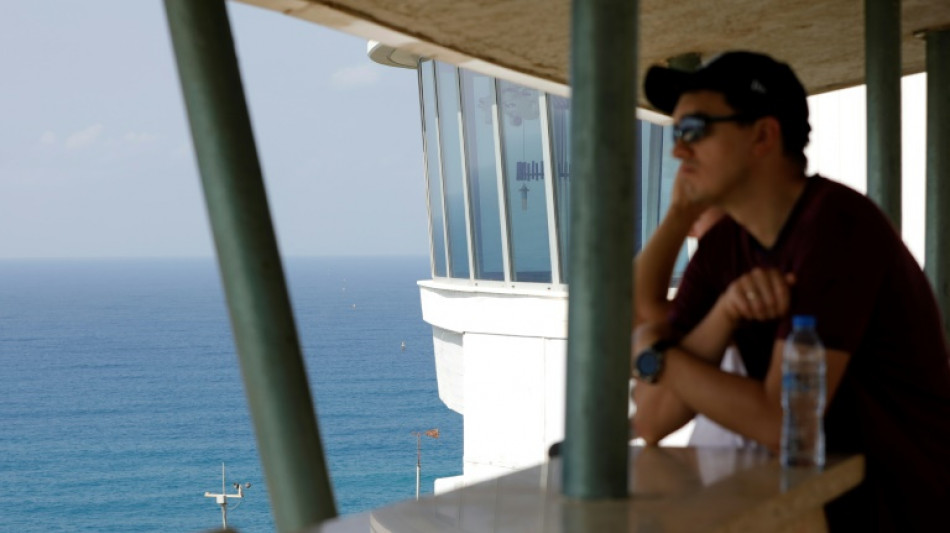
Lebanon years away from gas riches despite Israel deal: analysts / Photo: © AFP

 UK court quashes five ex-traders' Libor rate rigging convictions
 XM Receives “Global Customer Experience Leader Award 2026” at the TrustFinance Performance Awards
 Stocks slide as oil climbs on Mideast flareup
 Heavy casualties in Ukraine after Russian strikes
 French wine harvest set to hit historic low
 Kyiv 'cannot agree' to EU membership limiting food exports: minister
 Arteta targets more Arsenal glory after signing new deal until 2030

 Russell hit with Singapore grid penalty for taking new power unit
 Spotify expands audiobooks to more than 180 markets
 French-Japanese duo wins chemistry Nobel for solving molecular 'mystery'

 England's Nations League surge helps heal World Cup wounds

 Mayor of opposition stronghold Izmir defects to Erdogan party
 Mertens beats Gauff to set up Swiatek clash at China Open
 Benin full of pride at role in Messi's last dance

 France suspends stun grenade use at student protests ahead of PM speech
 Indonesian court hears 'negligence' complaint against state over fires, haze
 Rubio in Greece to urge against Western civilisation 'decline'
 Micron workers at Taiwan plant vote in favour of strike
 In 'The Social Reckoning,' Jeremy Allen White takes on Facebook's 'frightening' ambition

 Chip industry activists call for South Korea to recognise cancer cases
 Famine-scarred southern Madagascar braces for El Nino
 How the EU regulates lobbyists
 I.Coast refuge offers lifelong care for youngsters scorned as 'sorcerers'

 Indian central bank hikes rates for first time in more than 3 years

 Hotel Blacklist Launches New Accommodation Industry Risk Assessment Tool

Lebanon is nearing agreement with Israel over a maritime dispute involving offshore gas fields, but the cash-strapped country still faces an uphill struggle towards unlocking potential hydrocarbon riches, analysts say.
"A deal would mark one step forward but it does not mean that Lebanon has become a gas- or oil-producing country," said Marc Ayoub, an associate fellow at the American University of Beirut's Issam Fares Institute.
"We are talking of a timeline of five to six years... before the first gas" if commercially viable reservoirs are in fact found, the energy expert told AFP, describing the timeframe as "optimistic".
With the demand for gas rising worldwide because of an energy crisis sparked by Russia's invasion of Ukraine, Lebanon hopes that an offshore discovery would ease its current unprecedented financial downturn.
But more than a decade since it declared its maritime boundaries and an Exclusive Economic Zone, it still has no proven natural gas reserves.
One well drilled in 2020 by a consortium of energy giants TotalEnergies, Eni and Novatek showed only traces but no commercially viable gas deposits.
Further test drilling, in a block near the border, has been hampered by the maritime border dispute between Lebanon and Israel, which are technically still at war.
Following years of US-mediated negotiations, the rival states now appear to be nearing agreement after a draft proposal from Washington at the weekend was welcomed by both sides.
A deal would allow "offshore exploration activities to continue, but that doesn't mean that Lebanon has become rich... or that its crisis has been solved", Ayoub said.
- 'First gas' -
A 2012 seismic study of a limited offshore area by the British firm Spectrum estimated recoverable gas reserves in Lebanon at 25.4 trillion cubic feet (tcf).
The authorities in Lebanon have announced higher estimates.
Block 9 near the border with Israel contains the so-called Qana field or Sidon reservoir, and will be a major zone for offshore exploration by TotalEnergies and Eni that were awarded a contract in 2018.
After being partly claimed by Israel, the Qana field is expected to fall entirely to Lebanon as part of the maritime border agreement, according to Lebanese officials.
"This time next year, we should know if there is a commercial discovery in Qana or not," Ayoub said.
"If we have a discovery, it will take... no less than three to five years after exploration" before production could start.
This time frame, according to Ayoub, assumes there are no delays by Lebanese authorities who are widely blamed for the corruption and mismanagement behind the country's financial crash.
It took months for the Lebanese Petroleum Administration (LPA) regulatory body to name its board after it was formed in 2012, because of political disputes over nominations.
Several bidding rounds for offshore gas and oil licences have been hit by delays since they began in 2013.
Already, Lebanon lags far behind Israel which has been investing in the offshore Karish field for years and is expecting its first gas within weeks.
Cyprus and Egypt have also started to discover major reservoirs.
- Risky investment -
Roudi Baroudi, an energy consultant, said that gas or oil production could start within three years if commercially viable reservoirs are found.
But to attract energy firms and benefit from potential discoveries, Lebanon desperately needs to undergo reforms, he told AFP.
"Lebanon is not a good investment unless the government implements reforms," the energy expert said.
Reforms would provide "the basic assurances that international companies need to work with less risk".
State institutions in Lebanon have collapsed under the weight of the crisis, with strikes by civil servants adding to the paralysis.
An economic recovery plan has yet to take off more than three years since the financial downturn began, despite mounting pressures from foreign donors and the International Monetary Fund.
And political gridlock has caused a months-long delay in forming a new government amid fears of a presidential vacuum after Michel Aoun's mandate expires at the end of October.
With a bankrupt state unable to deliver more than an hour or two of mains electricity a day, energy firms may choose to work on their Lebanon projects out of Cyprus, according to Baroudi.
"With no rule of law, Lebanon is a jungle," he said.
"It's absolute chaos, whether judicially, financially or in terms of regulatory" bodies.
K.Brown--BTB