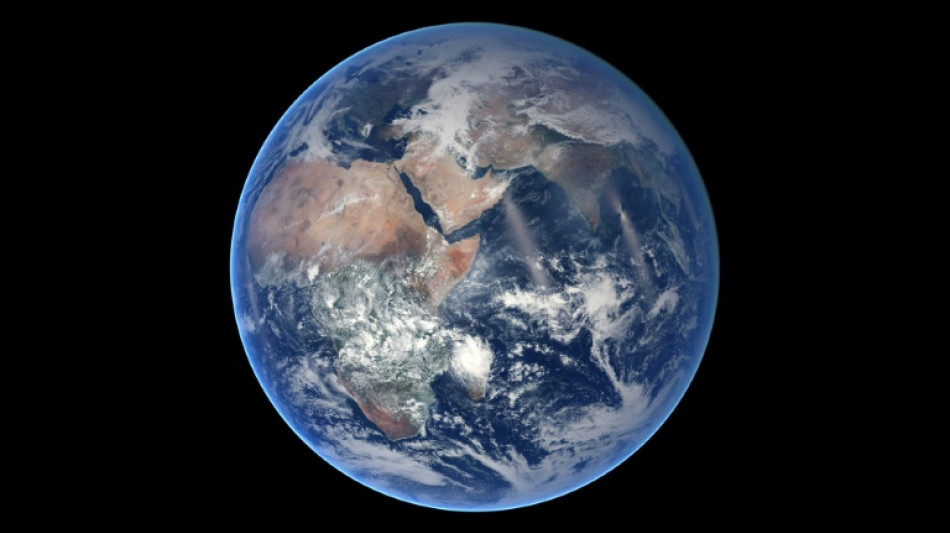
Earth now weighs six ronnagrams: New metric prefixes voted in / Photo: © NASA/AFP/File

 Alex Bodi pushes ahead with expansion: ALIX LASERS showroom planned for Bucharest

 Fossil fuels off COP31 agenda as global output keeps rising
 Haze not 'a threat' to Singapore F1 race: organisers

 COP31 organisers say to seek 'ambitious' action with their text

 Bartunkova thrashes Muchova to reach China Open semi-finals

 Drone hits Yandex data centre, in first such attack on Russia

 Oil prices surge and stocks sink on fresh inflation worries

 AI startup Manus raises $500m after Meta acquisition blocked by China
 From refuge to repatriations: Malaysia's Myanmar U-turn

 Morikawa says LIV players face 'business decision' after Rahm exit

 Tenzing Norgay's son says Himalayas sending climate warning

 On your bike! Bottas opts for two wheels to reach Singapore GP

 Alcaraz, Sinner, Osaka commit to Australian Open '1 Point Slam'

 Dodgers beat Braves to advance in MLB playoffs, Rays oust Yankees

 'A sun as black as my lungs': how corruption crucified a polluted Albania city

 The British historian helping the French rediscover de Gaulle

 Dodgers beat Braves to advance, Guardians survive in MLB playoffs
 Latin American, Caribbean women top Nobel literature buzz

 US says Fiji-based Chinese official paid bribes for Beijing
 After botched US execution, Christa Pike was nearly taken off life support

 Guinea-Bissau junta urges military unit loyal to ex-president to disarm
 As species decline, green turtles offer glimmer of hope
 Brothers Scott and Beauden Barrett named to start for All Blacks

 EU trade chief seeks to dial down China tensions

 'Never again Bolsonaro': thousands march ahead of Brazil election runoff

Say hello to ronnagrams and quettametres: International scientists gathered in France voted on Friday for new metric prefixes to express the world's largest and smallest measurements, prompted by an ever-growing amount of data.
It marks the first time in more than three decades that new prefixes have been added to the International System of Units (SI), the agreed global standard for the metric system.
Joining the ranks of well-known prefixes like kilo and milli are ronna and quetta for the largest numbers -- and ronto and quecto for the smallest.
The change was voted on by scientists and government representatives from across the world attending the 27th General Conference on Weights and Measures, which governs the SI and meets roughly every four years at Versailles Palace, west of Paris.
The UK's National Physical Laboratory, which led the push for the new prefixes, confirmed that the resolution had passed in a statement.
The prefixes make it easier to express large amounts -- for example, always referring to a kilometre as 1,000 metres or a millimetre as one thousandth of a metre would quickly become cumbersome.
Since the SI was established in 1960, scientific need has led to a growing number of prefixes. The last time was in 1991, when chemists wanting to express vast molecular quantities spurred the addition of zetta and yotta.
A yottametre is a one followed by 24 zeroes.
But even the mighty yotta is not enough to handle the world's voracious appetite for data, according to Richard Brown, the head of metrology at the UK's National Physical Laboratory.
"In terms of expressing data in yottabytes, which is the highest prefix currently, we're very close to the limit," Brown told AFP.
"At the bottom end, it makes sense to have a symmetrical expansion, which is useful for quantum science, particle physics -- when you're measuring really, really small things."
- New weight of the world -
The new prefixes can simplify how we talk about some pretty big objects.
"If we think about mass, instead of distance, the Earth weighs approximately six ronnagrams," which is a six followed by 27 zeroes, Brown said.
"Jupiter, that's about two quettagrams," he added -- a two followed by 30 zeros.
Brown said he had the idea for the update when he saw media reports using unsanctioned prefixes for data storage such as brontobytes and hellabytes. Google in particular has been using hella for bytes since 2010.
"Those were terms that were unofficially in circulation, so it was clear that the SI had to do something," he said.
However metric prefixes need to be shortened to just their first letter -- and B and H were already taken, ruling out bronto and hella.
"The only letters that were not used for other units or other symbols were R and Q," Brown said.
Convention dictates that the larger prefixes end in an A, and the smaller ones in an O.
And "the middle of the words are very, very loosely based on the Greek and Latin for nine and 10," Brown said.
The new prefixes should "future proof the system" and satisfy the world's need for higher numbers -- at least for the next 20 to 25 years, he added.
W.Lapointe--BTB