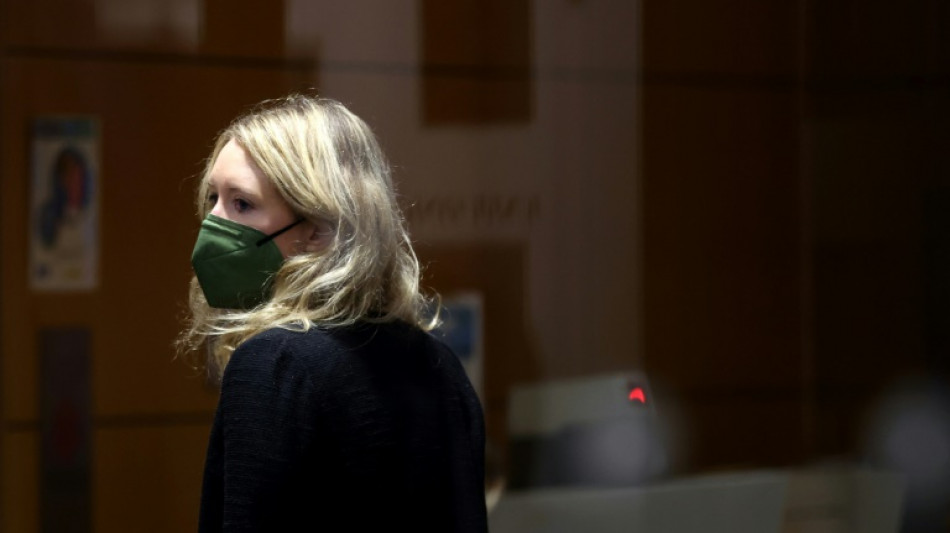
Elizabeth Holmes: Silicon Valley's fallen star / Photo: © GETTY IMAGES NORTH AMERICA/AFP

 Alex Bodi pushes ahead with expansion: ALIX LASERS showroom planned for Bucharest

 Fossil fuels off COP31 agenda as global output keeps rising

 Haze not 'a threat' to Singapore F1 race: organisers

 COP31 organisers say to seek 'ambitious' action with their text

 Bartunkova thrashes Muchova to reach China Open semi-finals

 Drone hits Yandex data centre, in first such attack on Russia

 Oil prices surge and stocks sink on fresh inflation worries
 AI startup Manus raises $500m after Meta acquisition blocked by China

 From refuge to repatriations: Malaysia's Myanmar U-turn
 Morikawa says LIV players face 'business decision' after Rahm exit

 Tenzing Norgay's son says Himalayas sending climate warning

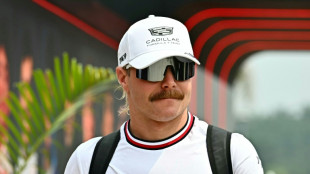 On your bike! Bottas opts for two wheels to reach Singapore GP

 Alcaraz, Sinner, Osaka commit to Australian Open '1 Point Slam'

 Dodgers beat Braves to advance in MLB playoffs, Rays oust Yankees

 'A sun as black as my lungs': how corruption crucified a polluted Albania city
 The British historian helping the French rediscover de Gaulle

 Dodgers beat Braves to advance, Guardians survive in MLB playoffs
 Latin American, Caribbean women top Nobel literature buzz

 US says Fiji-based Chinese official paid bribes for Beijing

 After botched US execution, Christa Pike was nearly taken off life support

 Guinea-Bissau junta urges military unit loyal to ex-president to disarm

 As species decline, green turtles offer glimmer of hope

 Brothers Scott and Beauden Barrett named to start for All Blacks

 EU trade chief seeks to dial down China tensions

 'Never again Bolsonaro': thousands march ahead of Brazil election runoff

Elizabeth Holmes's startup Theranos made her a multi-billionaire hailed as the next US tech visionary by age 30, but it all evaporated in a flash of lawsuits, ignominy and, finally, an 11-year prison sentence on Friday.
The rise and fall of Holmes, who in January was convicted of defrauding investors of her biotech startup, is a heavily chronicled saga that prompted a hard look at her methods but also the unseemly aspects of startup life.
In many ways Holmes fit the image of a Silicon Valley entrepreneur, from her dark-colored turtleneck sweaters that evoked tech legend and Apple founder Steve Jobs to her dropping out of California's elite Stanford University.
But it has all come crashing down with the tech star, who is now pregnant, set to surrender herself in April of next year to begin serving time.
The fundamental question surrounding her case was always whether Holmes was a true visionary who simply failed, as she claimed on the stand, or a skilled self-promoter who took advantage of a credulous context to commit fraud.
Her story begins in the US capital Washington, with her birth to a Congressional staffer mother and a father whose online biography says he was once an executive at Enron -- an energy company that collapsed in a massive fraud scandal.
She won admission to Stanford, and there began work on cutting-edge biomedical initiatives, founding in 2003 what would become Theranos when she was just 19.
Part of Holmes's ability to convince her backers was her apparent deep personal commitment -- she applied for her first patent while still at university and after dropping out, convinced her parents to let her use her tuition savings to build the company.
- 'Youngest woman self-made billionaire' -
By the end of 2010 she had raised a whopping $92 million in venture capital for Theranos, which she pledged was developing machines that could run a gamut of diagnostic tests on a few drops of blood.
Over the next couple years she assembled what one news report called the "most illustrious board in US corporate history," including former secretaries of state Henry Kissinger and George Shultz as well ex-Pentagon chief Jim Mattis.
"Sharp, articulate, committed. I was impressed by her. That didn't take the place of having the device prove itself," said Mattis in a surprise appearance on the stand.
Theranos hype kicked up another gear in 2014 and in the span of just over a year, a turtleneck-wearing Holmes appeared on the covers of Fortune, Forbes, Inc. and T: The New York Times Style Magazine.
Forbes gave her a $4.5 billion net worth in 2014, which was based on her half ownership of Theranos, and noted: "Youngest woman on Forbes 400; Youngest woman self-made billionaire."
This glowing coverage had an impact on Theranos investors like venture capitalist Chris Lucas who told Holmes' trial the Fortune article made him "proud we were involved, very proud of Elizabeth."
But there were some things that didn't end up in those glowing reports that gushed with statements like "Steve Jobs had massive ambition, but Holmes's is arguably larger."
- Silicon Valley sexism? -
For one, she personally put the logos of pharma giants Pfizer and Schering-Plough onto Theranos reports hailing its own blood-testing technology, which were then shared with investors.
That was done without the companies' permission and was a key piece of the prosecution's argument that she deliberately tried to inflate Theranos's credibility in order to win over backers.
She also kept secret the machines' failings and the fact that once Theranos began to do diagnostics on real patients, some of the tests were done using the same equipment sold to standard labs.
Ultimately though, it was a series of Wall Street Journal reports starting in 2015 -- which Holmes tried to kill by appealing to the paper's owner and Theranos investor Rupert Murdoch -- that set the company's collapse in motion.
Holmes's case also raised questions about why she was prosecuted, but not other tech CEOs who engaged in the "fake it until you make it" Silicon Valley method or other bad behavior.
Ellen Pao, the former CEO of Reddit and critic of tech industry discrimination, argued in a New York Times opinion piece that sexism bears some blame.
She noted that WeWork's Adam Neumann and Uber co-founder Travis Kalanick raised billions with hype, while there have been allegations of racism and sexism at Tesla and misleading claims about vaping from Juul's leaders.
Holmes "should be held accountable for her actions as chief executive of Theranos," Pao wrote.
But "it can be sexist to hold her accountable for alleged serious wrongdoing and not hold an array of men accountable for reports of wrongdoing or bad judgement," she added.
K.Thomson--BTB