Iran seeks to quell protests with death sentences, activists warn / Photo: © AFP

 Alex Bodi pushes ahead with expansion: ALIX LASERS showroom planned for Bucharest
 Fossil fuels off COP31 agenda as global output keeps rising

 Haze not 'a threat' to Singapore F1 race: organisers
 COP31 organisers say to seek 'ambitious' action with their text
 Bartunkova thrashes Muchova to reach China Open semi-finals
 Drone hits Yandex data centre, in first such attack on Russia
 Oil prices surge and stocks sink on fresh inflation worries

 AI startup Manus raises $500m after Meta acquisition blocked by China
 From refuge to repatriations: Malaysia's Myanmar U-turn

 Morikawa says LIV players face 'business decision' after Rahm exit
 Tenzing Norgay's son says Himalayas sending climate warning
 On your bike! Bottas opts for two wheels to reach Singapore GP

 Alcaraz, Sinner, Osaka commit to Australian Open '1 Point Slam'
 Dodgers beat Braves to advance in MLB playoffs, Rays oust Yankees
 'A sun as black as my lungs': how corruption crucified a polluted Albania city

 The British historian helping the French rediscover de Gaulle
 Dodgers beat Braves to advance, Guardians survive in MLB playoffs
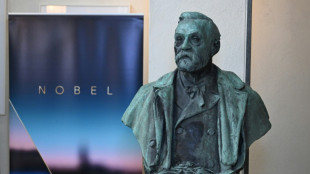 Latin American, Caribbean women top Nobel literature buzz
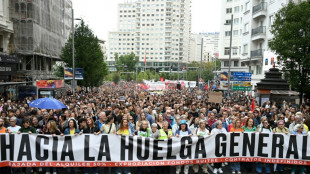
 US says Fiji-based Chinese official paid bribes for Beijing
 After botched US execution, Christa Pike was nearly taken off life support

 Guinea-Bissau junta urges military unit loyal to ex-president to disarm

 As species decline, green turtles offer glimmer of hope
 Brothers Scott and Beauden Barrett named to start for All Blacks
 EU trade chief seeks to dial down China tensions

 'Never again Bolsonaro': thousands march ahead of Brazil election runoff

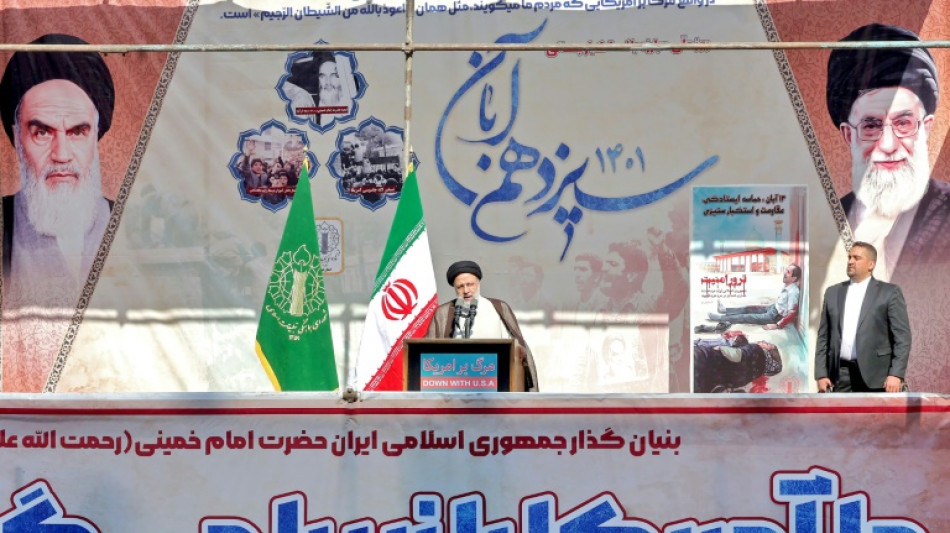
Iran, already one of the world's most prolific users of the death penalty, is planning to use capital punishment as a means to quell the protest movement by spreading a climate of fear in the population, activists warn.
The judiciary has already confirmed six death sentences over the protests, with Amnesty International saying that based on official reports at least 21 people currently on trial are charged with crimes that could see them hanged.
Iran currently executes more people annually than any nation other than China, according to rights groups.
Amnesty International says Iran put to death at least 314 people in 2021, while Norway-based Iran Human Rights (IHR) says the number of executions this year is already much higher at 482.
Campaigners warn that not only do the authorities plan to execute protesters on vague charges linked to alleged rioting or attacks on security forces during the demonstrations, but also step up hangings not related to the protest movement, notably of prisoners convicted on drug-related charges.
Amnesty said the authorities' pursuit of the death penalty is "designed to intimidate those participating in the popular uprising... and deter others from joining the movement".
The strategy aims to "instill fear among the public", it added, condemning a "chilling escalation in the use of the death penalty as a tool of political repression and the systematic violation of fair trial rights in Iran".
- 'Strong signal' -
The Iranian judiciary has conspicuously not named the six convicts already sentenced to death in a possible bid to prevent their names becoming rallying causes or hashtags on social media.
They have all been convicted either of "enmity against God" ("moharebeh") or "corruption on earth" ("efsad-e fel arz"), sharia-related charges that are capital crimes in Iran and which rights activists have long feared are used against opponents of the regime.
Amnesty has nonetheless said the nature of the charges makes it possible to deduce the names of those sentenced so far.
They include Mohammad Ghobadlou, a young man whose mother has been seen on social media making an impassioned plea for her son's life.
Among the 21 facing the death penalty is one woman, named by Amnesty as Farzaneh Ghare-Hasanlou, as well as her husband Hamid, a medical doctor.
Another risking capital punishment is Saman Seydi, also known as Saman Yasin, a Tehran-based rapper from Iran's Kurdish minority who has backed the protests on social media and is accused of firing into the air and harming national security.
Rights groups are calling for concerted action from the international community to stop the executions, especially with the UN Human Rights Council set to hold a rare special session on Iran on Thursday.
Campaigners had already noticed a troubling uptick in capital punishment this year even before the protest movement got underway, with Iran again executing large numbers on drug-related charges despite recent moves to limit such executions.
Rights groups also complain that disproportionately large numbers from Iran's ethnic minorities are executed, including Kurds but especially Baluch from the country's impoverished southeast.
"Unless the international community sends a very, very strong signal to the Islamic republic authorities, we will be facing mass executions," the director of IHR Mahmood Amiry-Moghaddam told the World Congress against the Death Penalty in Berlin.
He pointed to "not just political executions, but the ones that cost the least politically, particularly drug-related charges".
- 'Barrier of fear' -
The protests sparked by the death of Mahsa Amini, who had been arrested by morality police in Tehran, have turned into the biggest challenge for the authorities since the 1979 Islamic revolution.
Authorities in Iran describe the protests as "riots" with judiciary chief Gholamhossein Mohseni Ejei saying those on trial are "affiliated with counter-revolutionary elements" and will be "punished according to the law".
Earlier this month, 227 out of Iran's 290 MPs voted for a motion urging the use of the death penalty in relation to the protests, calling on the judiciary to apply "an eye for an eye" retributive justice.
The past year had already seen Iranians in and outside the country mobilising against the use of the death penalty, with the Persian hashtag #edam_nakon (#dont_execute) becoming a viral trend.
Among those currently languishing in jail in Iran is film director Mohammad Rasoulof, who was arrested even before the protests began and whose anti-death penalty film "There is No Evil" won the top prize at the 2020 Berlin film festival.
"The Islamic republic has used the death penalty to uphold the barrier of fear for 43 years," said Amiry-Moghaddam.
"The current protests have seen the collapse of that barrier which the Iranian authorities are now attempting to rebuild with the current repression and death sentences," he added.
M.Odermatt--BTB