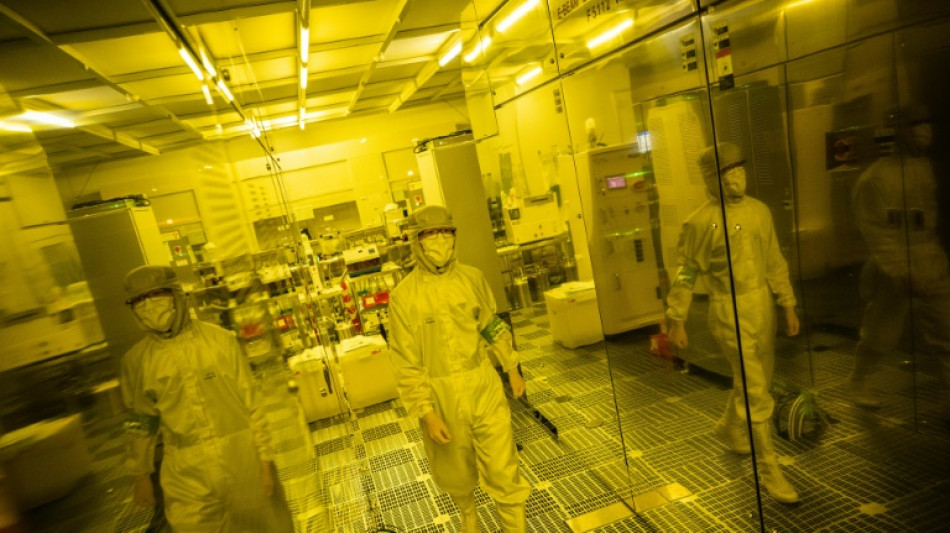
Inside a semiconductor 'clean room' at Japan's top university / Photo: © AFP

 Prague’s Concert for the Future Kicks Off on Wenceslas Square

 Prince William and Princess of Wales to Announce Earthshot Prize Winners in Mumbai

 Indonesia Forest Fires: Health Crisis, Diplomatic Strains and the Search for Solutions

 BYD Dolphin G Leasing Deal: Plug-in Hybrid Supermini Available from £174 a Month

 JUEL Group Expands from Real Estate to Hospitality with Hyatt Centric Malta Opening

 French Economy Shrinks 0.1% as Consumer Confidence Slumps

 Wall Street Ends Turbulent Week Higher Despite Inflation and AI Jitters

 Kansas City Fed Chief Says Inflation Is Still Running Too Hot

To study semiconductors at Japan's top university, first you need the right clothes -- protective overalls, shoe covers, plastic gloves and a lightweight balaclava to keep your hair out of the way.
Then, surgical mask in place, you step inside an "air shower" to remove all the dust from your body that could potentially contaminate the precision equipment.
Now, you are ready to enter the University of Tokyo's clean room, a highly controlled space where microchips are handled.
Clean rooms, a vital part of semiconductor factories, are also found at such universities, where aspiring tech innovators conduct research.
Chips are an indispensable part of the modern economy, used in everything from smartphones to cars and weapons.
That has made them politically sensitive, with the industry frequently caught in the crossfire as the United States and China tussle over access to advanced tech.
Japan is also ramping up its efforts to revive its once-world-leading chip industry: the government has promised up to $25 billion in subsidies to help triple sales of domestically produced chips by 2030.
Taiwanese chip behemoth TSMC opened a semiconductor factory in southern Japan in February and is planning a second facility for more advanced chips.
And a multi-billion-dollar joint venture called Rapidus, involving Sony, Toyota, IBM and others, aims to mass produce next-generation logic chips in Japan from 2027.
Chip expert and University of Tokyo professor Tadahiro Kuroda said Japan's push into a sector where it was once dominant feels like "spring has returned".
At the university's 600 square-metre (6,500 square-foot) chip lab, filled with cutting-edge machines, students use tweezers to handle the delicate materials.
With pipettes, they drip a red liquid chemical onto gleaming, pristine silicon wafers designed to contain a dizzying number of tiny transistors.
PhD student Kei Misumi, 27, who regularly works in the clean room, told AFP he hopes such advanced technology will further enrich people's lives.
C.Meier--BTB