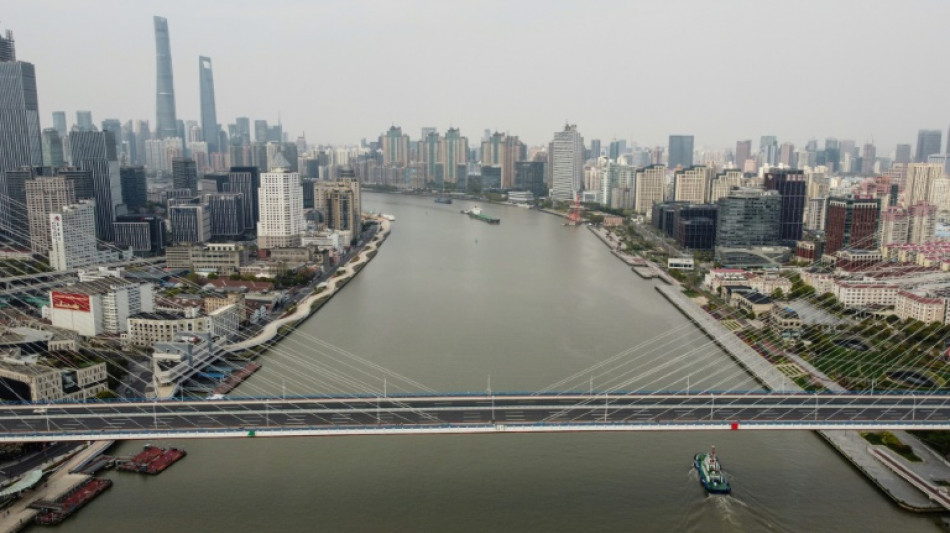
Tale of two cities as Shanghai goes into slow-motion lockdown / Photo: ©

 Split loyalties for Indian football fans at Brazil friendly

 India-Pakistan blockbuster brings cricket fever to Japan baseball field

 Wong waiting on Rafa after winning Asian Games tennis gold

 With Russia next door and rising costs, Latvia goes to the polls

 Penalty hero rues empty seats as Games hosts Japan win football gold

 North Korea fires ballistic missile after Seoul's apology demand

 US regulator finds Boeing 737 MAX software bug 'not a safety concern'

 Ohtani 'managing' injuries as Dodgers launch MLB post-season

 Botched US execution leaves murderer unconscious on ventilator: lawyers
 Cornell rape case exposes sexual violence at US colleges

 France held by Italy in Zidane's homecoming after Olise stunner

 Ethiopian pro-government militia claims Tigray airport as regional tensions spike

 Ohtani shaking off injuries as Dodgers launch MLB post-season

 Sea levels to rise in California as coastal wave surges up west coast

 New rallies urged in France as protests disrupt over 730 schools

 Djokovic survives China Open scare, Sabalenka starts strong

 King Charles to evoke colonial 'darkest days' on Caribbean tour

 Tesla shares jump after global car sales top estimates

 DR Congo Ebola outbreak killed more than 4,000: official figures

 Djokovic survives China Open scare against wildcard world no. 104

 Lula, Bolsonaro trade blows in final scramble for votes in Brazil

 New clashes erupt as protests disrupt over 560 French schools

 NY governor vows to close loophole after alleged Cornell gang rape

 Ethiopia Tigray rebels pushed back as regional tensions spike

 Stocks rise, yields fall as US job numbers disappoint

At home in Pudong district, on reduced pay and playing computer games to lift the gloom, 25-year-old Chinese engineer Terry is in the locked-down half of Shanghai.
Across the Huangpu river which bisects the city, Maria is making the most of her diminishing freedom with dinners out before Friday when her side -- Puxi -- is also ordered indoors.
Shanghai, China's economic engine room and largest city with 25 million people, is being split in two as authorities conjure new ways to control a lingering virus which is challenging China like never before.
The city, the cradle of China's youth culture, fashion and international finance, is now also the heart of the country's worst Covid-19 outbreak in two years.
On Wednesday it recorded nearly 6,000 cases as the Omicron variant whips through, shaking China's stated "zero-Covid" strategy to crush clusters wherever they emerge.
From New York and London to Bangkok and Tokyo, many of the world's major cities are opening up and learning to live with the virus.
But China's most outward-facing hub is shutting down -- albeit in slow motion -- as authorities test the entire population, ring compounds with barriers and order people home.
"I can't leave the house, can't buy groceries, can't hang out with friends," Terry, who works for a state-owned firm, told AFP, using his Anglicised name.
Pudong closed on Monday following weeks of scattergun shutdowns of local neighbourhoods where virus cases emerged.
Those left harried residents panic buying at supermarkets, with no time to plan their next moves as they fell under short, sharp 48-hour stay-at-home orders.
Like many others, Terry has gone onto a lower pay rate while his office is closed. Yet even if Pudong is reopened as planned on Friday, the city appears some way from defeating the virus.
The uncertainty is taking a toll, he said.
"I'm bored and in low spirits. I'm indoors for too long and can only watch TV, read books and play video games," he added.
- 'Enjoy every minute' -
In Puxi, the more populous historic core of the city -- home to the Bund waterfront, chic shops and some of Asia's glitziest nightlife -- drinkers gathered this week, knocking back outdoor beers before Friday's scheduled lockdown.
"I went out for dinner yesterday," Maria, an American city resident, told AFP.
"I'm trying to do things to preserve my mental health before the lockdown, I know it's going to be five days at the very least of not being able to leave my compound."
On Anfu Road, where Puxi's wealthy and fashionable meet for coffee, Shirley - a 42-year-old design worker - said she also planned to make the most of the days ahead.
"We'll cook and invite friends over, walk the dog and enjoy life every minute before we lock down."
Shanghai authorities have tried to limit the economic pain caused by the rolling lockdowns, offering tax breaks and handouts to small businesses.
But finance companies have taken matters into their own hands across the city, with reports of employees living in the office during the lockdown.
"Quilts and clothes will already be brought into offices," says analyst Qian Qimin from brokerage Shenwan Hongyuan Group.
Many residents are sanguine in the face of the new lockdown, seeing it as a necessary evil after weeks of targeted measures with limited success.
"The number of cases continued to increase," Frank Huang, a wine trader in Shanghai's Pudong district, told AFP.
"I think this (new) policy will achieve very good results and let our lives return to normal."
But elsewhere, frustration at China's dogmatic approach to the virus is seeping out, with empty shop shelves testament to the anxiety of residents scrambling for fresh food, while social media hosts a mix of dry humour and increasingly caustic commentary.
"The whole world is returning to the right track," one Weibo user posted this week. "(We are) the only country still waiting and living with the ghost of 2019."
As Shanghai experiments with unconventional control measures, a weary public is again facing a pandemic which shapes their daily lives more than two years since it began.
"We thought it was basically over," Miki Xiang, 31 and a freelance designer, told AFP. "Why did we start again?"
G.Schulte--BTB