'Dying with dignity': Dutch mark 20 years of euthanasia / Photo: ©

 Split loyalties for Indian football fans at Brazil friendly

 India-Pakistan blockbuster brings cricket fever to Japan baseball field
 Wong waiting on Rafa after winning Asian Games tennis gold

 With Russia next door and rising costs, Latvia goes to the polls

 Penalty hero rues empty seats as Games hosts Japan win football gold

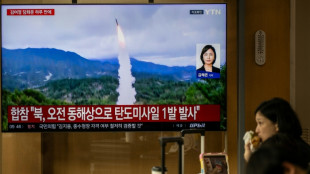 North Korea fires ballistic missile after Seoul's apology demand

 US regulator finds Boeing 737 MAX software bug 'not a safety concern'

 Ohtani 'managing' injuries as Dodgers launch MLB post-season

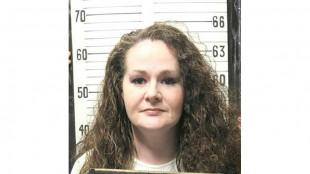 Botched US execution leaves murderer unconscious on ventilator: lawyers
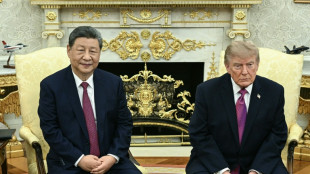
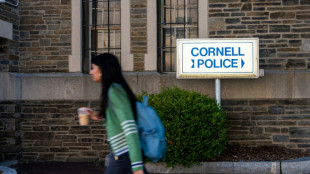 Cornell rape case exposes sexual violence at US colleges

 France held by Italy in Zidane's homecoming after Olise stunner

 Ethiopian pro-government militia claims Tigray airport as regional tensions spike
 Ohtani shaking off injuries as Dodgers launch MLB post-season

 Sea levels to rise in California as coastal wave surges up west coast

 New rallies urged in France as protests disrupt over 730 schools
 Djokovic survives China Open scare, Sabalenka starts strong
 King Charles to evoke colonial 'darkest days' on Caribbean tour
 Tesla shares jump after global car sales top estimates

 DR Congo Ebola outbreak killed more than 4,000: official figures
 Djokovic survives China Open scare against wildcard world no. 104
 Lula, Bolsonaro trade blows in final scramble for votes in Brazil

 New clashes erupt as protests disrupt over 560 French schools
 NY governor vows to close loophole after alleged Cornell gang rape

 Ethiopia Tigray rebels pushed back as regional tensions spike
 Stocks rise, yields fall as US job numbers disappoint
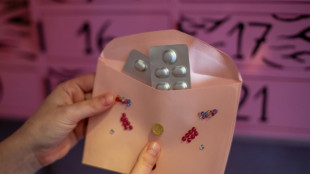
Golden butterflies adorn the walls of the Netherland's only euthanasia expertise centre, put up in remembrance of thousands of patients who have chosen to die with dignity over the past two decades.
Situated in a leafy upmarket suburb of The Hague, the Euthanasia Expertise Centre is the only one of its kind, giving information, assisting medical doctors and providing euthanasia as end-of-life care, which was legalised in a world first in the Netherlands on April 1, 2002.
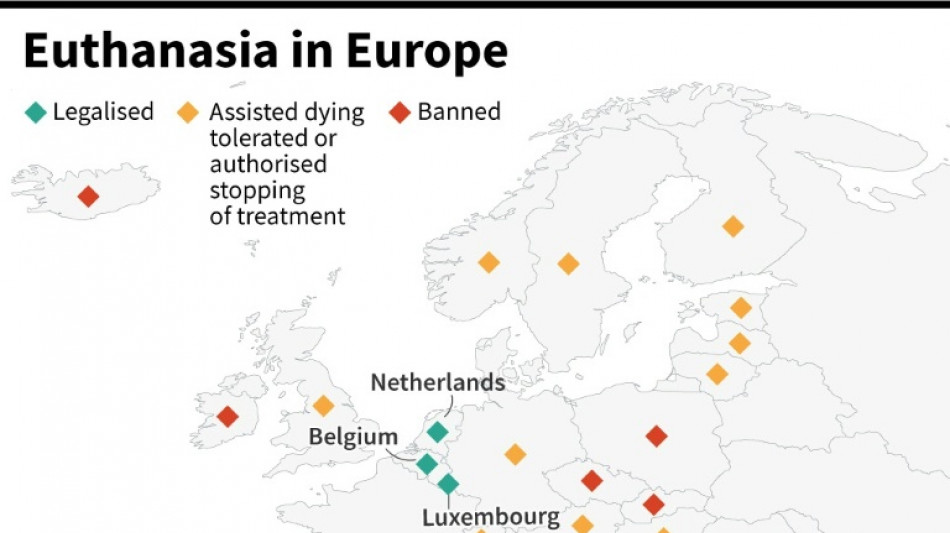
Belgium soon followed later that year and Spain last year became the sixth country to adopt euthanasia -- the act of intentionally ending a life to relieve a person's suffering, for instance through a lethal injection given by a doctor.
The number of people seeking euthanasia is growing in the Netherlands, with some 7,666 last year, up by more than 10 percent from the year before, according to official figures.
The vast majority are aged 60 or over, suffering from cancer or other terminal illnesses.
"Twenty years ago, when the law was passed it was known, but certainly not used as often as today," said Sonja Kersten, director of the Euthanasia Expertise Centre.
The reasons are many: an ageing Dutch population; the fact that euthanasia is no longer a taboo subject and society has opened up to the issue.
"Dying with dignity is a debate that's growing within Dutch society, which is quite open to the subject," Kersten said.
- 'Existential question' -
Euthanasia is only authorised in a few countries around the world.
In Belgium, which will mark two decades of euthanasia in May, some 40 French citizens also benefitted from the practice last year.
The decision to ask for euthanasia as end-of-life care remains a "difficult and existential question", Kersten said.
"It's neither a patient's right, nor a doctor's duty," to have euthanasia, she added.
In the Netherlands, euthanasia can only be carried out under strict conditions set down in Dutch law.
Children aged up to 16 need the permission of their parents and guardians, while parents must be involved in the process for children aged 16 and 17. From 18, any Dutch citizen may ask for assisted death.
In all cases, the patient must have "unbearable suffering with no prospect of improvement" and must have requested to die in a way that is "voluntary, well considered and with full conviction".
Other criteria apply as well, like the absence of a reasonable alternative to the patient's situation.
Doctors, too, cannot be forced to perform euthanasia.
- 'Die at home' -
The Euthanasia Expertise Centre helps doctors through the process by sharing knowledge and providing guidance. At the same time, the centre helps patients whose doctors refuse to help them.
The centre, established in 2012, is a foundation but patient care is reimbursed by health insurers.
It first positioned itself as the "Levenseindekliniek", Dutch for "End-of-life clinic", offering on-site euthanasia.
But even before the start, it became apparent that most patients preferred to die at home, Kersten said.
Today, the centre can call upon a network of about 140 doctors and nurses around the country, employed by the Euthanasia Expertise Centre.
Most euthanasia requests, however, are handled by the patient's own physician, with whom they already have a relationship of trust. Last year, this was the case for 80 percent of euthanasias performed in the country.
"There are however still doctors in the Netherlands who are opposed to euthanasia," said Kersten, adding "they have every right".
The centre's medical team itself provided euthanasia to nearly 900 people in 2020, out of nearly 3,000 requests, with figures on the rise.
About 20 percent had dementia or psychiatric disorders.
The Netherlands' highest court ruled in 2020 that doctors can euthanise patients with severe dementia without the fear of prosecution.
It concerns patients with advanced dementia who are no longer mentally competent, but who previously had a clear request for euthanasia.
The decision followed a landmark case, not related to the Expertise centre, in which a doctor was acquitted of providing euthanasia on a woman in 2016 with severe Alzheimer's disease, who earlier requested the procedure.
S.Keller--BTB