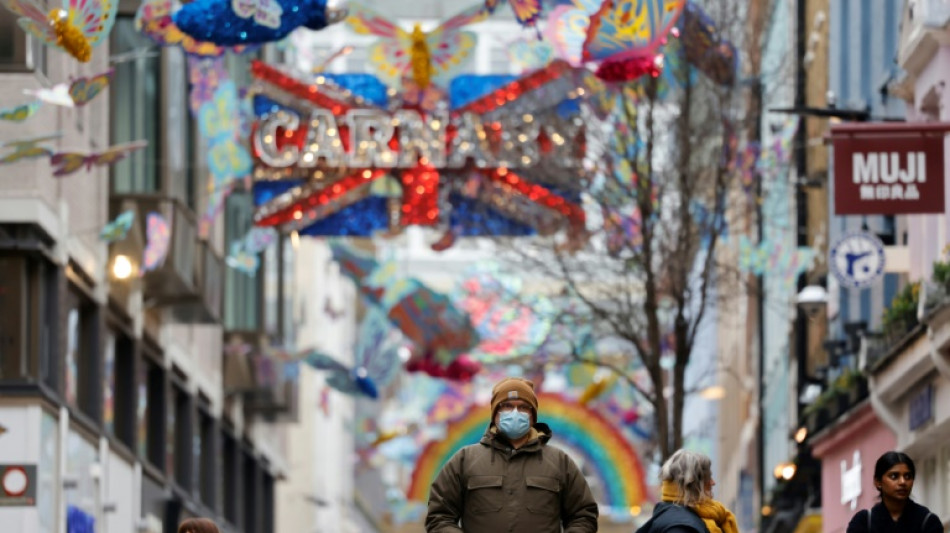
England lifts Omicron restrictions / Photo: ©

 Prague’s Concert for the Future Kicks Off on Wenceslas Square

 Prince William and Princess of Wales to Announce Earthshot Prize Winners in Mumbai

 Indonesia Forest Fires: Health Crisis, Diplomatic Strains and the Search for Solutions

 BYD Dolphin G Leasing Deal: Plug-in Hybrid Supermini Available from £174 a Month

 JUEL Group Expands from Real Estate to Hospitality with Hyatt Centric Malta Opening

 French Economy Shrinks 0.1% as Consumer Confidence Slumps

 Wall Street Ends Turbulent Week Higher Despite Inflation and AI Jitters

 Kansas City Fed Chief Says Inflation Is Still Running Too Hot

England on Thursday lifted coronavirus restrictions imposed to tackle the Omicron variant, with masks no longer required in enclosed places and vaccine passports shelved.
The number of positive Covid-19 cases has fallen sharply over the past two weeks, and although still at high levels, have plateaued in recent days.
The UK government introduced the so-called "Plan B" restrictions on December 8, after Prime Minister Boris Johnson warned of a looming "tidal wave" of Omicron.
Face masks were required in all enclosed spaces and, controversially, vaccine documentation also was to enter places such as nightclubs, football grounds and large-scale events.
On the streets of London around St Paul's Cathedral, there was general support for the lifting of restrictions, which comes after more than 37 million people had booster jabs.
"I think it's a really good thing," said Elizabeth Hynes, 71, who is originally from Ireland but has lived in England for 47 years.
"I was coming up the lifts here at St Paul's and I was looking at all the shows" being advertised, she said of the posters inside the underground station.
"And I thought 'how wonderful, it's like old times'.
"It's like we're getting back to how London was, and you realise how much you've missed live theatre and fantastic shows."
Hynes said she had stage-4 melanoma skin cancer, but had so far "been lucky" and not caught Covid.
"We don't know about tomorrow, we have to live... for today, trying to get a bit of enjoyment out of life," she added.
Julia, 28, from Spain, said it was time to "have a normal life".
"It's been two years and it's time to take responsibility ourselves," she said as she waited for the St Paul's eatery in which she works to open.
"In Spain we need to wear masks everywhere, even in the street," she added.
Even if "there's nobody in the street... you need to wear the mask. On the beach, you need to wear the mask.
"I prefer the UK restrictions because it's going to be very difficult to visit the family there. I'm fully vaccinated but I don't want to get the vaccine every nine months."
- 'Traumatic' -
England previously lifted restrictions on July 19, so-called "Freedom Day", but then introduced new rules as the Omicron wave arrived.
Health minister Sajid Javid credited the country's booster programme for allowing restrictions to be lifted.
"Our vaccines, testing and antivirals ensure we have some of the strongest defences in Europe and are allowing us to cautiously return to Plan A, restoring more freedoms to this country," he said.
From Thursday, passengers on London's transport network will still be required to wear face masks but they will no longer be mandatory in secondary school classrooms.
"It was traumatic for them, they couldn't hear the teachers, the teachers couldn't hear them," Hynes said of the mask rules in school.
US holidaymaker Ethan Letson, 24, agreed with London Mayor Sadiq Khan's decision to mandate face coverings on the capital's trains and buses.
"I still wear the mask on public transport, I will wear it in very crowded areas like the Underground. It's so tight down there, you could get sick at any time," he said.
Unlike Scotland and Wales, which set their own health policy, England kept nightclubs and bars open over the festive period.
But businesses still took a heavy hit as punters stayed at home.
Hospitality workers in the business district around St Paul's said things had only just started to improve.
"The last week, business has started to pick up again. Around Christmas it was dead," said bartender Lewis Colby, 39.
"People aren't so scared anymore, trains are busier coming into work, people are starting to drink more."
Despite the lifting of restrictions, those who test positive for coronavirus must still self-isolate for a minimum of five days.
Johnson said he also hopes to scrap those rules when they expire on March 24.
J.Horn--BTB



